
Fill a Balloon with CO₂
Blow up a balloon using a vinegar and bicarbonate soda. A classice science activity that kids can do with easy to find materials.
Adult supervision for setup
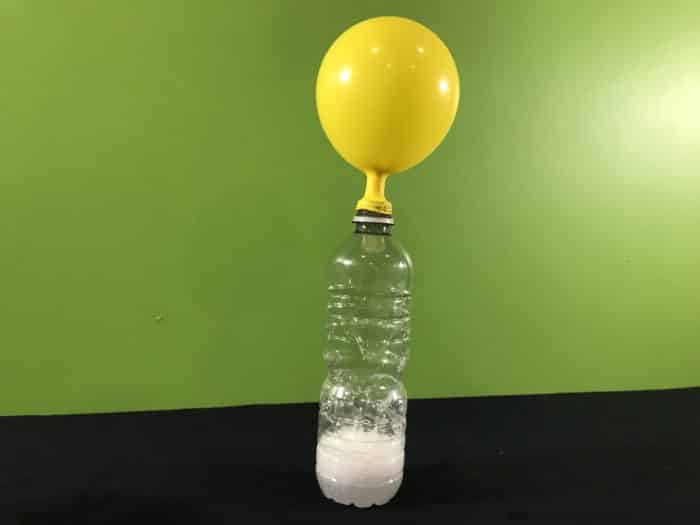
You will need
- Empty bottle
- Spoon
- Funnel
- Bicarbonate Soda
- Vinegar
- Balloon
- Safety glasses
Method
-
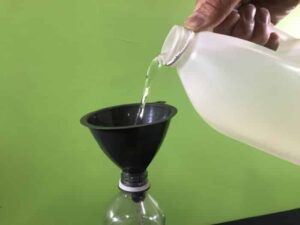
Place the funnel in the bottle and pour in 50mL of vinegar.
-
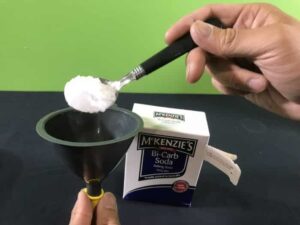
Put the funnel into the balloon and then add a spoonful of bicarbonate soda.
-
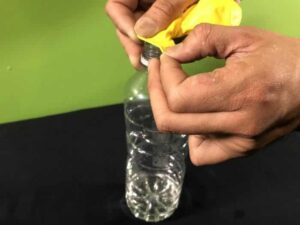
Carefully stretch the balloon over the top of the bottle. Keep the end of the balloon lower than the bottle opening to prevent the bicarbonate soda from falling into the vinegar when you’re not ready.
-
Whilst holding the balloon onto the opening of the bottle, raise up the balloon to allow the bicarbonate soda to fall into the vinegar in the bottle.
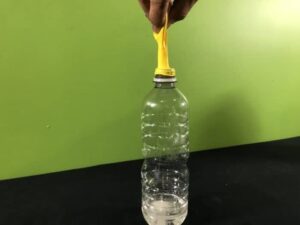
-
The balloon rises as it fills with carbon dioxide gas!
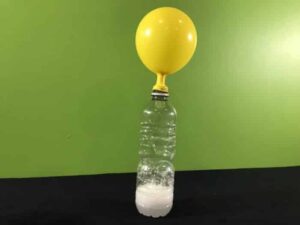
-
School science visits since 2004!
– Curriculum-linked & award-winning incursions.
– Over 40 primary & high school programs to choose from.
– Designed by experienced educators.
– Over 2 million students reached.
– Face to face incursions & online programs available.
– Early learning centre visits too!
-

-
Want to dive into acid-base chemistry?
Get the 30-minute video + PDF + curriculum links for your class here!

The science behind it
Why Does This Happen:
The Science of Filling a Balloon with CO2
This experiment is a classic demonstration of a chemical change where a solid and a liquid react to create a gas. When you mix vinegar (acetic acid) and bicarbonate soda (a base), they undergo an acid-base reaction.
The initial reaction produces sodium acetate and carbonic acid. However, carbonic acid is highly unstable in these conditions. It almost instantly decomposes into liquid water and carbon dioxide gas (CO2).
Vinegar + Bicarbonate Soda → Carbonic Acid + Sodium Acetate
While the water and sodium acetate stay behind in the bottle, the carbon dioxide molecules spread out rapidly. Because gases expand to fill whatever container they are in, the CO2 rises out of the vinegar solution and pushes against the walls of the balloon. As more gas is produced, the internal pressure increases, causing the balloon to inflate!
Variables to test
Find out more on variables here.
-
Reactant Ratios
Change the amount of bicarbonate soda or vinegar. Is there a “limiting reactant” where adding more of one doesn’t make the balloon any bigger because the other has been completely used up? -
Container Volume
Does the size of the bottle matter? In a larger bottle, the gas has more empty space to fill before it starts pushing into the balloon. Does this change how quickly the balloon inflates? -
Thermal Energy
Does the temperature of the vinegar matter? Heat increases the kinetic energy of the molecules, which typically speeds up the rate of reaction. Does warm vinegar inflate the balloon faster than cold vinegar? -
Gas Purity
If you squeeze the air out of the balloon before starting, does it inflate differently? This ensures you are measuring only the volume of the CO2 produced.
To ensure your experiment is valid, try to keep your “seal” on the bottle neck tight so that no gas escapes. Remember to only change one variable at a time!

Teacher's note
Curriculums change, and so does the way you implement them in your classroom. Please use your own experience and knowledge of your students to use these resources to best effect for student learning.
Still want the curriculum links?
Here are the suggested links:
Australian Curriculum (ACARA) Science:
NSW Science syllabuses:
Victorian Curriculum Science:
Want this experiment — and many more — running in your classroom?
Have us visit your school — every student gets three hands-on experiments in 60–90 minutes with a qualified presenter.








