
How to make a lava lamp
Create an Alka-Seltzer lava lamp that really works! A fun experiment about buoyancy that can be run with kitchen materials that's great for the kids!
Adult supervision for setup
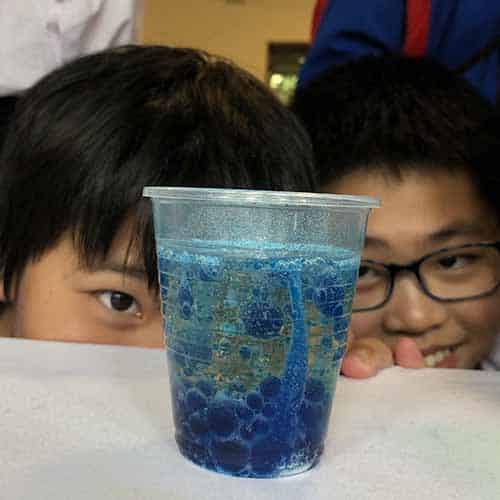
You will need
- A clean transparent PET bottle or clear cup
- Vegetable oil (try different types of oils to see how it affects the lamp!)
- Water
- Alka-Seltzer tablets
- Food colouring
- Funnel
Method
-
Fill the bottle about half full of water and add a few drops of food colouring.
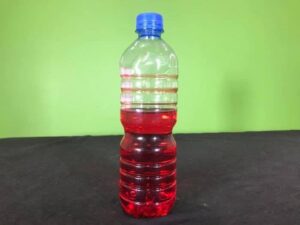
-
Fill the rest of the bottle with cooking oil and allow the components to settle and separate.
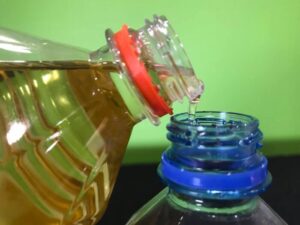
-
Break an Alka-Seltzer tablet into quarters, and drop one piece into the bottle. If you are doing this in a cup, add the whole tablet!
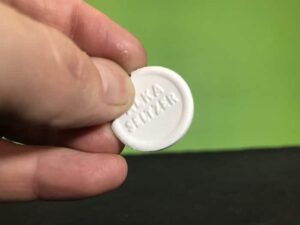
-
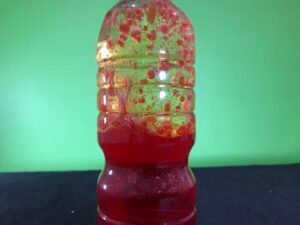
Watch as the bottle swirls and churns like a real lava lamp!
-
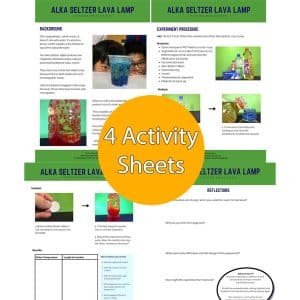
Go further – buy 4 x student activity sheets as extension worksheets.
This student science booklet has been created by experienced science educators from the Fizzics Education team.
Use these student worksheets as blackline masters for your science class!

-
Get the Unit of Work on States of Matter here!
- What are the different states of matter?
- How does heat affect the size of materials?
- How does liquid nitrogen affect materials and much more!
Includes cross-curricular teaching ideas, student quizzes, a sample marking rubric, scope & sequences & more

-
School science visits since 2004!
– Curriculum-linked & award-winning incursions.
– Over 40 primary & high school programs to choose from.
– Designed by experienced educators.
– Over 2 million students reached.
– Face to face incursions & online programs available.
– Early learning centre visits too!
-

The science behind it
Why Does This Happen?
The Science of How to Make a Lava Lamp
Creating a homemade lava lamp is a brilliant way to explore density and intermolecular forces. Oil is hydrophobic (water-fearing), meaning its molecules do not mix with water. Additionally, oil is less dense than water, which is why it always floats on the surface.
The “lava” effect is powered by a chemical reaction. An Alka-Seltzer tablet contains two solid reactants: citric acid and sodium bicarbonate (a base). They cannot react while dry, but once they dissolve in the water, they undergo an acid-base reaction that produces carbon dioxide gas (CO2).
As these gas bubbles form, they hitch a ride on the coloured water droplets, making them less dense than the oil. This causes the droplets to rise to the top. When the bubbles pop at the surface, the gas escapes, and the water droplets become dense again, sinking back to the bottom. This cycle continues as long as the tablet is reacting!
Nature’s Lava Lamps: Blue-Green Algae
In our waterways, blue-green algae use a similar method to control their buoyancy. They have tiny compartments called vacuoles that they fill with gas to float to the surface for sunlight. When they need nutrients from the bottom of the river, they empty the vacuoles to sink. This clever biological “lava lamp” trick allows them to out-compete other plants, often leading to toxic algal blooms.
Lava Lamp Version 2: The Salt Method
You can also create a lava lamp using salt! When you add salt to the floating oil, it clings to the oil droplets and drags them down because salt is much denser than water. Once at the bottom, the salt dissolves in the water, “releasing” the oil and allowing it to float back to the top.
Commercial lava lamps work differently; they use convection currents. A heat source at the bottom makes the “lava” expand and become less dense, causing it to rise. At the top, it cools, contracts, becomes denser, and sinks again. This is the same process that drives our weather systems and ocean currents! You can learn more by creating a convection spiral here.
Variables to test
Find out more on variables here.
-
Thermal Energy
What happens if the oil is warm versus cold? Temperature affects viscosity (how easily a liquid flows). Does the “lava” move faster in warm oil? -
Molecular Friction
Try different oil types, such as canola, olive, or baby oil. Do different viscosities change the shape or speed of the rising water droplets? -
Reaction Kinetics
What happens if you freeze the Alka-Seltzer tablet first? Does reducing the internal energy of the reactants slow down the production of CO2? -
Gas Concentration
Try using half a tablet versus three tablets. Does a massive increase in gas volume make the lamp more turbulent or just turn it into a messy foam?

Teacher's note
Curriculums change, and so does the way you implement them in your classroom. Please use your own experience and knowledge of your students to use these resources to best effect for student learning.
Still want the curriculum links?
Here are the suggested links:
Australian Curriculum (ACARA) Science:
NSW Science syllabuses:
Victorian Curriculum Science:
Want this experiment — and many more — running in your classroom?
Have us visit your school — every student gets three hands-on experiments in 60–90 minutes with a qualified presenter.








