
Gooey slime
Find out how to make Gooey slime in no time. Part of > 150 free science experiments, Easy to do and cheap to make. Make slime and get messy 🙂
Adult supervision for setup
You will need
- 500mL PVA Glue in a cup
- Borax (found in the homecare aisle of the supermarket)
- Food colouring
- Mixing bowl and spoon
- A cup of water
Method
-
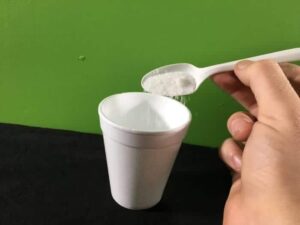
Dissolve the borax into the water. Keep adding borax until it won’t dissolve anymore in the water.
This means that the solution is saturated.
-
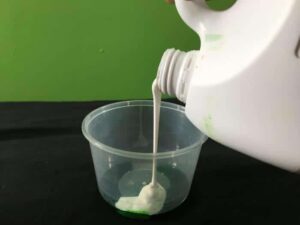
Gently add 100mL of the saturated borax solution to the PVA glue and stir.
-
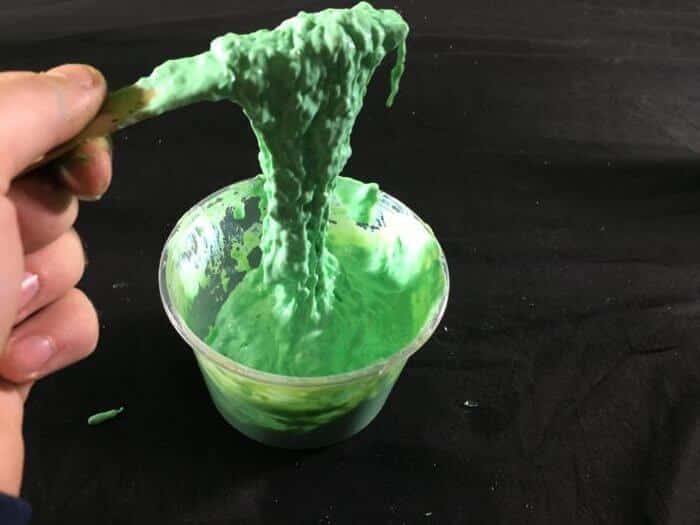
Gooey slime!
Keep adding borax solution to the PVA glue until a thick slime has been produced.

-
Get the Unit of Work on States of Matter here!
- What are the different states of matter?
- How does heat affect the size of materials?
- How does liquid nitrogen affect materials and much more!
Includes cross-curricular teaching ideas, student quizzes, a sample marking rubric, scope & sequences & more
-
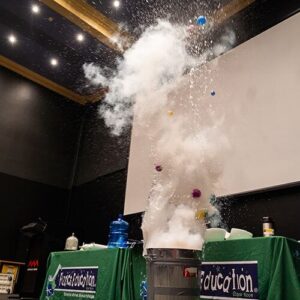
School science visits since 2004!
– Curriculum-linked & award-winning incursions.
– Over 40 primary & high school programs to choose from.
– Designed by experienced educators.
– Over 2 million students reached.
– Face to face incursions & online programs available.
– Early learning centre visits too!
-

The science behind it
Why Does This Happen?
The Science of Gooey PVA Slime
Slime isn’t just fun to play with; it’s a lesson in polymer chemistry! Polymerisation is a vital process used to create many everyday items, from nylon and paint to synthetic rubber and even chewing gum. This process involves joining small molecules (monomers) together to form incredibly long, repeating chains called polymers.
PVA glue contains polyvinyl alcohol, a polymer made of carbon, hydrogen, and oxygen atoms. In the bottle, these long chains slide past each other easily, which is why the glue flows like a thick liquid. However, when you add a borax solution, borate ions are released. These ions act like tiny pieces of “chemical sticky tape” that link the long PVA chains together.
This process is called cross-linking. The borate ions form weak bonds between the chains, stopping them from sliding freely. This creates a hydrogel—a three-dimensional molecular matrix that traps water within its network. The result is a substance that isn’t quite a solid and isn’t quite a liquid; it’s a non-Newtonian fluid!
A hydrogel can absorb a huge amount of water, but it does have a breaking point. If you add too much water, the weak ionic bonds can no longer hold the network together. The matrix collapses, the cross-linking fails, and you are left with a soupy, watery mess.
Variables to test
Find out more on variables here.
-
Polymer Purity
What happens if you use a clear PVA solution versus standard white PVA school glue? School glue often contains “fillers” like calcium carbonate; does this make the slime more or less stretchy? -
Adhesive Chemistry
Try using a different type of glue, such as a clear “washable” glue or a wood glue. Do they all contain the same amount of polyvinyl alcohol required for cross-linking? -
Shear-Thickening Additives
Try adding cornflour to your slime. Cornflour is another polymer (starch). How does mixing two different types of polymers change the viscosity and texture of the goo? -
Cross-linker Concentration
Does adding more borax solution make the slime stiffer? This tests how the density of the cross-links affects the flexibility of the molecular matrix.
Remember, the key to a great experiment is to change only one variable at a time while keeping everything else the same. This ensures your results are valid and scientifically sound!

Teacher's note
Curriculums change, and so does the way you implement them in your classroom. Please use your own experience and knowledge of your students to use these resources to best effect for student learning.
Still want the curriculum links?
Here are the suggested links:
Australian Curriculum (ACARA) Science:
NSW Science syllabuses:
Victorian Curriculum Science:
Want this experiment — and many more — running in your classroom?
Have us visit your school — every student gets three hands-on experiments in 60–90 minutes with a qualified presenter.








