
Pen chromatography
Learn about chromatography with this fun science experiment using simple materials! Discover hidden colours in felt tip pens with ease. Find out more…
Adult supervision for setup
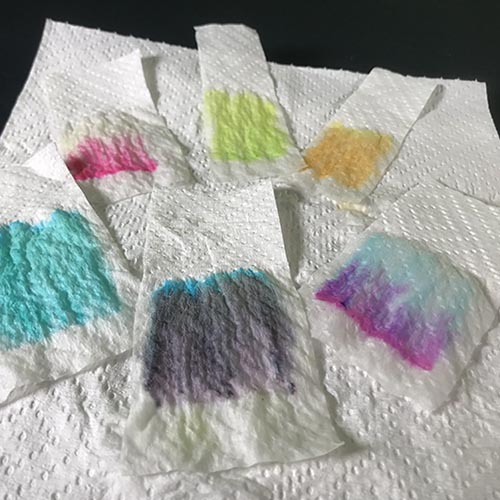
You will need
- A glass of water
- Different coloured felt tip pens
- White paper towelling
- Scissors
Method
-
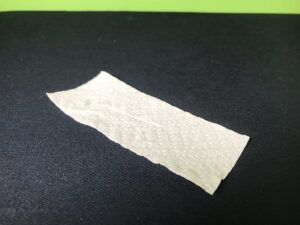
Cut a thin strip of white paper towelling using your scissors.
-
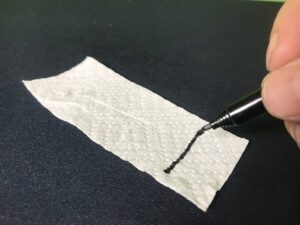
With one of the felt tips pens, draw a line across the paper towelling strip roughly 1cm from the bottom of the paper.
-
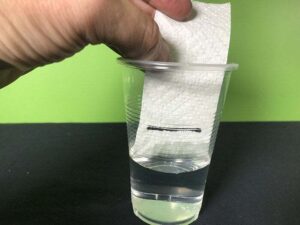
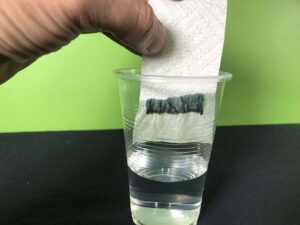
Carefully place the paper strip into the water so that only the edge of the paper touches the surface of the water. Water will rapidly rise up through the paper due to capillary action.
-
Once the water reaches the ink line, lift the paper strip off the surface of the water. You’ll notice that the ink rises upwards as the water comes up through the ink line. If you look closely, you might see some colours coming out of the line that you didn’t see before!
-
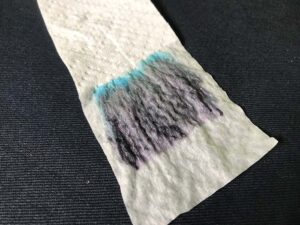
The longer you run the chromatography experiment, the more the colours spread out across the paper.
-
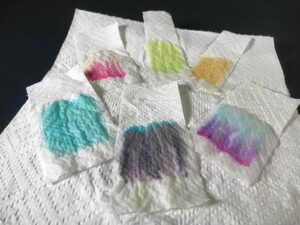
Try different felt tip pens for your chromatography investigation! Purple, orange and black inks tend to have hidden colours within them … which other colour inks also have hidden colours?
-
Get the Unit of Work on Mixtures here!
- How can we separate mixtures?
- What are the different techniques?
- From chromatography to magnetism, join us to explore the variety of ways we can separate mixtures!
Includes cross-curricular teaching ideas, student quizzes, a sample marking rubric, scope & sequences & more

-
School science visits since 2004!
– Curriculum-linked & award-winning incursions.
– Over 40 primary & high school programs to choose from.
– Designed by experienced educators.
– Over 2 million students reached.
– Face to face incursions & online programs available.
– Early learning centre visits too!

-

The science behind it
What is happening?
The Science of Pen Chromatography
Chromatography is a powerful technique used by scientists to separate chemical mixtures. When we use it on ink or food colouring, we can see the results with our own eyes as the hidden “ingredients” of a colour begin to reveal themselves. While we can see dyes easily, this same method is used in labs to separate invisible compounds like sugars or amino acids, which are then “tagged” with stains so they can be identified.
The process relies on a mobile phase (the solvent, like water) moving through a stationary phase (the paper). As the water travels, it carries the ink mixture with it. Different components of the ink move at different speeds based on their solubility and their “affinity” for the paper versus the solvent. Essentially, it’s a race: molecules that are more hydrophilic (water-loving) stay in the water longer and travel further, while those that are more attracted to the paper fibres lag behind.
The water climbs the paper against gravity thanks to capillary action. This is powered by two forces: adhesion (water molecules sticking to the paper fibres) and cohesion (water molecules sticking to each other). Together, they pull the liquid upwards through the tiny gaps in the paper.
Scientific Myth-Busting: A common misconception is that ink separates based on the size of the molecules (with smaller ones travelling further). In paper chromatography, it is actually about chemical polarity and solubility. However, size is a major factor in gel electrophoresis, a different technique used to separate DNA and proteins!
Variables to test
Find out more on variables here.
-
Substrate Porosity
Try coffee filter paper versus paper towelling or even newspaper. Does the thickness or “tightness” of the paper fibres change how clearly the colours separate? -
Solvent Properties
Permanent markers won’t budge in water because their ink is non-polar. Try using methylated spirits, isopropyl alcohol, or turpentine. Which solvents “unlock” which inks? -
Ink Composition
Do biro pens or highlighters work? Compare water-based “washable” markers to “professional” art pens to see which brands use the most complex blends of dyes. -
Environmental Factors
Does the temperature of the solvent affect the speed of the capillary action? Does hot water make the “race” happen faster?
Extension: Forensic Investigation
Put your skills to the test in a mock forensic lab! You can use chromatography to “fingerprint” a pen used in a crime. By comparing the chromatography pattern (the chromatogram) of a ransom note to pens found on different suspects, you can identify the exact match. No two brands of black pens are quite the same!

Teacher's note
Curriculums change, and so does the way you implement them in your classroom. Please use your own experience and knowledge of your students to use these resources to best effect for student learning.
Still want the curriculum links?
Here are the suggested links:
Australian Curriculum (ACARA) Science:
NSW Science syllabuses:
Victorian Curriculum Science:
Want this experiment — and many more — running in your classroom?
Have us visit your school — every student gets three hands-on experiments in 60–90 minutes with a qualified presenter.








