
Walking water
Two paper towels Water Food colouring- ideally two different colours Three Cups
Adult supervision for setup
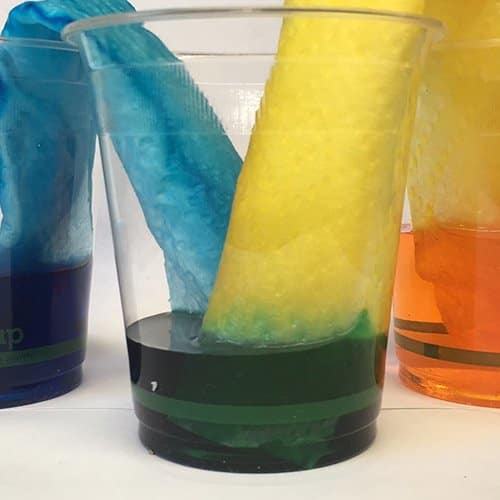
You will need
- Two paper towels
- Water
- Food colouring – ideally two different colours
- Three Cups
Method
-
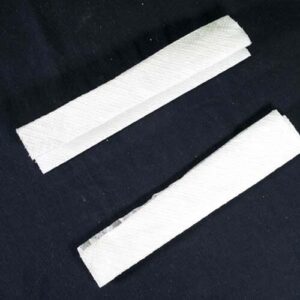
Fold the two paper towels into two tubes roughly 20cm long.
-
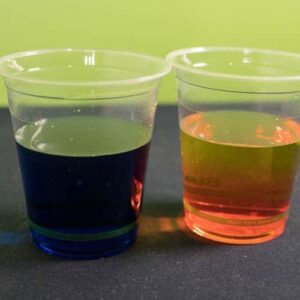
Fill two cups with water and add food dye to each, ideally of different colours. To get the best effect, use undiluted food colouring or at least very strong!
-
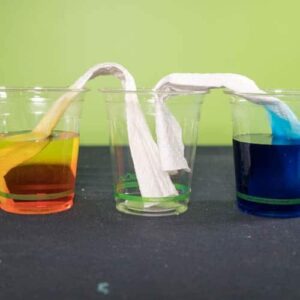
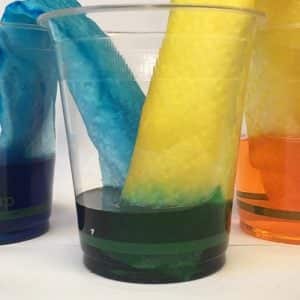
Place an empty cup between the two full cups. Place one end of a paper tube into one cup filled with coloured water and the other end into the centre empty cup. Repeat this step with the other cup of coloured water and paper towel, so that the cups and paper towels alternate as follows: cup, towel, cup, towel, cup.
-
Wait for several hours. If you would like to see the process more clearly set up a time-lapse camera to watch over your experiment!
-
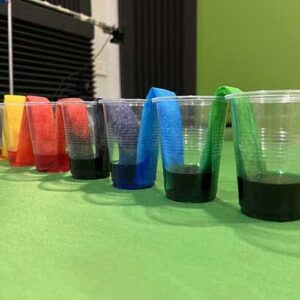
Go further – try to arrange the colours and cups to make a rainbow!
-
Get the Unit of Work on Water Science here!
- Explore the water cycle
- Learn about cohesion, adhesion & capillary action
- From water currents to floatation, join us to explore water science!
Includes cross-curricular teaching ideas, student quizzes, a sample marking rubric, scope & sequences & more
-
School science visits since 2004!
– Curriculum-linked & award-winning incursions.
– Over 40 primary & high school programs to choose from.
– Designed by experienced educators.
– Over 2 million students reached.
– Face to face incursions & online programs available.
– Early learning centre visits too!
-

The science behind it
What is happening?
The Science of Walking Water
Water has a remarkable ability called capillary action. This is the process where liquid flows through narrow spaces without the help of, or even in opposition to, external forces like gravity. In this experiment, the water “walks” up and across the paper towel to reach the empty glass.
This happens because of three key properties of water:
- Cohesion: Water molecules are “sticky” and like to stay close to each other.
- Adhesion: Water molecules are also attracted to other materials, like the fibres in a paper towel.
- Surface Tension: The “skin” on the surface of the water helps pull the rest of the liquid along as the first molecules move forward.
As the dyed water travels through the tiny gaps in the paper towel fibres, it eventually drips into the empty glass. If you used two different primary colours (like red and blue), you would have seen them mix in the middle glass to create a secondary colour (purple)!
Variables to test
Find out more about variables here.
-
Thermal Energy
Does it make a difference with hot vs. cold water? Does the speed of the “walking” change with temperature? -
Pigmentation
Try different food colours. Do some dyes travel faster through the fibres than others? -
Material Porosity
Try tissue paper vs. paper towels vs. printing paper. Which material has the best structure for capillary action to occur?

Teacher's note
Curriculums change, and so does the way you implement them in your classroom. Please use your own experience and knowledge of your students to use these resources to best effect for student learning.
Still want the curriculum links?
Here are the suggested links:
Australian Curriculum (ACARA) Science:
NSW Science syllabuses:
Victorian Curriculum Science:
Want this experiment — and many more — running in your classroom?
Have us visit your school — every student gets three hands-on experiments in 60–90 minutes with a qualified presenter.








