
Marshmallow & spaghetti towers
Build a marshmallow tower – how high can you go? A classic STEM activity for kids to try out. Test your planning skills and patience with this none 🙂
Adult supervision for setup
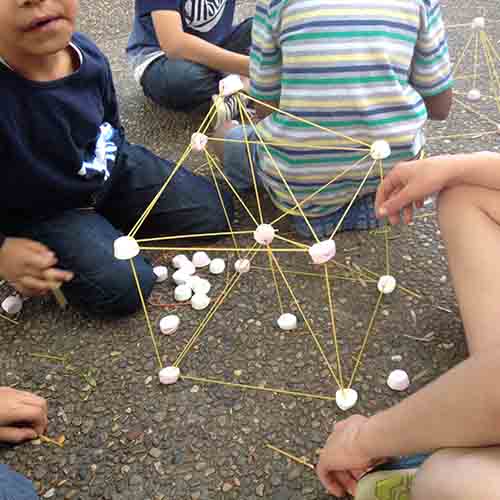
You will need
- A packet of spaghetti
- A packet of marshmallows
- A measuring tape
- A dustpan and broom nearby (expect lots of spaghetti breakages!)
- Patience!
Method
-
Have a think about how the base of your marshmallow tower will work.
- Will this be a triangle?
- What about a square?
- Why not try a pentagon?
This planning will help you in the long run! Start to form the base of your tower by gently pushing the spaghetti strands into your marshmallows.
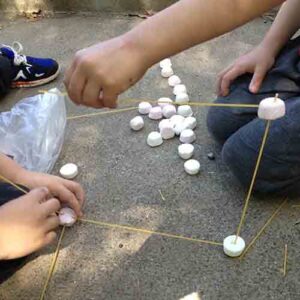
-
Begin to form some height with your spaghetti strands. You might try going straight upwards or perhaps you might want to try smaller modular units that can be put together repetitively.
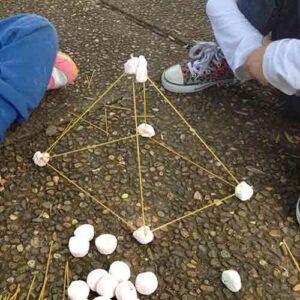
-
If trying the modular route, consider how this will scale upwards as you build. Keep the dimensions the same for each unit if you choose this build strategy!
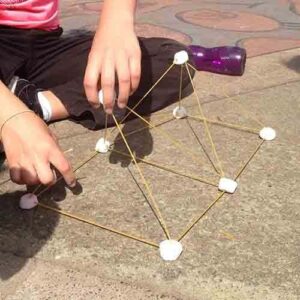
-
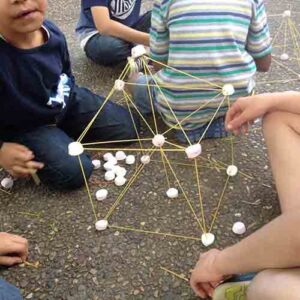
Try different shapes! You might find that you need to create some extra ‘connector marshmallows’ to hold your shape together!
Does this tell you something about how the forces work within your tower?
-
Get the Unit of Work on Forces here!
- Push, pull
- Friction & spin!
From inertia to centripetal force, this unit covers many concepts about Newton’s Laws!
Includes cross-curricular teaching ideas, student quizzes, a sample marking rubric, scope & sequences & more

-
School science visits since 2004!
– Curriculum-linked & award-winning incursions.
– Over 40 primary & high school programs to choose from.
– Designed by experienced educators.
– Over 2 million students reached.
– Face to face incursions & online programs available.
– Early learning centre visits too!

-

The science behind it
What is this about?
Building Marshmallow and Spaghetti Towers
Building marshmallow and spaghetti towers is a fantastic way to explore the physics of forces and the limitations of different construction materials.
- Spaghetti: Spaghetti can handle a fair amount of force travelling down the length of the strand (compression), but it will quickly snap if it is bent or twisted. Because it is brittle, you must consider how force is transferred through each strand. You likely found that arranging your spaghetti into triangular shapes produced the most stable structure. This is because triangles are the only polygon that cannot be deformed without changing the length of one of its sides, making them the foundation of nearly every major bridge and skyscraper.
- Marshmallows: Marshmallows are gooey in their centre, which means they can be easily torn if a shearing force is applied. They act as the “nodes” or joints of your structure. You would have also found that marshmallows introduce a mass distribution problem—too many marshmallows on one side and the tower’s centre of gravity shifts, causing it to topple!
Applications
Understanding how forces flow through a structure is critical for engineering. These days, complex computer modelling is used to test the effect of different structural arrangements and material types to determine the optimum design of a building before a single brick is laid.
Every material has a known breaking point, and different arrangements of these materials produce different patterns of compression (squishing together) and tension (pulling apart). If a design isn’t balanced to handle these forces, the structure is at risk of catastrophic failure. This is why engineers use “truss” systems—interconnected triangles—to distribute loads evenly across a wide area.
Variables to explore
Find out more on variables here.
-
Adhesive Quality
Try different brands or ages of marshmallows. Do “stale” marshmallows provide a stiffer joint than fresh, gooey ones? -
Structural Reinforcement
Would binding multiple spaghetti strands together with tape increase the strength and the ultimate height of your tower? -
Binding Materials
Try using jelly babies or Blu-Tack as the binding material instead. Does the increased density of these materials make the tower more stable or more likely to collapse under its own weight? -
Environmental Factors
Does it matter if you build your tower on a cold or hot day? Consider how humidity might affect the “snap” of the spaghetti or the “melt” of the marshmallows!

Teacher's note
Curriculums change, and so does the way you implement them in your classroom. Please use your own experience and knowledge of your students to use these resources to best effect for student learning.
Still want the curriculum links?
Here are the suggested links:
Australian Curriculum (ACARA) Science:
NSW Science syllabuses:
Victorian Curriculum Science:
Want this experiment — and many more — running in your classroom?
Have us visit your school — every student gets three hands-on experiments in 60–90 minutes with a qualified presenter.








