
Measure the speed of light with chocolate
Ever tried measuring speed of light using chocolate? It's possible & quite easy to do! A fun science activity that you get to eat 🙂
Adult supervision for setup
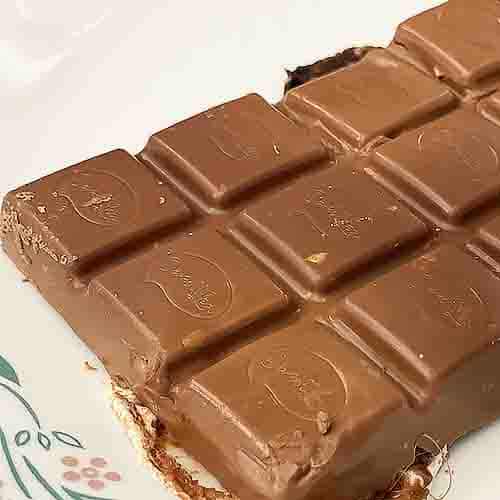
You will need
- A bar of chocolate
- Microwave
- Ruler & calculator
- A plate (and potentially a flat bottom dish)
- Adult help
- Option: If you don't have chocolate, cheese slices work too!
Method
-
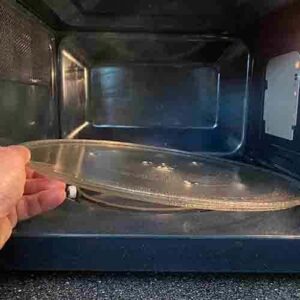
Remove the microwave turntable and then ring with wheels from the microwave.
-
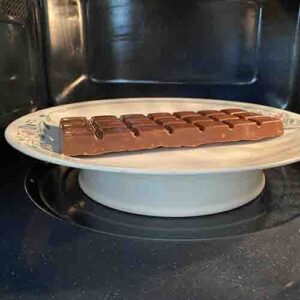
Place your chocolate bar on a ceramic plate and put this into the microwave. You might find that adding a flat plastic dish will help raise the plate above the turntable motor.
NB: Don’t use metal or metal-rimmed plates inside your microwave!
-
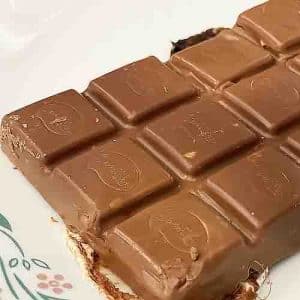
Run the microwave for around 20 seconds and then look to see if there are any melted spots on the chocolate bar.
Repeat until you get melted spots but don’t go so far as to burn the chocolate!
-
Be careful at this point, the chocolate is hot!
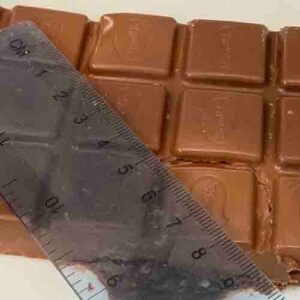
Use a ruler to measure the distance between the middle of two adjacent melted spots of chocolate. You should find that there are several places to take this measurement and so you could take the average between different melted spot pairs.
-
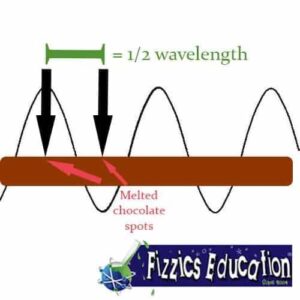
What you have measured is 1/2 the wavelength of light! Read below to work out the speed of light using chocolate and a little bit of mathematics.
-
Don’t let the chocolate go to waste 🙂
-
School science visits since 2004!
– Curriculum-linked & award-winning incursions.
– Over 40 primary & high school programs to choose from.
– Designed by experienced educators.
– Over 2 million students reached.
– Face to face incursions & online programs available.
– Early learning centre visits too!
-

-
Get the Unit of Work on Light & Colour here!
- What is colour addition vs subtraction?
- What is opacity, translucence & transparency?
- What is the difference between refraction & reflection?
- Explore UV light, lenses, thermochromism and more!
Includes cross-curricular teaching ideas, student quizzes, a sample marking rubric, scope & sequences & more
The science behind it
What is going on?
The Science of Measuring the Speed of Light with Chocolate
The speed of light in a vacuum, denoted as c, is a universal physical constant used in many scientific calculations, including Einstein’s famous equation E=mc2. Its exact value is defined as 299,792,458 metres per second.
The Wave Equation
To calculate the speed of light using a microwave and chocolate, we use the fundamental wave equation:
c = λf
- c = Speed of light
- λ (Lambda) = Wavelength (the distance between two consecutive peaks of the wave)
- f = Frequency (how many times the wave cycles per second, measured in hertz)
How It Works: Standing Waves
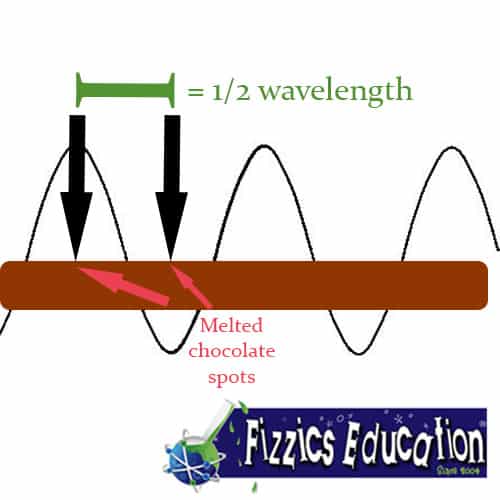
Inside a microwave, the electromagnetic waves reflect off the walls, creating standing waves. These waves have “nodes” (points of no movement) and “antinodes” (points of maximum energy).
- Melted Spots: The chocolate only melts at the antinodes where the energy is highest.
- Measuring Wavelength: The distance between two melted spots represents half of a wavelength (1/2 λ). To get the full wavelength, we must multiply the distance between the spots by two.
- Microwave Frequency: Most standard microwaves operate at a frequency of 2.45 gigahertz (2,450,000,000 Hz).
Example Calculation
If the distance between melted spots is 6.2 cm:
- Full wavelength (λ) = 6.2 × 2 = 12.4 cm
- Convert to metres = 0.124 m
- Speed (c) = 0.124 × 2,450,000,000 = 303,800,000 m/s
Variables to test
Find out more on variable testing here.
-
Spatial Distribution
Does it matter where you place the chocolate? Try placing it higher or lower to see how the three-dimensional standing wave pattern changes. -
The Turntable Factor
What happens if the chocolate spins? (Hint: Rotation “smears” the energy distribution because the chocolate passes through multiple high-energy points!) -
Material Choice
Try cheese slices. Their high moisture and fat content might show melted spots more clearly than chocolate, making them easier to measure. -
Hardware Variation
Try different microwaves. Do older models or higher-power models yield a more accurate result for the speed of light?

Teacher's note
Curriculums change, and so does the way you implement them in your classroom. Please use your own experience and knowledge of your students to use these resources to best effect for student learning.
Still want the curriculum links?
Here are the suggested links:
Australian Curriculum (ACARA) Science:
NSW Science syllabuses:
Victorian Curriculum Science:
Want this experiment — and many more — running in your classroom?
Have us visit your school — every student gets three hands-on experiments in 60–90 minutes with a qualified presenter.








