
Carbon sugar snake
Create a growing carbon sugar snake with simple ingredients. A science activity for the adults to try that demonstrates combustion for kids.
Adult supervision for setup
You will need
- A wide baking tray filled with 2 kg of sand
- 1 tablespoon of bicarbonate soda
- 4 tablespoons of icing mixture (powdered sugar)
- 50 mL of ethanol, lighter fluid, or methylated spirits
- A BBQ lighter
- Bowl & spoon
- Fire extinguisher, fire blanket, or running water & bucket nearby
- Qualified adult supervision & no wind whatsoever (ideally in a fume cupboard)
Method
-
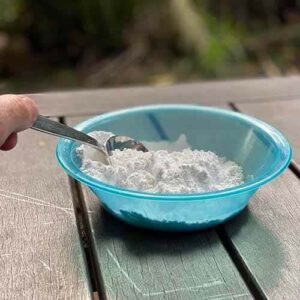
Combine 4 tablespoons of icing mixture & 1 tablespoon bicarbonate soda in a bowl.
-
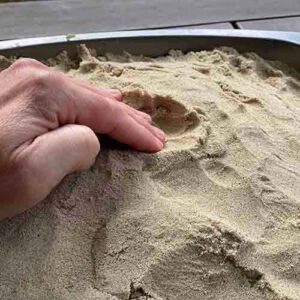
Make a small indentation in the sandpile in your baking tray (making sure the sandpile is at least 5cm deep).
Place your baking tray in a place away from any flammable materials and near your fire extinguisher, fire blanket or bucket of water.
-
This step is for adults!
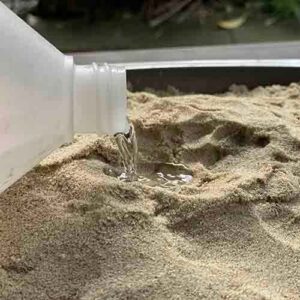
Get an adult to pour roughly 20mL of methylated spirits, lighter fluid or ethanol into the indentation in the sand.
Once wet, add small amounts of methylated spirits around the edge of the hole as well (no more than 30mL).
Danger: do not use more than 50mL methylated spirits in total. Do not run in windy conditions!
-
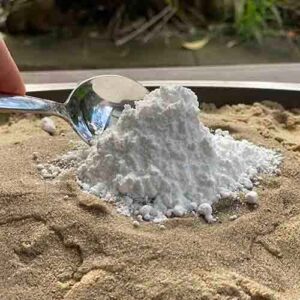
Using the spoon, carefully add the mixture of icing mixture and bicarbonate soda to the centre of the indentation in the sand.
-
This step is for adults!
Firstly, ensure that your fire extinguisher, fire blanket or bucket of water is ready to go nearby.
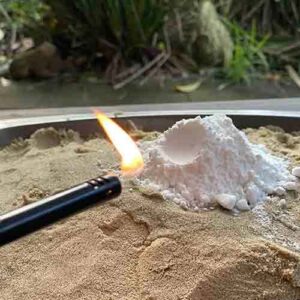
Use the BBQ lighter to light the edge of the base of the icing mixture & bicarbonate soda pile.
Be careful – this should only be done in still conditions without any wind or drafts to blow on the flame.
-
Watch this under adult supervision
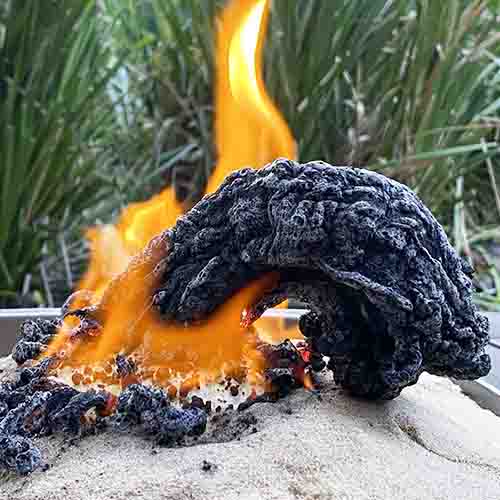
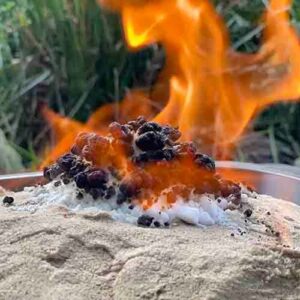
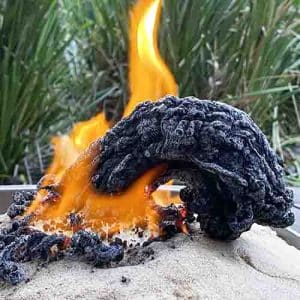
The flame will move over the powder pile and begin to burn the top of it. Watch the powder closely… you will see small nodules of black carbon start to form and rise off the main powder pile.
-
Watch this under adult supervision
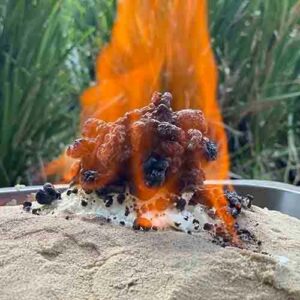
The nodules of burnt carbon will start to join and rise upwards.
A “carbon sugar snake” will begin to form as the experiment continues.
The process is slow but relentless!
-
Watch this under adult supervision
The carbon snake will form a column and rise upwards until falling to the side under its own mass.
The sugar pile will continue to burn until all of the methylated spirits is used up and the outer layer of white powder is black. This process will take around 20 to 30 minutes, depending on the amount of methylated spirits that you used.
Don’t touch the carbon sugar snake until the flame has gone out and you have waited at least 10 minutes for it to cool down.
-
School science visits since 2004!
– Curriculum-linked & award-winning incursions.
– Over 40 primary & high school programs to choose from.
– Designed by experienced educators.
– Over 2 million students reached.
– Face to face incursions & online programs available.
– Early learning centre visits too!
-

-
Get the Unit of Work on Heat Energy here!
- What actually is heat?
- How does heat move through different materials?
- How does heat change the properties of materials and more!
Includes cross-curricular teaching ideas, student quizzes, a sample marking rubric, scope & sequences & more

The science behind it
What is going on?
The Science of the Carbon Sugar Snake
SAFETY WARNING: This experiment must not be performed without qualified adult supervision. It should never be conducted in breezy conditions and is ideally suited for a fume cupboard in a science laboratory.
The growing “snake” is the result of three distinct chemical reactions happening simultaneously. When you ignite the fuel, the heat triggers a chain reaction involving the sugar (sucrose) and the bicarbonate soda.
- Combustion: When sugar burns in the presence of oxygen, it produces carbon dioxide gas and water vapour. these gases provide the initial “push” that helps the snake rise.
C12H22O11 + 12O2 → 12CO2 + 11H2O
- Thermal Decomposition of Sugar: Because the oxygen is limited, not all the sugar burns away. Instead, the intense heat causes the sugar molecules to break down into solid carbon and water vapour. This solid carbon is what gives the snake its black colour and physical structure.
C12H22O11 → 12C + 11H2O
- Thermal Decomposition of Bicarbonate Soda: As the bicarb reaches approximately 80°C, it breaks down into sodium carbonate, water vapour, and carbon dioxide.
2NaHCO3 → Na2CO3 + H2O + CO2
The carbon dioxide and water vapour from these reactions are trapped by the solid carbon and sodium carbonate, blowing the mixture up like a long, lightweight foam tube. It is essentially a “carbon balloon” that grows longer as more gas is produced!
Variables to test
Find out more on variables here.
- Reactant Ratios
Try changing the ratios of the icing mixture and the bicarbonate soda. Does more bicarb make a lighter, airier snake, or does it cause the structure to collapse? - Surface Geometry
If there is no indentation in the sand to “pool” the fuel, will the snake still form a column, or will it spread out into a flat crust? This looks at how confinement affects the growth direction. - Fuel Type
Does the type of sugar matter? Compare icing sugar (which contains a little cornstarch) to caster sugar. How does the particle size affect the speed of the reaction? - Catalyst Effects
Would adding a small amount of another substance change the rate of carbonisation? This is a more advanced look at how different chemicals can speed up or slow down a reaction.
Remember, this is a chemical change because new substances (carbon and gases) are formed that cannot be turned back into sugar and bicarb!

Teacher's note
Curriculums change, and so does the way you implement them in your classroom. Please use your own experience and knowledge of your students to use these resources to best effect for student learning.
Still want the curriculum links?
Here are the suggested links:
Australian Curriculum (ACARA) Science:
NSW Science syllabuses:
Victorian Curriculum Science:
Want this experiment — and many more — running in your classroom?
Have us visit your school — every student gets three hands-on experiments in 60–90 minutes with a qualified presenter.








