Double cone roller
Can you get the double cone roller to move uphill? Or is it an illusion? This science activity will have you looking closer at rotational forces & centre of balance!
Adult supervision for setup
You will need
- 2 empty 1.5L soda bottles
- 2 cork kitchen pot stands (1 cm thick)
- 2 wooden chopsticks (27 cm long)
- 2 takeaway containers
- Sticky tape
- 5 supermarket catalogues (approx. 1mm thick each)
- Note: You can substitute these with materials of similar dimensions.
- Optional: A protractor to measure the angles
Method
-
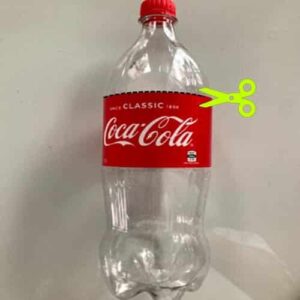
Cut the soda bottles at the edge of their label.
-
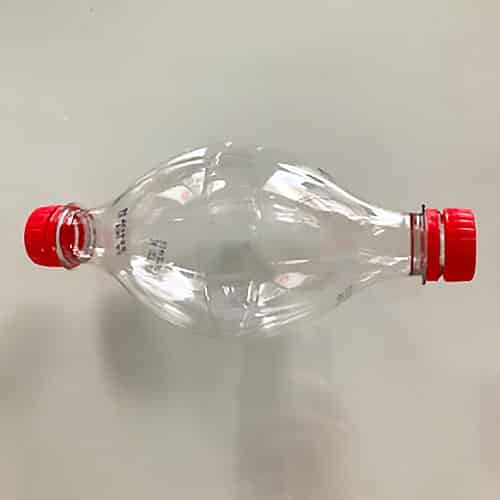
Tape the conical parts o the soda bottle together.

-
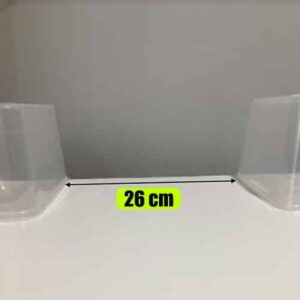
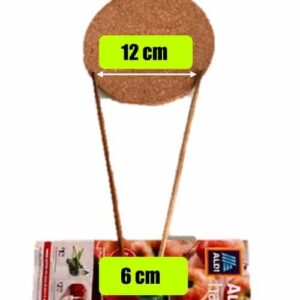
Place two takeaway containers upside down, about 26cm apart.
-
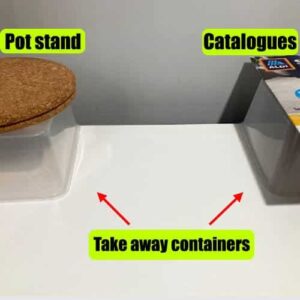
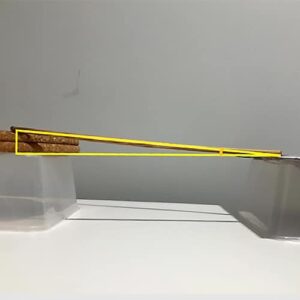
Put both of the pot stands on one container and two catalogues on the other (the number of catalogues or pot stands will vary dependent on the thickness of the at catalogues that you use)
-
Put the chopsticks on the pot stands and the catalogues in V shape. The ends on the pot stands are 12cm apart and the other ends are 6 cm apart. Fix them in place using sticky tape.
-
Your chopstick ramp should now be at an angle (you could measure this with a protractor).
Now it’s time to try your double cone roller!
- Carefully place the double cones on the lower side of the chopsticks.
- Can your double cone roll uphill (or is this really an illusion)?
This may need several trials to make it roll, whereby you will need to alter the angle of the ramp by either changing the number of the catalogues or pot stands to modify the slope.
-
Get the Unit of Work on Forces here!
- Push, pull
- Friction & spin!
From inertia to centripetal force, this unit covers many concepts about Newton’s Laws!
Includes cross-curricular teaching ideas, student quizzes, a sample marking rubric, scope & sequences & more
-
School science visits since 2004!
– Curriculum-linked & award-winning incursions.
– Over 40 primary & high school programs to choose from.
– Designed by experienced educators.
– Over 2 million students reached.
– Face to face incursions & online programs available.
– Early learning centre visits too!

-

The science behind it
What is going on?
The Science of the Double Cone Roller
The “uphill” roller is a classic physics demonstration that relies on the difference between visual perception and the laws of gravity. While it looks like the object is rolling upward, it is actually moving to a lower gravitational potential energy state.
The secret lies in the Centre of Mass (COM). In any object, the COM is the average position of all the parts of the system. Gravity pulls on this specific point. For your double cone, the COM is located exactly in the middle of the two bottle caps.
Why the Illusion Works
As the double cone moves toward the wider end of the V-shaped chopsticks, the rails contact the cone at increasingly smaller diameters. This allows the wide center of the cone to “sink” lower between the rails.
- Mechanical Advantage: Even though the chopsticks are slanted upward, the V-shape widens at a faster rate than the ramp rises.
- Gravitational Force: Because the cone’s center is dropping closer to the ground as it moves forward, gravity is actually pulling it “downhill,” even though its path along the rails looks like it’s going up!
Variables to test
Find out more on variables here.
-
Cone Geometry
Does it matter if you use small or large soda bottles? A larger diameter changes how quickly the COM sinks. Does this make the “uphill” movement faster? -
Rail Divergence
Vary the width of the “V-shape” of the chopsticks. If the V is too narrow, the cone won’t sink fast enough to overcome the incline. What is the critical angle where it stops rolling? -
Incline Angle
Vary the angle of the chopstick ramps. At what slope does the physical height of the ramp finally beat the sinking effect of the V-shape? -
Surface Friction
What happens if you replace the chopsticks with another material, like smooth plastic straws or rough wooden skewers? How does frictional force affect the smooth start of the roller?
To ensure a fair test, try to release the roller from the same spot without giving it a “push.” This ensures that only gravity is doing the work!

Teacher's note
Curriculums change, and so does the way you implement them in your classroom. Please use your own experience and knowledge of your students to use these resources to best effect for student learning.
Still want the curriculum links?
Here are the suggested links:
Australian Curriculum (ACARA) Science:
NSW Science syllabuses:
Victorian Curriculum Science:
Want this experiment — and many more — running in your classroom?
Have us visit your school — every student gets three hands-on experiments in 60–90 minutes with a qualified presenter.