
Balloon survives the flame
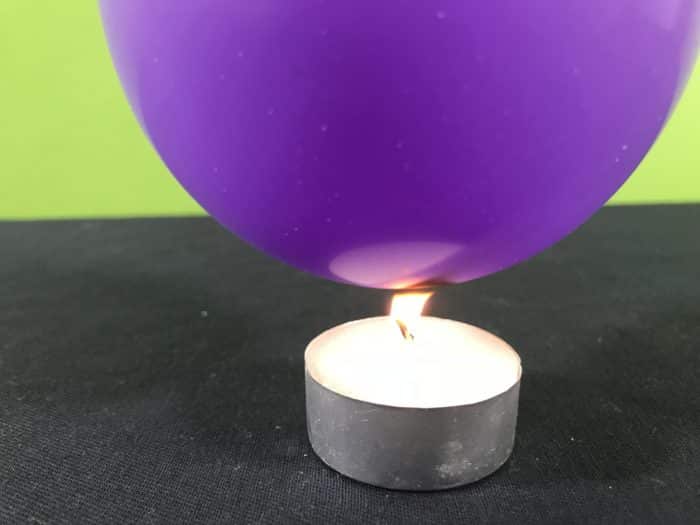
What happens if you put a balloon over a flame? Will it explode or will it not? Find out with this fun experiment what will happen!
Adult supervision for setup
You will need
- One candle
- Matches
- A balloon filled with water
- Adult supervision.
- A small plate
- Water
Method
-
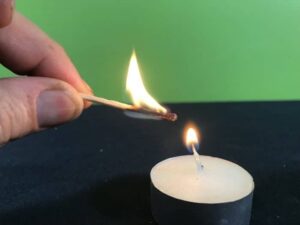
Light the bottom of the candle and allow the wax to melt. Then stick the candle onto the plate.
-
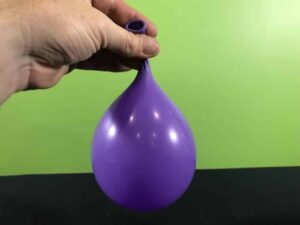
Fill a balloon with water and tie its end. Make sure that you keep the balloon fairly small to avoid stretching the rubber too much.
-
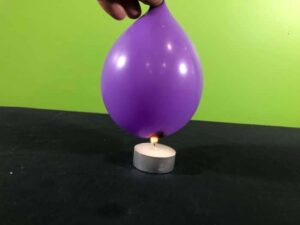
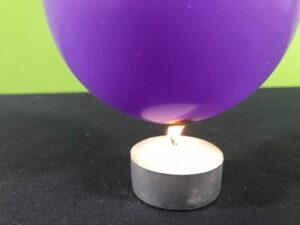
Light the candle and place the balloon over the flame so that the flame touches the balloon.
-
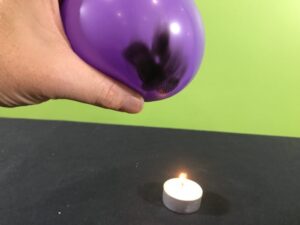
Slowly count to ten and then remove the balloon from the flame. It should not have popped.
-
Try the same experiment with a balloon filled with air. It should pop straight away. Or try holding the water balloon over the flame for a longer period of time. Will it eventually pop?
-
School science visits since 2004!
– Curriculum-linked & award-winning incursions.
– Over 40 primary & high school programs to choose from.
– Designed by experienced educators.
– Over 2 million students reached.
– Face to face incursions & online programs available.
– Early learning centre visits too!
-

-
Get the Unit of Work on Heat Energy here!
- What actually is heat?
- How does heat move through different materials?
- How does heat change the properties of materials and more!
Includes cross-curricular teaching ideas, student quizzes, a sample marking rubric, scope & sequences & more

The science behind it
Why Does This Happen?
You’ll find that you can run this for quite a while longer than the air-filled balloon purely because the water will continue to absorb the heat from the flame. So, how long could you run this? Well, it really depends on how much water you have in the balloon as well as the quality of the rubber balloon itself. Try varying the levels of the water in the balloon and see how long your experiment can last!
BTW; whilst the water balloon survives the flame, the water inside the balloon will start to cycle around and around due to convection. Convection is the movement of either gases or liquids due to uneven heating causing density changes that drive movement. How does this convection work in the balloon then?
– Warmer water rises due to the water expanding and becoming less dense than the surrounding colder water.
– As the warmer water rises, the surrounding colder water moves underneath to replace the warm water.
– Once the warmer water reaches the top of the balloon it is away from the flame… so it contracts as it cools down. This contraction makes this water denser and so this water moves down again.
– In the meantime… the water that had moved near the candle flame also heats up and expands & rises… and the process keeps repeating as a continual circular motion of water within the balloon!
Variables to test
- Try different size balloons.
- Can you reduce the amount of water in the balloon and still have it survive the flame?
- Does adding very cold water to the balloon make it survive significantly longer?

Teacher's note
Curriculums change, and so does the way you implement them in your classroom. Please use your own experience and knowledge of your students to use these resources to best effect for student learning.
Still want the curriculum links?
Here are the suggested links:
Australian Curriculum (ACARA) Science:
NSW Science syllabuses:
Victorian Curriculum Science:
Want this experiment — and many more — running in your classroom?
Have us visit your school — every student gets three hands-on experiments in 60–90 minutes with a qualified presenter.








