
Dry ice between spoons
Grab an adult because this experiment could get dangerous! Learn why and what happens when you put dry ice between spoons!
Adult supervision for setup
You will need
- Dry ice pellets
- 2 metal spoons
- Tongs, gloves & adult help
Method
-
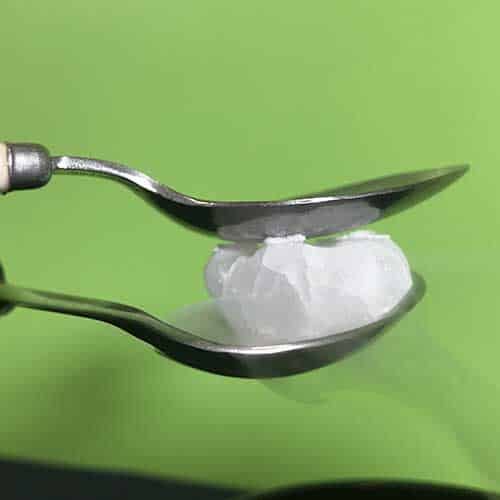
Place a pellet of dry ice on a spoon.

-
Place another spoon on top of the other spoon, resting on top of the dry ice pellet.
Gently squeeze the two spoons together as if they were BBQ tongs
With the right pressure they should begin to vibrate and squeal!

-
Get the Unit of Work on States of Matter here!
- What are the different states of matter?
- How does heat affect the size of materials?
- How does liquid nitrogen affect materials and much more!
Includes cross-curricular teaching ideas, student quizzes, a sample marking rubric, scope & sequences & more

-
School science visits since 2004!
– Curriculum-linked & award-winning incursions.
– Over 40 primary & high school programs to choose from.
– Designed by experienced educators.
– Over 2 million students reached.
– Face to face incursions & online programs available.
– Early learning centre visits too!

-

The science behind it
Why Does This Happen?
The Science of Dry Ice and Singing Spoons
Safety Note: Dry ice is extremely cold (-78.5°C). Never touch it with bare skin—always use tongs and heavy-duty gloves. Ensure you are working in a well-ventilated area.
When you press a warm metal spoon against dry ice, it screams, squeals, or “sings.” This noisy phenomenon is caused by a combination of sublimation and rapid vibration.
Why does it scream?
Dry ice is solid carbon dioxide (CO2). Unlike water ice, it doesn’t melt into a liquid; it sublimates, turning directly into a gas.
- Thermal Energy Transfer: The spoon is much warmer than the dry ice. When they touch, heat flows rapidly from the metal into the ice, causing it to sublimate at an incredible rate.
- Gas Pressure: A tiny layer of CO2 gas forms instantly between the spoon and the ice. This gas pushes the spoon away.
- High-Frequency Vibration: As the spoon is pushed away, the pressure drops, and the spoon falls back onto the ice. This happens thousands of times per second. These rapid collisions create sound waves that we hear as a high-pitched squeal.
Variables to test
Find out more on variables here.
-
Thermal Conductivity
Try plastic vs. metal spoons. Metal is a great conductor of heat, while plastic is an insulator. Does the plastic spoon stay silent because it can’t transfer heat fast enough to cause rapid sublimation? -
Surface Area and Mass
Try small vs. large pieces of dry ice. Does the mass of the ice or the size of the contact point change the pitch or volume of the sound? -
Applied Pressure
What happens if you press the spoon down harder? Does increasing the force change the frequency of the vibrations and result in a higher or lower pitch? -
Initial Temperature
Try dipping the spoon in hot water before touching the ice. Does the increase in thermal energy make the reaction more violent or the sound louder?
To ensure a fair test, try to use the same type of spoon when testing different pieces of ice, so you know the change in sound is only due to the ice itself!

Teacher's note
Curriculums change, and so does the way you implement them in your classroom. Please use your own experience and knowledge of your students to use these resources to best effect for student learning.
Still want the curriculum links?
Here are the suggested links:
Australian Curriculum (ACARA) Science:
NSW Science syllabuses:
Victorian Curriculum Science:
Want this experiment — and many more — running in your classroom?
Have us visit your school — every student gets three hands-on experiments in 60–90 minutes with a qualified presenter.








