
Suspended rice
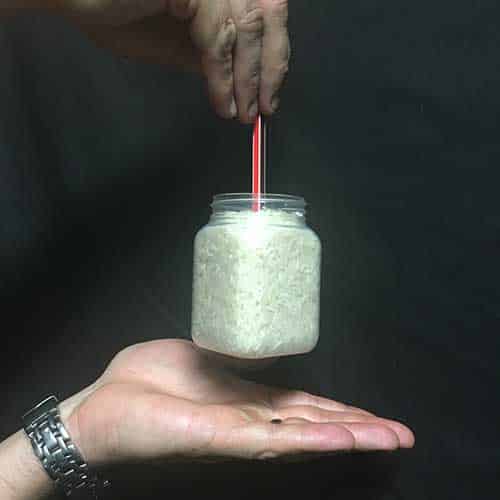
Did you know you can suspend rice in the air with just a pencil! This super experiment is called suspended rice but get an adult because it may get messy!
Adult supervision for setup
You will need
- A Coke bottle or any other plastic screw-top bottle (the smaller the better)
- Uncooked Rice
- A pencil or chopstick or any other straight rod
Method
-
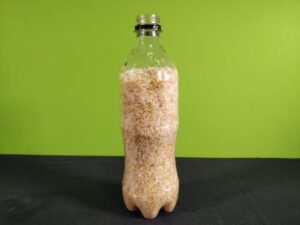
Fill the bottle with uncooked rice.
-
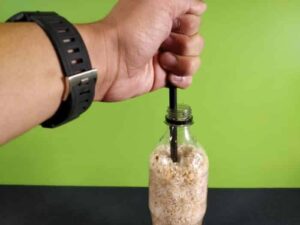
Plunge the pencil straight down into the bottle. Try to lift the bottle just by the pencil. Doesn’t work too well…
-
Now try plunging the pencil in and out at least 30 – 40 times at different heights for compaction.
-
Can you now lift the bottle off the table just using the pencil? Why does this work?
This experiment is worth running over a large bowl to catch any mess!
Troubleshooting
Doesn’t work? Try putting the pencil into the rice at different heights each time.
-
Get the Unit of Work on Forces here!
- Push, pull
- Friction & spin!
From inertia to centripetal force, this unit covers many concepts about Newton’s Laws!
Includes cross-curricular teaching ideas, student quizzes, a sample marking rubric, scope & sequences & more

-
School science visits since 2004!
– Curriculum-linked & award-winning incursions.
– Over 40 primary & high school programs to choose from.
– Designed by experienced educators.
– Over 2 million students reached.
– Face to face incursions & online programs available.
– Early learning centre visits too!
-

The science behind it
Why Does This Happen
The Friction in Rice Experiment
The more contact between two surfaces, the greater the friction. When you push the pencil in and out of the rice, you are slowly compacting the grains and pushing the air out of the container. As the air gaps disappear, the rice grains are packed tighter and tighter against each other and the sides of the pencil.
This compaction increases the normal force—the pressure the rice exerts against the surface of the pencil. This means that more and more rice gets in contact with your pencil, which slowly but surely increases the frictional resistance. Eventually, there is so much friction that you can lift the entire rice-filled jar or bottle into the air, as the frictional forces have become greater than the downward force of gravity!
Road safety application
Friction is all about contact, something that you definitely want when it comes to your tyres! Friction allows you to transfer forces from your vehicle to the road surface, allowing you to change direction, accelerate, and brake safely.
Regularly check the condition of your tyres, ensuring that they have enough tread to disperse water (to keep the rubber in contact with the road) as well as ensuring they are inflated to the correct pressure. Over-inflated or under-inflated tyres change the contact patch with the road, which can significantly reduce the friction available when you need it most.
Variables to test
Find out more on variables here.
-
Grain Type
Try different types of rice, such as long-grain vs. arborio. Do smoother or rougher grains change how quickly the bottle can be lifted? -
Tool Diameter
Try different widths of pencils, chopsticks, or sticks. Which size provides the optimal surface area for the quickest results? -
Substrate
Is it possible to perform the same demonstration using sand or gravel in the bottle? How does the size of the particles affect the “grip”?

Teacher's note
Curriculums change, and so does the way you implement them in your classroom. Please use your own experience and knowledge of your students to use these resources to best effect for student learning.
Still want the curriculum links?
Here are the suggested links:
Australian Curriculum (ACARA) Science:
NSW Science syllabuses:
Victorian Curriculum Science:
Want this experiment — and many more — running in your classroom?
Have us visit your school — every student gets three hands-on experiments in 60–90 minutes with a qualified presenter.








