
Liquid Nitrogen & Toys !
Liquid nitrogen and toys don't mix too well together! Learn about the properties of an object and grab an adult because this experiment could get dangerous!
Adult supervision for setup
Method
-
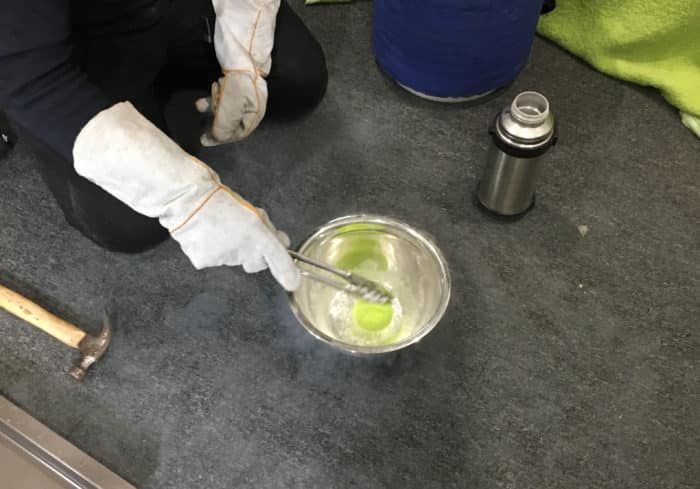
Put on the safety glasses and gloves. Place the rubber toy into the metal bowl.
-
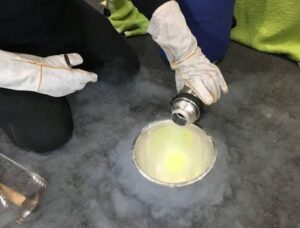
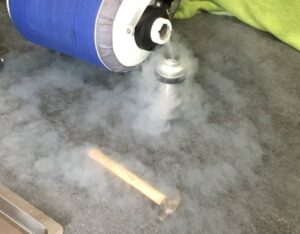
Slowly pour liquid nitrogen over the rubber toy and wait for at least 15 seconds for the rubber to cool down.
-
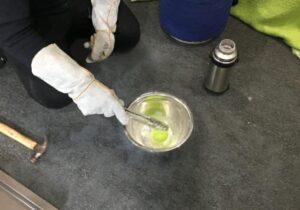
Using tongs, take the rubber toy out of the liquid nitrogen and then break with a hammer. If you are running this with onlookers nearby you should cover the toy with a cloth first before breaking the toy to stop fragments going near the onlookers.
-
Get the Unit of Work on States of Matter here!
- What are the different states of matter?
- How does heat affect the size of materials?
- How does liquid nitrogen affect materials and much more!
Includes cross-curricular teaching ideas, student quizzes, a sample marking rubric, scope & sequences & more

-
School science visits since 2004!
– Curriculum-linked & award-winning incursions.
– Over 40 primary & high school programs to choose from.
– Designed by experienced educators.
– Over 2 million students reached.
– Face to face incursions & online programs available.
– Early learning centre visits too!
-

The science behind it
Why Does This Happen?
The Science of Liquid Nitrogen and Toys
Safety Note: Do not try this at home or school unless you have formal training and the correct safety equipment for handling liquid nitrogen. At -196°C, it can cause instant frostbite.
Why does a bouncy rubber ball shatter like glass after a dip in liquid nitrogen? This transformation is a dramatic look at how temperature dictates the physical state of polymers and elastomers.
The Glass Transition Phase
Most toy balls and “squishy” toys are made of elastomers—long, chain-like molecules that are tangled together. At room temperature, these chains can slide and stretch, which gives the toy its “bouncy” or “pliable” nature.
- Extreme Cooling: When dropped into liquid nitrogen (-196°C), the thermal energy in the rubber is sucked out. The molecular chains stop sliding and lock into place.
- Glass Transition: The material enters what scientists call the glass transition phase. It loses its elasticity and becomes hard and brittle. Instead of deforming when hit, the material shatters.
- Reversibility: As the shattered pieces warm back up to room temperature, the molecules regain their energy and start sliding again. The “glass” shards turn back into squishy bits of rubber!
Variables to test
Find out more on variables here.
-
Internal Structure
Does it make a difference if the rubber toy is hollow or solid? A hollow toy has less mass to cool down, but a solid toy might shatter more violently due to internal stresses. -
Cross-Sectional Geometry
Try toys with different shapes and thicknesses. Do thin edges freeze faster and become brittle sooner than the thicker core of the toy? -
Temperature Thresholds
Compare this to cooling toys with dry ice (-78.5°C). Is dry ice cold enough to reach the glass transition temperature of the specific rubber used in the toy, or does it require the extreme cold of liquid nitrogen? -
Material Composition
Does a silicone toy behave differently than a latex or natural rubber toy? Different polymers have different freezing points for their elasticity.
To keep your experiment valid, try to leave the toys in the liquid nitrogen for the same amount of time to ensure they have reached “thermal equilibrium” (chilled all the way through) before testing their brittleness!

Teacher's note
Curriculums change, and so does the way you implement them in your classroom. Please use your own experience and knowledge of your students to use these resources to best effect for student learning.
Still want the curriculum links?
Here are the suggested links:
Australian Curriculum (ACARA) Science:
NSW Science syllabuses:
Victorian Curriculum Science:
Want this experiment — and many more — running in your classroom?
Have us visit your school — every student gets three hands-on experiments in 60–90 minutes with a qualified presenter.








