
Freezing a flower in liquid nitrogen
Make sure to get a professional for this experiment because it is gonna get wild! What would happen if you poured liquid nitrogen on a bunch of flowers?
Adult supervision for setup
Method
-
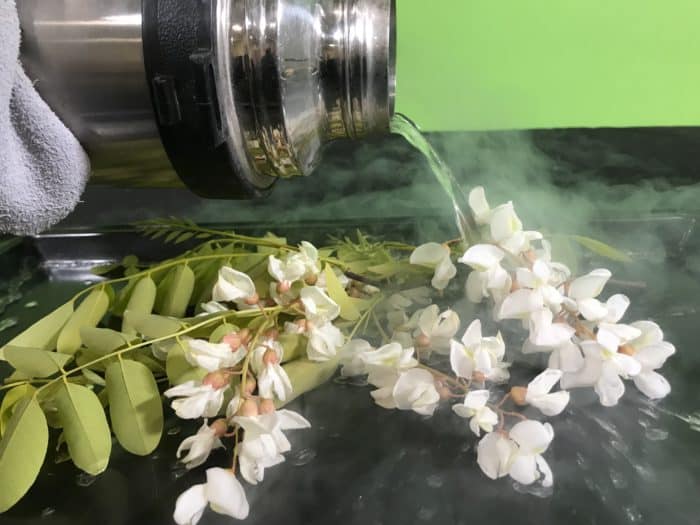
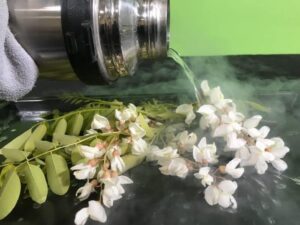
This experiment works best with large bunches of flowers or large flowers such as a rose or hibiscus. Place the flowers in a tray and carefully pour liquid nitrogen over the flowers. Read the explanation below after watching the short video on liquid nitrogen freezing a flower.
-
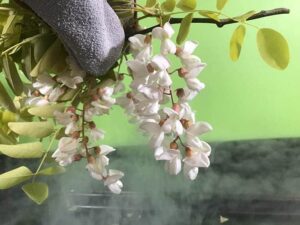
After cooling the flowers to -196°C, the flowers will retain their shape but are also incredibly brittle.
-
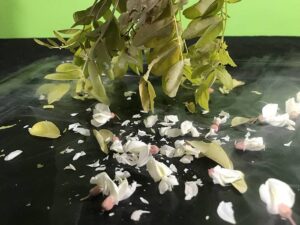
If you give the bunch of flowers a squeeze with a gloved hand, the flower petals will crumble and fall down into the tray!
-
Get the Unit of Work on States of Matter here!
- What are the different states of matter?
- How does heat affect the size of materials?
- How does liquid nitrogen affect materials and much more!
Includes cross-curricular teaching ideas, student quizzes, a sample marking rubric, scope & sequences & more

-
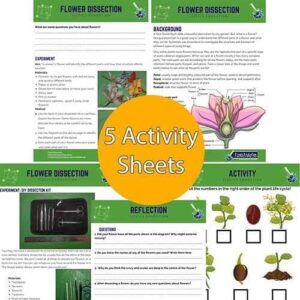
Go further – buy 5 x student activity sheets as extension worksheets.
This student science booklet has been created by experienced science educators from the Fizzics Education team.
Use these student worksheets as blackline masters for your science class!

-
School science visits since 2004!
– Curriculum-linked & award-winning incursions.
– Over 40 primary & high school programs to choose from.
– Designed by experienced educators.
– Over 2 million students reached.
– Face to face incursions & online programs available.
– Early learning centre visits too!

-

The science behind it
Why Does This Happen
Liquid nitrogen has a temperature of -196°C. It is so cold that it freezes the water inside the plant cells quite easily. When it has warmed up, the flower becomes quite slimy as some of the cells have broken apart (lysed) and the liquid water inside is able to flow easily. The flower petals have effectively lost their structure. Try this experiment with lettuce leaves or a banana too!
Applications
Freezing flowers using liquid nitrogen is one way that cut flowers can be preserved through freeze-drying. By rapidly cooling the flowers, the ice crystals inside the cells do not get large enough to break the cell walls (thereby retaining the flower structure). Once the flowers are frozen solid, the moisture within the flowers is then carefully removed using a vacuum pump which causes the solid ice to sublimate into a gas which the vacuum pump then slowly moves to another chamber. Through this technique, the flowers have their water removed so that the colours remain without liquid water inside the plant. A lack of water means that the colours do not degrade due to chemical reactions that are helped by the presence of water. Once the flowers are freeze-dried, they can be returned to normal room temperatures and placed on display!
Classroom activity sheets for this experiment
Create, reflect & extend!



Teacher's note
Curriculums change, and so does the way you implement them in your classroom. Please use your own experience and knowledge of your students to use these resources to best effect for student learning.
Still want the curriculum links?
Here are the suggested links:
Australian Curriculum (ACARA) Science:
NSW Science syllabuses:
Victorian Curriculum Science:
Want this experiment — and many more — running in your classroom?
Have us visit your school — every student gets three hands-on experiments in 60–90 minutes with a qualified presenter.








