
Gummy bear osmosis
The gummy bear osmosis experiment is perfect for variable testing! Learn how to design a simple kitchen chemistry activity that explores how water moves.
Adult supervision for setup
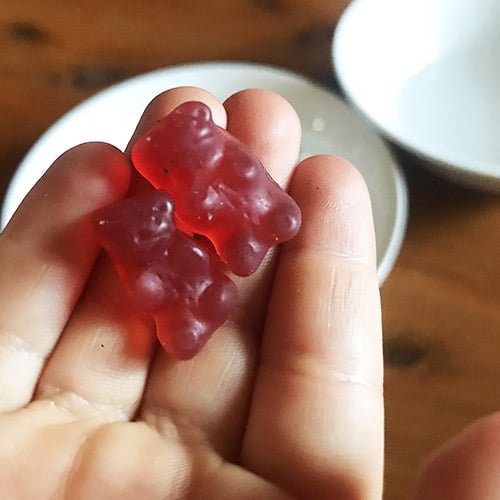
You will need
- A packet of gummy bears
- Salt
- At least two bowls
- Water
- Optional: sugar, stopwatch and either measuring scales or a ruler
Method
-
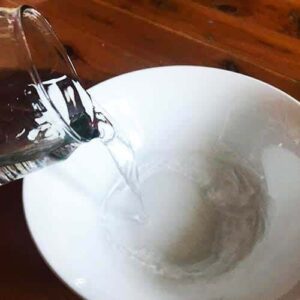
Pour the same amount of water into each of your bowls. You’ll want enough water to be able to immerse your gummy bears in this activity.
-
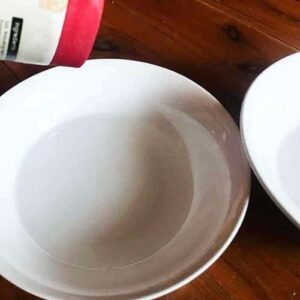
Add salt to one of your bowls of water and leave the other with just plain water. You could also make another bowl with sugar added to it too as an extra experimental test.
-
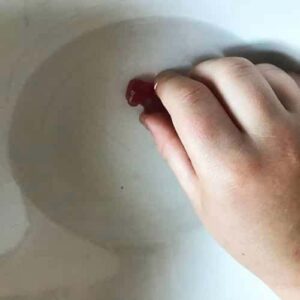
Place a gummy bear into each of the bowls. Keep a gummy bear aside as a control for measuring against later. Now it’s time to wait!
-
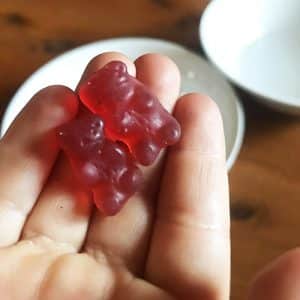
Over time you’ll find that one of your gummy bears will start to swell. How big can the gummy bear get? That’s up to you to find out!
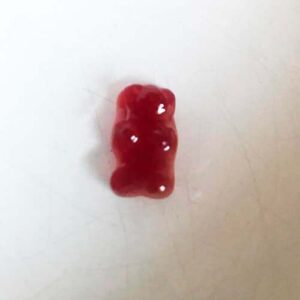
-
Look at the difference! Do you know why this worked? Read below!
-
Get the Unit of Work on Water Science here!
- Explore the water cycle
- Learn about cohesion, adhesion & capillary action
- From water currents to floatation, join us to explore water science!
Includes cross-curricular teaching ideas, student quizzes, a sample marking rubric, scope & sequences & more

-
School science visits since 2004!
– Curriculum-linked & award-winning incursions.
– Over 40 primary & high school programs to choose from.
– Designed by experienced educators.
– Over 2 million students reached.
– Face to face incursions & online programs available.
– Early learning centre visits too!
-

The science behind it
What is happening?
The Science of Gummy Bear Osmosis
The gummy bear experiment is a classic demonstration of osmosis. This is the biological process where water molecules move from an area of high water concentration (a dilute solution) to an area of low water concentration (a more concentrated solution).
The gummy bear acts as a semi-permeable membrane. Its gelatin structure allows tiny water molecules to pass through, but it traps the larger sugar and protein molecules inside. Because the gummy bear is essentially a “solid” block of sugar and gelatin, the concentration gradient between the bear and the plain water is very high, causing the bear to swell significantly as water rushes in.
In saltwater, the effect is different. Because the surrounding water already contains dissolved salt, the difference in water concentration is smaller. The gummy bear won’t swell as much because the system reaches equilibrium (where the water concentration inside and outside the bear is the same) much sooner.
Osmosis Vocabulary
Hypertonic Solution
A hypertonic solution has a higher concentration of solute (salt or sugar) than the inside of a cell or gummy bear. In this environment, water moves out of the object, causing it to shrink or look wrinkled.
Isotonic Solution
An isotonic solution has an equal concentration of solute compared to the inside of the object. Water moves in and out at the same rate, so the size remains stable and “healthy.”
Hypotonic Solution
A hypotonic solution has a lower concentration of solute than the inside of the object. Water moves into the object. This is what happened to your gummy bear in pure water, making it swell up and become fragile.
Application
Within your body, every cell membrane uses osmosis to control its internal environment. While our gummy bears are simply semi-permeable, human cells are selectively permeable. This means they use specialized “pumps” and channels to choose exactly which proteins, ions, and nutrients can enter or exit, ensuring your body stays in a state of homeostasis.
Variables to test
Find out more on variable testing here.
-
Solute Concentration
Try differing amounts of salt or sugar in the water. Can you predict the final size of the bear as the concentration in the water increases? -
Thermal Energy
What happens if you use hot, warm, or cold water? Does the speed of osmosis increase with temperature, or does the hot water simply dissolve the gelatin? -
Pigmentation
Does the colour of the gummy bear matter? Does the dye used in the bear affect how much water can be absorbed?

Teacher's note
Curriculums change, and so does the way you implement them in your classroom. Please use your own experience and knowledge of your students to use these resources to best effect for student learning.
Still want the curriculum links?
Here are the suggested links:
Australian Curriculum (ACARA) Science:
NSW Science syllabuses:
Victorian Curriculum Science:
Want this experiment — and many more — running in your classroom?
Have us visit your school — every student gets three hands-on experiments in 60–90 minutes with a qualified presenter.








