
Handy Movement
Want to know how our hands work? Lucky for you this handy movement science experiment teaches you how tendons and muscles are used to move our body!
Adult supervision for setup

You will need
- Hand template on paper or card ( get the hand template here )
- Scissors
- Straws
- Tape or Glue
- String
Method
-
Cut out the hand template using scissors.
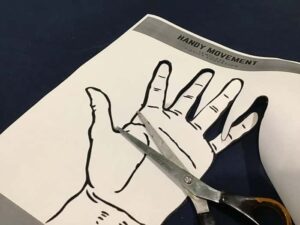
-
Bend the paper/card where the knuckles are.
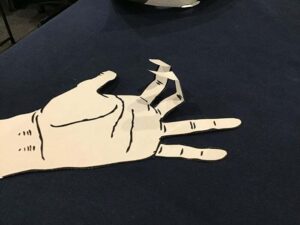
-
Cut up the straws to represent the lengths of the bones in your hand.
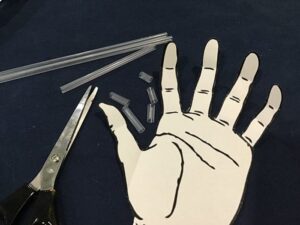
-
Glue or tape the straws in place, making sure you don’t crush the straws. Leave one cm gaps between the straws where the knuckles are to allow the fingers to bend.
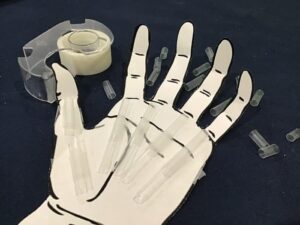
-
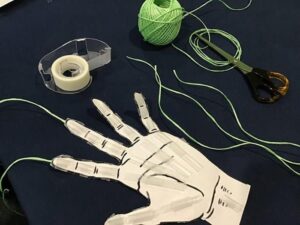
Tape 30cm pieces of string to the top of the fingers and thumb.
-
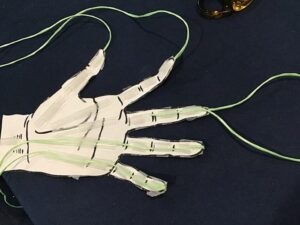
Thread the string through the straws, down each finger.
-
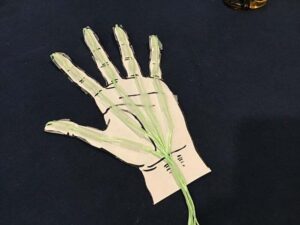
Add one straw at the wrist and thread all the strings down this straw. You can cut a slit up the straw if there isn’t enough space.
-
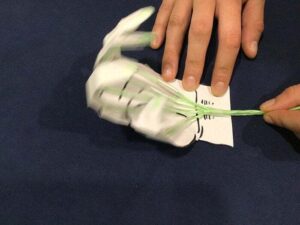
Holding the edge of the paper, gently pull on the strings from below the wrist. Your paper hand model should curl up like a real hand!
-
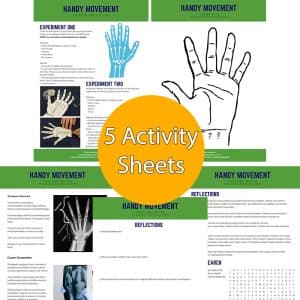
Go further – buy 5 x student activity sheets as extension worksheets.
This student science booklet has been created by experienced science educators from the Fizzics Education team.
Use these student worksheets as blackline masters for your science class!

-
School science visits since 2004!
– Curriculum-linked & award-winning incursions.
– Over 40 primary & high school programs to choose from.
– Designed by experienced educators.
– Over 2 million students reached.
– Face to face incursions & online programs available.
– Early learning centre visits too!
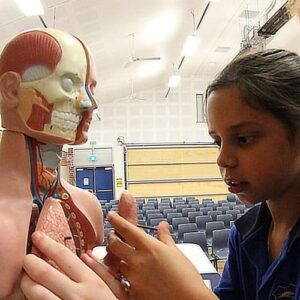
-

-
Get the Unit of Work on the human body here!
- Learn about the major body systems
- Dive into the five senses
- How does digestion, respiration, circulation and many other processes work and more!
Includes cross-curricular teaching ideas, student quizzes, a sample marking rubric, scope & sequences & more

The science behind it
What is Happening?
Hand model with string, straw and cardboard
The human hand is a complex masterpiece of engineering. Each hand contains 19 bones, plus another 8 in your wrist. The three bones in each finger and two bones in each thumb are called phalanges. These connect to the metacarpals, which are the five bones that make up the palm of your hand.
The bones of the hand provide both structural support and incredible flexibility. They are divided into three categories:
- Carpal bones: Located in the wrist, these are eight irregularly shaped bones that allow for complex rotation.
- Metacarpals: There are five metacarpals in the palm, each providing the base for a finger or thumb.
- Phalanges: These are the distal bones furthest from the arm. Each finger has three phalanges, while the thumb only has two.
A tendon is a fibrous connective tissue that attaches muscle to bone. Interestingly, there are actually no muscles inside your fingers! Instead, the muscles that control your fingers are located in your palm and your forearm. These muscles pull on the tendons, which act like cables to move your fingers.
In this experiment, the twine represents the tendons and the straws represent the tendon sheaths. These sheaths act like a pulley system, keeping the tendons tight against the bone so that when the muscle pulls, the finger curls efficiently rather than the tendon just “bowstringing” away from the hand. Look at the back of your hand as you wiggle your fingers; you can actually see these tendons sliding beneath your skin!
Variables to test
Find out more on variables here.
-
Grip Strength
Can you construct this hand model so that it can hold a physical weight, like a cup or a pencil? What is the maximum load it can “pinch”? -
Anatomy Placement
What happens if you change the positions or lengths of the straws? Does the finger still curl in a natural way, or does it become harder to pull? -
Opposable Thumbs
Can you adjust the cardboard thumb to make it truly “opposable” so it can touch the tips of the other fingers?

Teacher's note
Curriculums change, and so does the way you implement them in your classroom. Please use your own experience and knowledge of your students to use these resources to best effect for student learning.
Still want the curriculum links?
Here are the suggested links:
Australian Curriculum (ACARA) Science:
NSW Science syllabuses:
Victorian Curriculum Science:
Want this experiment — and many more — running in your classroom?
Have us visit your school — every student gets three hands-on experiments in 60–90 minutes with a qualified presenter.








