
Make a tea bag rocket
Launch a tea bag rocket! Grab some adult help and the materials listed to make a tea bag fly. An easy experiment that looks at hot air rising!
Adult supervision for setup
You will need
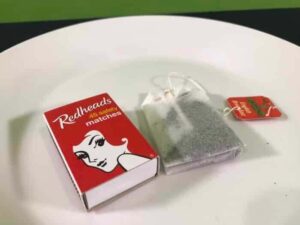
- A tea bag that is stapled (a heat-pressed sealed bag will not work)
- Matches (adult supervision is a must!)
- Non-flammable plate
Method
-
Do this experiment away from your curtains or anything else flammable. SAFETY FIRST!
-
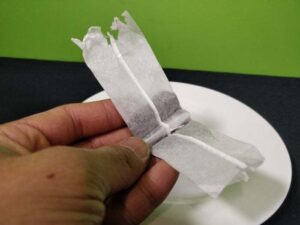
Cut the top of the bag to remove the staple.
-
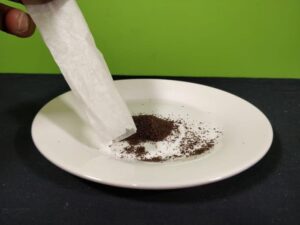
Pour the tea leaves onto the plate and flatten them out.
-
Open up the teabag so that it forms a cylinder.
Place the paper cylinder on top of the “Tea Leaf Launchpad” you’ve made in the previous step.
Ensure that you have set this up away from anything flammable!
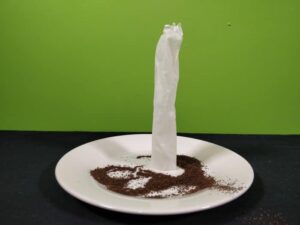
-
WITH AN ADULT light the top of the cylinder.
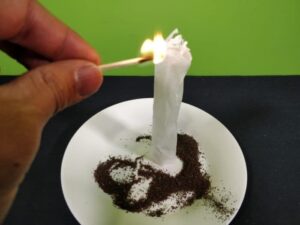
-
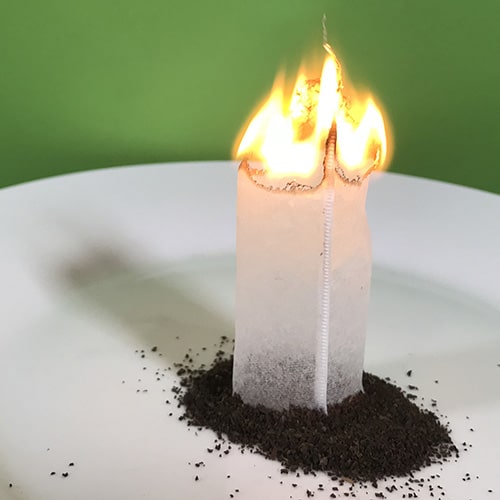
Watch the fire burn downwards. When the fire reaches the bottom your teabag rocket should lift off!
Troubleshooting
- Sometimes the teabag grabs onto the tea leaves on the plate. Try the activity again but this time gently place the tea bag on the tea leaves as lightly as possible.
- Different brands of tea bags burn differently. You may find that the tea bag burns so well that there is no leftover ash to rise upwards. If this is the case, try another brand.
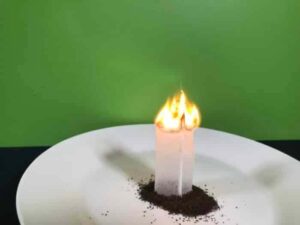
-
Get the Unit of Work on Heat Energy here!
- What actually is heat?
- How does heat move through different materials?
- How does heat change the properties of materials and more!
Includes cross-curricular teaching ideas, student quizzes, a sample marking rubric, scope & sequences & more

-
School science visits since 2004!
– Curriculum-linked & award-winning incursions.
– Over 40 primary & high school programs to choose from.
– Designed by experienced educators.
– Over 2 million students reached.
– Face to face incursions & online programs available.
– Early learning centre visits too!
-

The science behind it
Do you know why hot air rises though?
The Science of the Tea Bag Rocket
Hot air rises! In this experiment, you created a convection current. As the tea bag burns, it heats the air inside the hollow cylinder, creating a column of hot air that rushes upwards.
The rocket can only take flight once the tea bag has burned down almost completely. This is because the remaining ash becomes incredibly light—so light that the upward force of the rising hot air is finally strong enough to overcome the force of gravity. Anyone who has seen a hot air balloon in flight has seen this basic principle in action on a much larger scale.
Why does hot air rise?
Heating air adds kinetic energy to the molecules. These “excited” molecules move around much faster and push further away from each other compared to the molecules in cold, low-energy air. When molecules spread out, the substance becomes less dense.
According to the rules of buoyancy, a less dense substance will always rise above a more dense substance. This causes the hot air to “float” upward through the cooler, denser surrounding air. This process is a simple demonstration of the convection currents that drive everything from massive thunderstorms in our atmosphere to deep-sea ocean currents.
Variables to test
Find out more on variables here.
-
Material Density
Try different types of tea bags. Do they all work the same, or do some brands leave behind ash that is too heavy to lift? -
Tissue Paper Comparison
Is it possible to recreate this effect using a lightweight cylinder of tissue paper? -
Mass vs. Lift
Could you do this with a roll of standard office paper? (Hint: Consider the weight of the paper compared to the amount of heat it can generate.)

Teacher's note
Curriculums change, and so does the way you implement them in your classroom. Please use your own experience and knowledge of your students to use these resources to best effect for student learning.
Still want the curriculum links?
Here are the suggested links:
Australian Curriculum (ACARA) Science:
NSW Science syllabuses:
Victorian Curriculum Science:
Want this experiment — and many more — running in your classroom?
Have us visit your school — every student gets three hands-on experiments in 60–90 minutes with a qualified presenter.








