
Make your own Crystals
Grow salt crystals with this simple sciecne activity! Easy to setup and kids love watching their crystals grow. Find out more here…
Adult supervision for setup
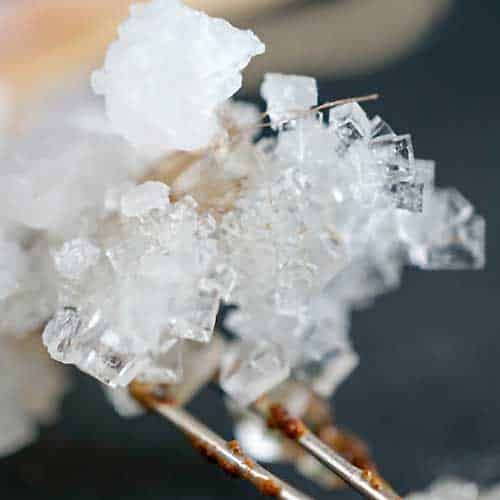
You will need
- Adult help
- Three cups of table salt
- 1L of water
- One Pencil
- 1 Paperclip
- A piece of string, cut to size
- One strong plastic or Pyrex jar
Method
-
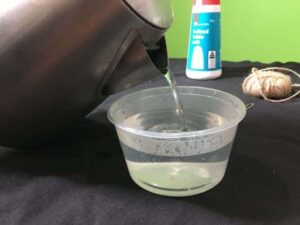
Boil the water with the help of an adult.
Pour the water into the plastic jar. Do not use glass as it may break.
-
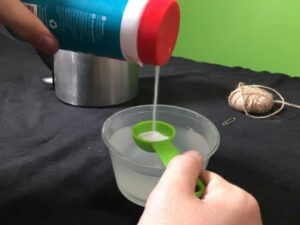
Add the salt one table spoon at a time. Allowing the salt to dissolve before you add more table spoons.
Continue adding salt until you cannot dissolve anymore and it collects at the bottom of the jar.
-
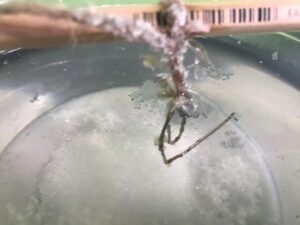
Tie one end of the string around the pencil and the other end around the paperclip.
Dangle the string into the saturated salt solution, so that the paperclip doesn’t touch the bottom of the jar or its sides.
-
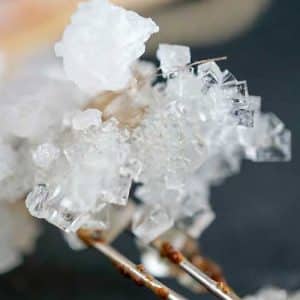
Allow the jar to sit undisturbed for one week. Salt crystals should form at the top of the string
-
Get the Unit of Work on Mixtures here!
- How can we separate mixtures?
- What are the different techniques?
- From chromatography to magnetism, join us to explore the variety of ways we can separate mixtures!
Includes cross-curricular teaching ideas, student quizzes, a sample marking rubric, scope & sequences & more
-
School science visits since 2004!
– Curriculum-linked & award-winning incursions.
– Over 40 primary & high school programs to choose from.
– Designed by experienced educators.
– Over 2 million students reached.
– Face to face incursions & online programs available.
– Early learning centre visits too!
-

The science behind it
Why Does This Happen:
The Science of Making Your Own Crystals
When you dissolve salt in boiling water, you are creating a supersaturated solution. This is a special state where the water contains more dissolved material (solute) than it would normally be able to hold at room temperature. Because hot water molecules move faster and are spaced further apart, they can “tuck” more salt molecules between them.
As the water cools, the solution becomes unstable. The water can no longer hold all that salt, and the excess starts to “fall out” of the liquid. In this experiment, the water travels up the string through a process called capillary action. This happens because the water molecules are attracted to the fibres of the string (adhesion) and to each other (cohesion), allowing the liquid to climb upward against gravity.
As the water reaches the string and begins to evaporate into the air, it leaves the salt molecules behind. These molecules begin to stack together in a very organized, repeating geometric pattern, which is what creates a crystal!
You can dive deeper into the mechanics of capillary action at USGS Water Science.
Variables to test
Find out more on variables here.
-
Solute Variety
Try using Epsom salts or sugar instead of table salt. Do different molecular structures result in different crystal shapes or growth speeds? -
Thermal Energy
Compare using cold water versus boiling water. Does the initial temperature change the total mass of the crystals you are able to grow? -
Substrate Texture
Does it matter which material you use for the crystals to form on? Compare a rough cotton string, a smooth nylon fishing line, or a wooden stick. This tests how surface area and “nucleation points” affect growth. -
Evaporation Rate
Place one experiment in a sunny window and another in a dark cupboard. Does the rate of evaporation change whether you get many tiny crystals or a few large ones?
To keep your experiment valid, remember to only change one variable at a time while keeping everything else exactly the same!

Teacher's note
Curriculums change, and so does the way you implement them in your classroom. Please use your own experience and knowledge of your students to use these resources to best effect for student learning.
Still want the curriculum links?
Here are the suggested links:
Australian Curriculum (ACARA) Science:
NSW Science syllabuses:
Victorian Curriculum Science:
Want this experiment — and many more — running in your classroom?
Have us visit your school — every student gets three hands-on experiments in 60–90 minutes with a qualified presenter.








