
Model a pandemic classroom activity
Model a pandemic using kitchen materials as a classroom activity. Its all about understanding how disease spreads through a simple visual demonstration.
Adult supervision for setup
You will need
- Red cabbage
- Kettle with boiling water (and adult help!)
- Heatproof container for the cabbage leaves
- Strainer
- Gloves
- Knife (and adult help!)
- Chopping board
- Clear cups
- Bicarbonate soda
- Water
Method
-
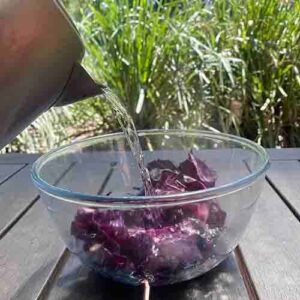
Chop the red cabbage into pieces and add them to a heatproof container. Pour boiling water over the red cabbage leaves and leave for at least 5 to 10 minutes (the more the better).
Strain the cabbage leaves and collect the warm red cabbage juice for use in the experiment.
-
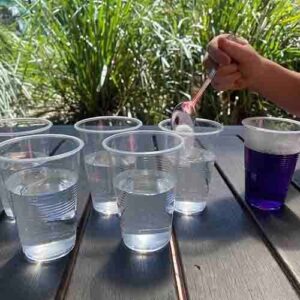
Set up 5 cups in a row. Add water to each cup and stir in a spoon of bicarbonate soda into one of them. Allow any extra bicarbonate soda to settle so others don’t see it when you do the experiment (ideally, you should dissolve all of the bicarbonate soda so no-one can see it!).
The bicarbonate soda represents the “infection”.
As a variation, you could use vinegar instead. In this case the purple cabbage juice will turn bright pink.
-
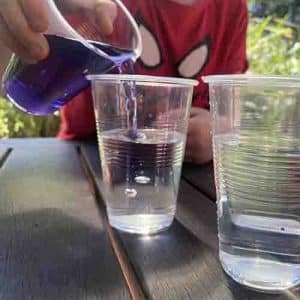
Pour the cabbage juice into the 4 water cups first. You should see the water turn a light purple colour.
The purple cabbage juice represents a health check of a patient. Light purple, in this case, equals healthy!
-
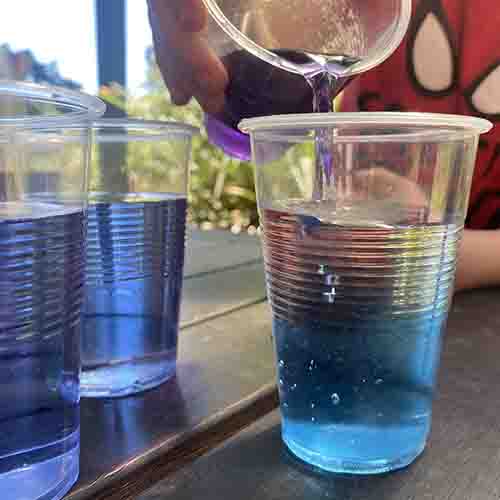
Pour the cabbage juice into the bicarbonate soda mixture… it turns a green colour! This is because of the red pigment in the cabbage, also known as anthocyanin, which responds to differences in pH. In this case, the cabbage juice turns green/aqua in the presence of an alkaline substance. (more about garden indicators here).
The green/aqua colour represents a positive test for infection.

-
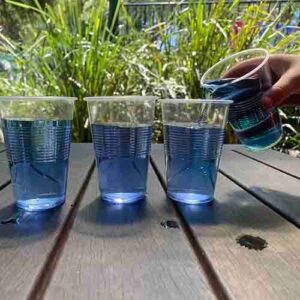
Now pour small amounts of the green bicarbonate soda solution into the other 4 cups of purple cabbage juice… they now turn green too! This shows that we can make all of the cups alkaline by moving bicarbonate soda through all of the cups.
This can be used as an analogy of how infection spreads due to contact between people.
-
School science visits since 2004!
– Curriculum-linked & award-winning incursions.
– Over 40 primary & high school programs to choose from.
– Designed by experienced educators.
– Over 2 million students reached.
– Face to face incursions & online programs available.
– Early learning centre visits too!
-

-
Get the Unit of Work on the human body here!
- Learn about the major body systems
- Dive into the five senses
- How does digestion, respiration, circulation and many other processes work and more!
Includes cross-curricular teaching ideas, student quizzes, a sample marking rubric, scope & sequences & more

The science behind it
More on pandemics
The Science of Modelling a Pandemic
In this activity, we use chemistry to model how an infectious disease can spread through a community. We use red cabbage juice, a natural pH indicator, to represent our “testing kit”. Red cabbage contains a pigment called anthocyanin, which changes its molecular structure and colour depending on the acidity or alkalinity of the liquid it is in.
- Acids (Pink/Red): When the indicator meets an acid (like vinegar), it gains extra hydrogen ions (H+), reflecting red or pink light.
- Bases (Blue/Green/Yellow): When it meets a base (like baking soda or “infected” alkaline water), it releases H+ ions or reacts with hydroxide ions (OH–), changing to a blue or green hue.
By starting with one “infected” cup containing an alkaline solution and swapping liquids between classmates, we can visually track how quickly a pathogen moves through a population. When the cabbage juice is added at the end, any cup that turns green represents a “positive” case! This demonstrates exponential growth, where a single case can lead to many infections in a very short time.
Understanding Pandemics
A pandemic is the worldwide spread of a new disease to which most people do not have immunity. For a disease to be classified as a pandemic, it must cross multiple international borders and sustain human-to-human transmission within those new regions, spreading beyond what health experts normally expect.
A major example was the COVID-19 outbreak, which was declared a pandemic by the World Health Organisation (WHO) in March 2020. Because the virus was new to humans, it spread rapidly from its origin in China to over 100 countries within months, significantly impacting global health and the economy.
Controlling the Spread
The best way to stop a pandemic is to break the chain of infection. For respiratory viruses like COVID-19 or the flu, the most effective methods include:
- Physical Distancing: Keeping at least 1.5 metres away from others to avoid respiratory droplets.
- Hand Hygiene: Washing hands thoroughly with soap for at least 20 seconds to break apart the fatty outer layer (envelope) of many viruses.
- Respiratory Etiquette: Covering your nose and mouth with a tissue or flexed elbow when coughing or sneezing to prevent aerosol transmission.
- Isolation: Avoiding close contact with anyone showing cold or flu-like symptoms.
Student Podcast: Understanding Viruses
Viruses can be confusing! In the podcast below, we explore how they move from person to person and the simple science behind keeping yourself and your community safe.

Teacher's note
Curriculums change, and so does the way you implement them in your classroom. Please use your own experience and knowledge of your students to use these resources to best effect for student learning.
Still want the curriculum links?
Here are the suggested links:
Australian Curriculum (ACARA) Science:
NSW Science syllabuses:
Victorian Curriculum Science:
Want this experiment — and many more — running in your classroom?
Have us visit your school — every student gets three hands-on experiments in 60–90 minutes with a qualified presenter.








