
Skittle science!
Make a colourful science experiment at home with Skittles! An easy and fun experiment to do at home that will teach all about chemical reactions.
Adult supervision for setup
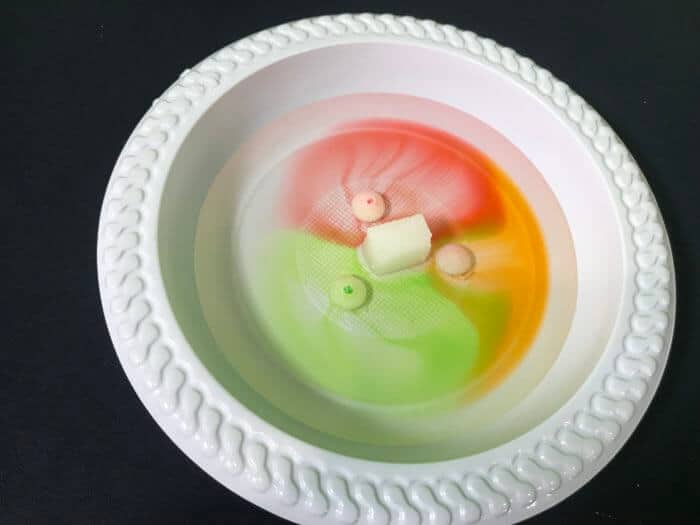
You will need
- Three different coloured Skittles
- One sugar cube, or a teaspoon of sugar
- Clear water
- One flat, shallow white plate
- A mess bucket and cleaning materials
Method
-
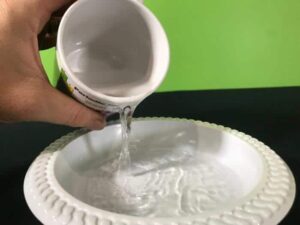
Fill the shallow plate with water to around 0.5cm deep.
-
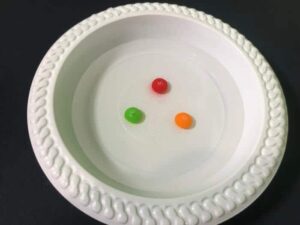
Arrange the Skittles in a triangle near the centre of the plate.
-
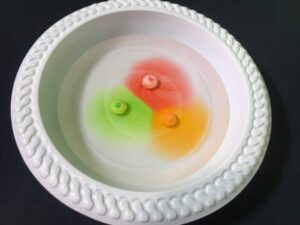
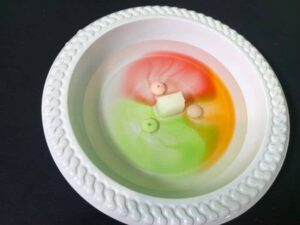
Allow the colours of the Skittles to spread through the water.
The colours should form a cross in the middle of the plate.
-
Once a coloured cross is formed, place the sugar directly in the middle of the cross.
You should see the colours start to move away from the sugar cube. Read below to find out why!
-
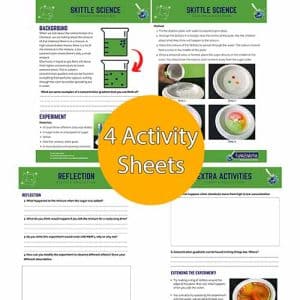
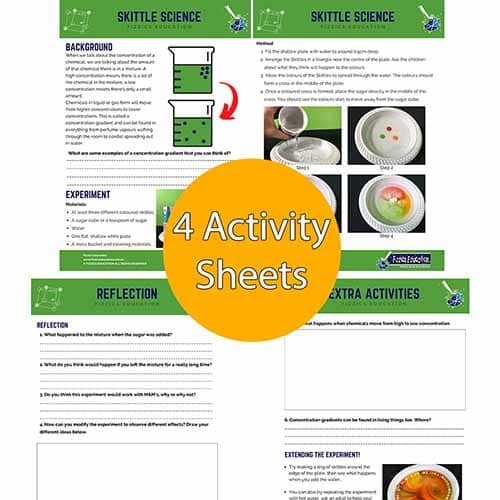
Go further – buy 4 x student activity sheets as extension worksheets.
This student science booklet has been created by experienced science educators from the Fizzics Education team.
Use these student worksheets as blackline masters for your science class!

-
Get the Unit of Work on Mixtures here!
- How can we separate mixtures?
- What are the different techniques?
- From chromatography to magnetism, join us to explore the variety of ways we can separate mixtures!
Includes cross-curricular teaching ideas, student quizzes, a sample marking rubric, scope & sequences & more
-
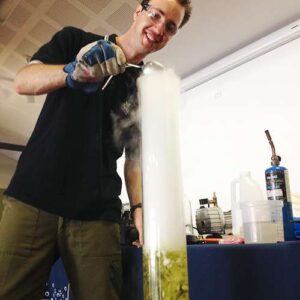
School science visits since 2004!
– Curriculum-linked & award-winning incursions.
– Over 40 primary & high school programs to choose from.
– Designed by experienced educators.
– Over 2 million students reached.
– Face to face incursions & online programs available.
– Early learning centre visits too!
-

The science behind it
Why Does This Happen?
The Science of Skittle Science!
This experiment explores a fundamental concept in chemistry: diffusion. In nature, chemicals naturally move from areas of high concentration to areas of low concentration. This is known as moving along a concentration gradient. You can see this when perfume vapours waft across a room or when cordial spreads through a glass of water.
When you add water to the Skittles, the sugar and food colouring in the shells begin to dissolve. Initially, the colours move outwards because the concentration of sugar is highest at the Skittle and lowest in the surrounding water. Interestingly, the colours often meet in the middle without mixing immediately. This is because each Skittle creates a solution with a similar density and sugar concentration; since they are “equal,” they push against each other rather than mixing.
If you add a sugar cube to the centre, you create a new area of high concentration. As the cube dissolves, it pushes outwards towards the edges of the plate where the sugar concentration is lower (the solvent is purer there). This outward flow of sugar molecules actually pushes the existing coloured water back towards the edges!
Classroom Activity Sheets
Create, reflect, and extend your learning with our student worksheets!

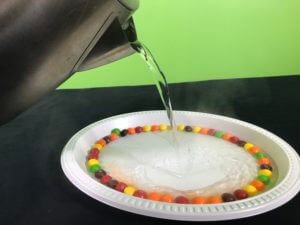
The Rainbow Effect
Try placing a ring of Skittles around the edge of a plate and adding hot water to the centre to watch a beautiful rainbow emerge!

Variables to test
Find out more on variables here.
-
Solute Competition
What happens if the water already has dissolved sugar in it? Does this slow down the rate of diffusion from the Skittles because the concentration gradient is less steep? -
Candy Coating
Try M&Ms or other hard-shelled lollies. Does the presence of chocolate or different types of glazing wax affect how quickly the dye dissolves? -
Thermal Energy
Compare hot water versus cold water. Heat increases the kinetic energy of the water molecules—does this make the rainbow form faster? -
Solvent Type
Would the experiment work with vinegar or milk? Milk contains fats and proteins that might interfere with the movement of the dyes.
Always remember to change only one variable at a time to keep your experiment a fair test!

Teacher's note
Curriculums change, and so does the way you implement them in your classroom. Please use your own experience and knowledge of your students to use these resources to best effect for student learning.
Still want the curriculum links?
Here are the suggested links:
Australian Curriculum (ACARA) Science:
NSW Science syllabuses:
Victorian Curriculum Science:
Want this experiment — and many more — running in your classroom?
Have us visit your school — every student gets three hands-on experiments in 60–90 minutes with a qualified presenter.








