
Slinky shake experiment
Get an understanding of how waves are formed and are a basis to light and sound! This experiment is simple to create and fun for everyone to try!
Adult supervision for setup
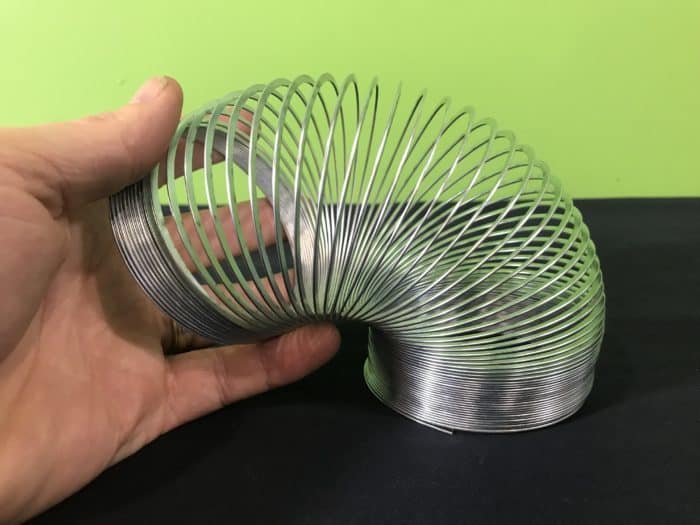
You will need
- One metal slinky
- Two people and a bit of room
Method
-
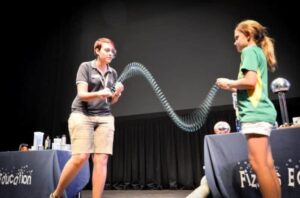
Two people hold the ends of a slinky and walk about five meters apart.
-
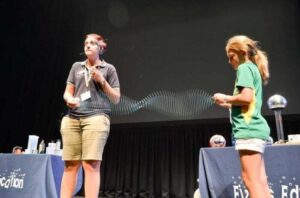
One person moves the slinky end up and down whilst the other person holds their end steady.
-
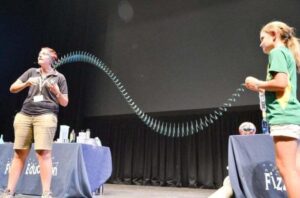
Watch the slinky – how many waves form in between the two people?
What happens if you go faster or slower? How many ways can you make the wave travel?
-
School science visits since 2004!
– Curriculum-linked & award-winning incursions.
– Over 40 primary & high school programs to choose from.
– Designed by experienced educators.
– Over 2 million students reached.
– Face to face incursions & online programs available.
– Early learning centre visits too!
-

-
Get the Unit of Work on Sound here!
- What is amplitude?
- What is frequency?
- How does sound travel and what does it look like and more!
Includes cross-curricular teaching ideas, student quizzes, a sample marking rubric, scope & sequences & more
The science behind it
Why Does This Happen?
The Science of the Slinky Shake
The “Slinky Shake” experiment is one of the best ways to visualise how energy moves through the world. Whether it’s light travelling through space or sound moving through a room, energy travels in waves. A wave is a disturbance that transfers energy from one place to another without transferring matter.
Transverse Waves
When you wobble a slinky up and down, you create a transverse wave. In this type of wave, the particles of the material move at right angles (up and down) to the direction the wave is travelling (left to right).
- Energy Transfer: Think of a “Mexican Wave” at a cricket match. The people stand up and sit down, but they don’t move around the stadium with the wave—only the energy moves!
- Standing Waves: If you shake the slinky at just the right speed, you create a standing wave. This is where some parts of the slinky move rapidly (antinodes) while other spots stay perfectly still (nodes).

Notice that the particles move up and down, but they don’t travel with the wave itself?
This illustrates the important point that most waves are an energy transfer, not a material transfer.
Think of people standing in a line and jumping up and down:

The locations that were not moving are known as nodes.
The locations that move the most are known as antinodes.

Longitudinal Waves (Sound)
Sound waves travelling through air or liquids are longitudinal waves. Instead of moving up and down, the air molecules move backwards and forwards in the same direction as the wave.
- Compression and Rarefaction: As the wave passes, it creates pulses of “contracted” air followed by “stretched” air. This represents kinetic energy being passed from molecule to molecule.
- Local Disturbance: When a subwoofer “hits” your chest, the air isn’t travelling all the way from the speaker to you. Instead, the air right in front of you is being disturbed locally as the energy propagates through it.

Check out the animation below from a single point source of sound, with the sound energy travelling radially around the sound source, similar to what happens with a boxed loudspeaker.

Variables to test
Find out more on variables here.
- Material Density
Try a plastic slinky versus a metal one. How does the weight and flexibility of the material change the speed at which the wave travels? - Harmonics
How many standing waves (loops) can you form as you speed up your shaking? This demonstrates the concept of frequencies and harmonics. - Spring Constant
What happens if you try a different type of spring, like a heavy industrial spring or a light toy spring? Does the tension change the wave’s amplitude? - Axis of Movement
If you shake the slinky side-to-side instead of up-and-down, do the waves still form? This explores polarisation in transverse waves.

Teacher's note
Curriculums change, and so does the way you implement them in your classroom. Please use your own experience and knowledge of your students to use these resources to best effect for student learning.
Still want the curriculum links?
Here are the suggested links:
Australian Curriculum (ACARA) Science:
NSW Science syllabuses:
Victorian Curriculum Science:
Want this experiment — and many more — running in your classroom?
Have us visit your school — every student gets three hands-on experiments in 60–90 minutes with a qualified presenter.








