
Soda Can Electroscope
Learn about positive and negative electrical charges and how opposites attract with this easy and fun science experiment.
Adult supervision for setup
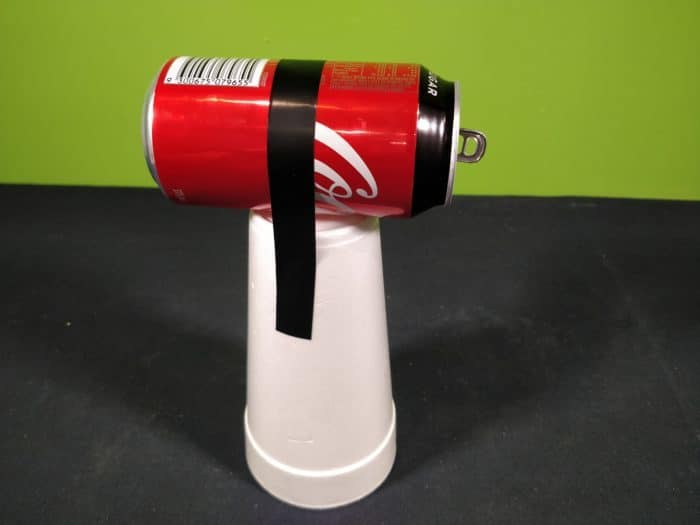
You will need
- One empty Soda Can
- Insulation Tape
- One Styrofoam Cup
- Aluminium Foil
- Scissors
- Adult supervision
Method
-
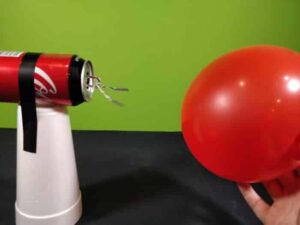
Tape the can to the styrofoam cup.
-
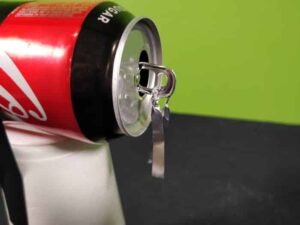
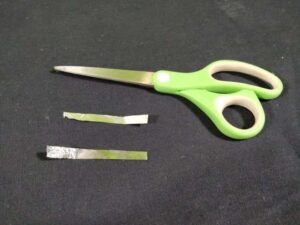
Cut two strips of aluminium foil, approximately 4cm x 0.5cm.
-
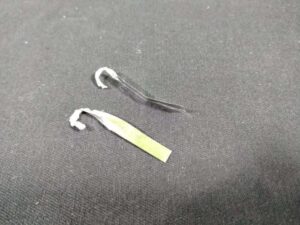
Make a hook on the end of each aluminium strip. Hang the strips off the end of the ring pull tab.
Place the electroscope near your TV. What happens to the strips? Why?
-
“A very simple electroscope!”
Try charging up a balloon by rubbing it with a piece of cloth. Bring it near the electroscope… what happens?
-
Get the Electricity & Magnetism Unit of Work here!
- How does electricity actually flow?
- What makes magnets become magnetic?
- Why is there electromagnetism and what does this tell us about electricity & magnetism?
- From series & parallel circuits to conductors & insulators, there’s a lot to explore & learn!
Includes cross-curricular teaching ideas, student quizzes, a sample marking rubric, scope & sequences & more.

-
School science visits since 2004!
– Curriculum-linked & award-winning incursions.
– Over 40 primary & high school programs to choose from.
– Designed by experienced educators.
– Over 2 million students reached.
– Face to face incursions & online programs available.
– Early learning centre visits too!

-

The science behind it
Why Does This Happen?
The Science of the Soda Can Electroscope
An electroscope is one of the oldest scientific instruments used to detect the presence and magnitude of an electric charge on a body. It works on the fundamental principle of electrostatics: like charges repel each other, while opposite charges attract.
How It Works: Conduction and Repulsion
When you touch a charged object to the aluminum can, the electrical charges (electrons) flow through the conductive metal and down into the lightweight aluminum foil leaves.
- Charging by Conduction: Because both leaves receive the same charge (either both positive or both negative), they immediately begin to push away from each other.
- Detecting Fields: As you bring the electroscope near other statically charged objects, like a TV screen, the leaves will move further apart or move closer together depending on the strength and polarity of the electric field.
- Discharge: If an object with an opposite charge is brought near, or if you touch the can with your finger (grounding it), the excess charge is neutralized. The leaves lose their repulsive force and hang straight down.
Electrostatic Induction
You don’t even have to touch the can to make the leaves move! Through electrostatic induction, the electric field of a nearby charged object causes the charges within the metal can to separate. For example, a negative balloon will push electrons away from the top of the can and down into the leaves, causing them to diverge even without direct contact.
Variables to test
Find out more on variables here.
- Inertia and Mass: How thick can the strips of foil be before it doesn’t work? Heavier strips require more electrostatic force to overcome gravity.
- Conductivity and Moisture: What happens if the soda can is still wet inside? Water is a conductor and can “leak” the static charge into the air or the supporting surface, preventing the leaves from charging up.
- Insulation: Can you attach the can to a metal, ceramic, plastic, or glass cup instead? The material supporting the can must be an insulator (like plastic or glass) to prevent the charge from escaping to the table.
- Humidity: Does the experiment work better on a dry day? Moist air is more conductive and will discharge your electroscope much faster than dry air.

Teacher's note
Curriculums change, and so does the way you implement them in your classroom. Please use your own experience and knowledge of your students to use these resources to best effect for student learning.
Still want the curriculum links?
Here are the suggested links:
Australian Curriculum (ACARA) Science:
NSW Science syllabuses:
Victorian Curriculum Science:
Want this experiment — and many more — running in your classroom?
Have us visit your school — every student gets three hands-on experiments in 60–90 minutes with a qualified presenter.








