
Underwater telephone
Create an underwater telephone! An easy activity that amplifies underwater sounds using simple materials. An experiment worth showing the kids!
Adult supervision for setup
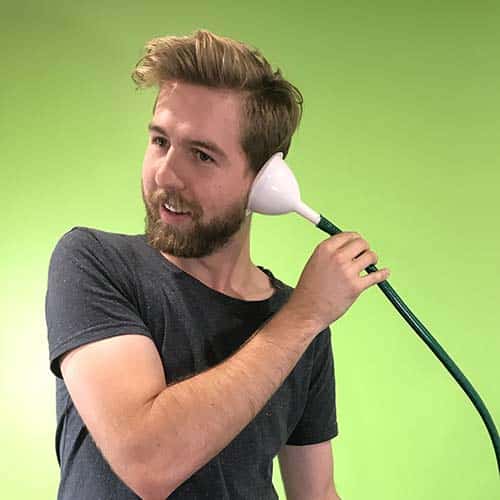
You will need
- Two plastic funnels
- Rubber tubing to fit the funnels
- One balloon
- A friend in a pool
- Adult supervision
Method
-
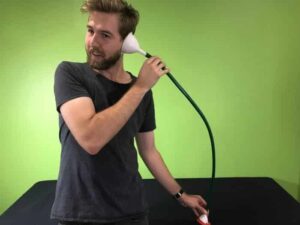
Fir both ends of the rubber tube with the funnels.
-
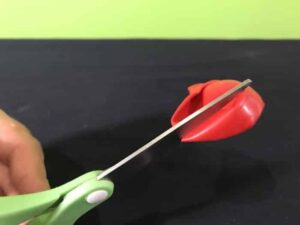
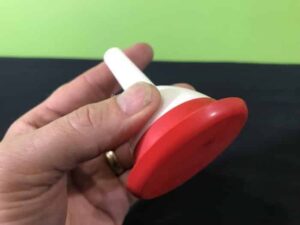
Stretch the balloons over the end of one of the funnels, making sure that it is tight across the funnels opening.
-
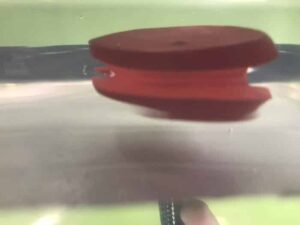
Place the funnel, with a balloon, into the pool.
-
Place the other funnel over your ear. Can you hear sounds from inside the pool? Have a friend talk to you from under the water. Can you hear them clearly?
-
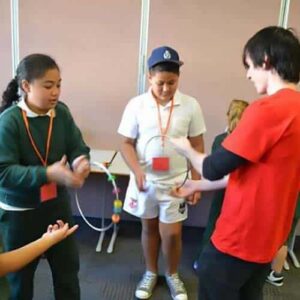
School science visits since 2004!
– Curriculum-linked & award-winning incursions.
– Over 40 primary & high school programs to choose from.
– Designed by experienced educators.
– Over 2 million students reached.
– Face to face incursions & online programs available.
– Early learning centre visits too!
-

-
Get the Unit of Work on Sound here!
- What is amplitude?
- What is frequency?
- How does sound travel and what does it look like and more!
Includes cross-curricular teaching ideas, student quizzes, a sample marking rubric, scope & sequences & more

The science behind it
Why Does This Happen?
The Science of the Underwater Telephone
Sound is essentially a pressure wave produced by vibrations. In this experiment, the stretched balloon acts like an artificial eardrum. It picks up the vibrations travelling through the water, and as the balloon skin begins to vibrate, it amplifies the sound, directing it up the tube so you can hear it clearly.
Whales and dolphins can send messages across vast distances—sometimes hundreds of kilometres—because sound travels much more efficiently through water than through air. In fact, sound travels about four times faster in water! This is because water molecules are packed much more tightly together than gas molecules in the air. This higher density allows the kinetic energy of the sound wave to be passed from one molecule to the next very quickly and with far less attenuation (energy loss).
Interestingly, because water is incompressible compared to air, it maintains the integrity of the sound wave over much longer distances. This is why the ocean can be a very noisy place if you have the right equipment to listen!
Variables to test
Find out more on variables here.
-
Acoustic Friction
Is there a limit to the length of the hose? As sound travels through the air inside the tube, it eventually loses energy. Does a longer hose make the sound quieter or more muffled? -
Surface Area & Collection
What happens if you change the funnel size? A larger funnel acts like a bigger “ear,” catching more vibrations from the water. Does this result in a louder output? -
Membrane Necessity
Can the underwater telephone work without the balloon? This tests whether you need a diaphragm to convert the water vibrations into air vibrations, or if the water can move the air in the tube directly. -
Medium Density
Does the telephone work differently in salty seawater versus fresh tap water? Salinity changes the density of the water, which theoretically affects the speed and clarity of the sound.
When testing your variables, ensure you keep your voice or the sound source at the same volume each time. This makes your experiment a fair test and your data more reliable!

Teacher's note
Curriculums change, and so does the way you implement them in your classroom. Please use your own experience and knowledge of your students to use these resources to best effect for student learning.
Still want the curriculum links?
Here are the suggested links:
Australian Curriculum (ACARA) Science:
NSW Science syllabuses:
Victorian Curriculum Science:
Want this experiment — and many more — running in your classroom?
Have us visit your school — every student gets three hands-on experiments in 60–90 minutes with a qualified presenter.








