
Wine glass gravitron
Use a wine glass to create a homemade gravitron! This experiment all about inertia vs gravity and is a great activity for looking at forces.
Adult supervision for setup
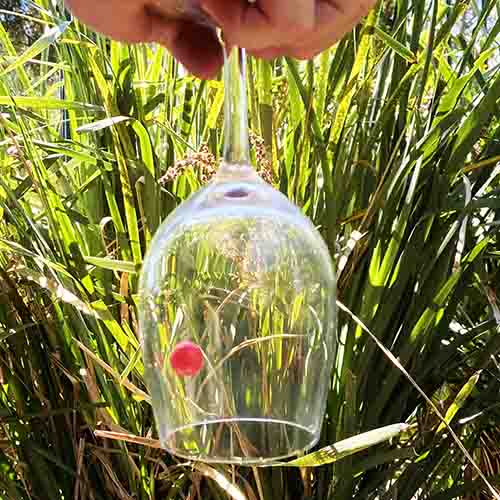
You will need
- A wine glass or a similarly shaped container
- A marble or plastic ball
Method
-
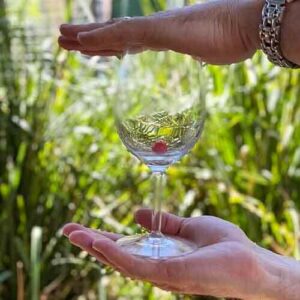
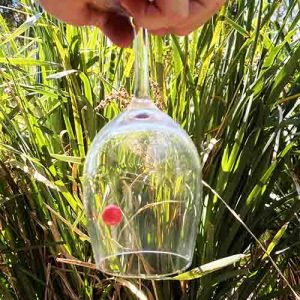
Hold the wine glass with both hands as shown and begin to swirl the ball inside the glass around and around.
-
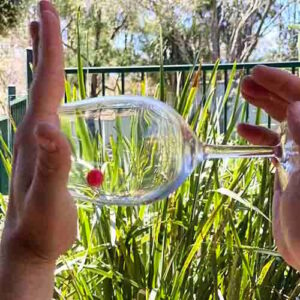
Speed up the swirling pace and turn the wine glass on it’s side.
-
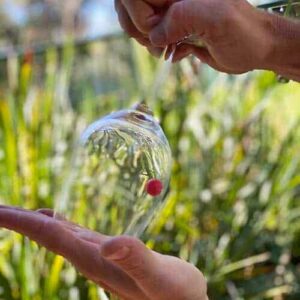
Start to move the wine glass rapidly back and forth to build up even more speed of the ball inside the glass. Now begin to tip the glass upside-down whilst still moving the glass rapidly.
You cannot slow down now!
-
Completely turn the wine glass upside-down whilst still moving the wine glass back and forth rapidly. If you’ve got it right, the ball will continue to speed around and around the glass without falling out!
-
Get the Unit of Work on Forces here!
- Push, pull
- Friction & spin!
From inertia to centripetal force, this unit covers many concepts about Newton’s Laws!
Includes cross-curricular teaching ideas, student quizzes, a sample marking rubric, scope & sequences & more
-
School science visits since 2004!
– Curriculum-linked & award-winning incursions.
– Over 40 primary & high school programs to choose from.
– Designed by experienced educators.
– Over 2 million students reached.
– Face to face incursions & online programs available.
– Early learning centre visits too!

-

The science behind it
What is going on?
The Science of the Wine Glass Gravitron
The “Wine Glass Gravitron” is a thrilling demonstration of Newton’s First Law of Motion and the physics of circular movement. This experiment explores how forces like inertia and centripetal force interact to overcome gravity.
Understanding the Forces
Inertia is the tendency of an object to resist changes in its state of motion. According to Newton, an object at rest stays at rest, and an object in motion will continue to move in a straight line unless acted upon by an external force.
- The “Straight Line” Struggle: As you swirl the glass, the ball wants to fly off in a straight line (tangent to the circle). However, the wall of the glass gets in the way, pushing back against the ball.
- Centripetal Force: This is the “center-seeking” force. The curved walls of the glass provide this force, constantly pushing the ball toward the center and forcing it to follow a circular path instead of a straight one.
As long as you swirl the glass fast enough, the normal force (the push from the glass wall) creates enough friction and upward pressure against the curved surface to counteract the pull of gravity. This is exactly how “Gravitron” amusement park rides work—the ride spins so fast that inertia pins you against the wall, allowing the floor to drop away without you falling!
Variables to test
Find out more on variables here.
-
Mass and Momentum
Try different weights of balls (e.g., a ping pong ball vs. a marble). Does a heavier mass require more speed to stay inside the glass, or does its increased inertia make it easier to pin against the wall? -
Container Geometry
Try different shaped glasses. Can you do this with a straight-sided glass? This tests how the angle of the wall contributes to the vertical support of the ball. -
Frictional Coefficient
What happens if you change the inside surface of the glass by adding tape or a bit of oil? How does friction affect the ball’s ability to “grip” the side of the glass while spinning? -
Angular Velocity
Use a stopwatch to see how slow you can swirl before the ball falls. What is the minimum velocity required to overcome gravity for your specific glass and ball?
To ensure your experiment is a fair test, try to use the same swirling motion for each trial and only change one variable at a time!

Teacher's note
Curriculums change, and so does the way you implement them in your classroom. Please use your own experience and knowledge of your students to use these resources to best effect for student learning.
Still want the curriculum links?
Here are the suggested links:
Australian Curriculum (ACARA) Science:
NSW Science syllabuses:
Victorian Curriculum Science:
Want this experiment — and many more — running in your classroom?
Have us visit your school — every student gets three hands-on experiments in 60–90 minutes with a qualified presenter.








