
Shaving cream rain clouds
A fun science activity for kids! This is all about modelling rain falling from clouds using simple ingredients from the local shops. Kids love it
Adult supervision for setup

You will need
- Shaving cream
- A plastic cup filled with water
- A straw
- Blue food colouring
Method
-
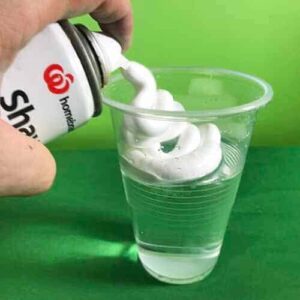
Add shaving cream to the cup of water. Fill it up over the brim!
-
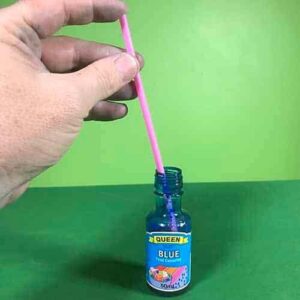
Use the straw to collect some of the blue food colouring. Place the end of the straw into the food colouring and then put your finger on top of the straw. As long as you keep your finger on the end of the straw, you should now be able to lift up the straw without the food colouring falling out.
This works due to air pressure pushing the food colouring up into the straw. An example of this can be seen in the upside-down water cup experiment!
-
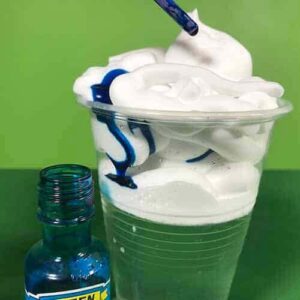
Carefully add drops of blue food colouring on top of the shaving cream
-
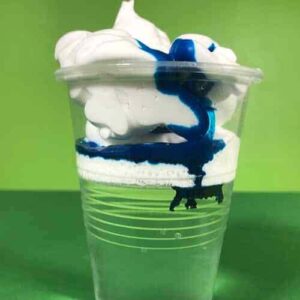
The food colouring will slowly move through the shaving cream until it reaches the water layer. At that point you’ll see the food colouring begin to stream out into the water.
As the food colouring is denser than the water, the food colouring drops to the bottom of the cup. A simple rain model!
-
Get the Unit of Work on Water Science here!
- Explore the water cycle
- Learn about cohesion, adhesion & capillary action
- From water currents to floatation, join us to explore water science!
Includes cross-curricular teaching ideas, student quizzes, a sample marking rubric, scope & sequences & more
-
School science visits since 2004!
– Curriculum-linked & award-winning incursions.
– Over 40 primary & high school programs to choose from.
– Designed by experienced educators.
– Over 2 million students reached.
– Face to face incursions & online programs available.
– Early learning centre visits too!
-

The science behind it
Why Does This Happen?
The Science of Shaving Cream Clouds
In this experiment, the shaving cream represents a cloud and the food colouring represents water vapour. Food colouring is denser than both shaving cream and water; as it moves through the foam, it eventually becomes too heavy for the “cloud” to hold, acting just like rain!
Rain is a form of precipitation. This occurs when water vapour in a cloud condenses to form drops large enough to fall. Precipitation can take many forms: rain, drizzle, hail, snow, and sleet. It is all determined by relative humidity, which is the amount of water in the air compared to what the air can actually hold at that specific temperature.
- Temperature Rise: If the temperature goes up but the amount of water stays the same, the relative humidity falls (the air has more “room” for water).
- Temperature Fall: If the temperature drops, the relative humidity rises. If it drops past the dew point, the air becomes saturated and the water must condense into liquid droplets.
If the air is cold enough (below freezing), these droplets will freeze and fall as snow or sleet. Rain is a vital part of the water cycle, where water evaporates from oceans and lakes, forms clouds, and eventually falls back to Earth to begin the process all over again.
Variables to test
Find out more on variables here.
-
Density Comparison
Try using different food colours. Do some “rain” faster than others? -
Liquid Substrates
If you place shaving cream on another liquid such as canola oil or glycerine, does the experiment still work? Consider how the density of the bottom liquid affects how the “rain” falls. -
Foam Structure
Can you use a different foam on top of the water, such as soap foam or even whipped “aquafaba” (pea foam)? How does the bubble size in the foam change the way the dye travels?

Teacher's note
Curriculums change, and so does the way you implement them in your classroom. Please use your own experience and knowledge of your students to use these resources to best effect for student learning.
Still want the curriculum links?
Here are the suggested links:
Australian Curriculum (ACARA) Science:
NSW Science syllabuses:
Victorian Curriculum Science:
Want this experiment — and many more — running in your classroom?
Have us visit your school — every student gets three hands-on experiments in 60–90 minutes with a qualified presenter.








