
Upside-down water cup
Discover the science behind the upside-down water cup experiment… just how does the water not fall out? Part of >150 free experiments on the site!
Adult supervision for setup
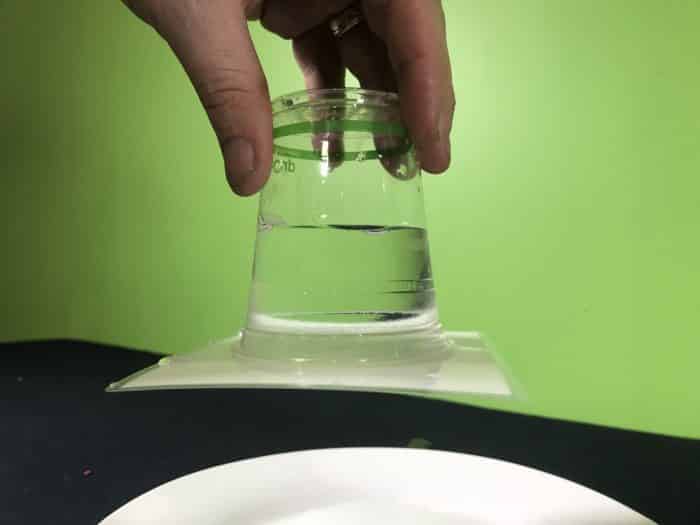
You will need
- One cup of water full to the brim with water.
- One piece of card, larger than the cup rim. You can also use paper.
- An area that you can get wet.
Method
-
Fill your cup with water (try different levels each time!).
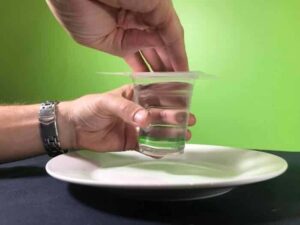
Gently place a dry card on top of the cup, making sure there is good contact over the cup rim.
If doing this inside have a tray, bowl or plate to catch the water spilling
-
Carefully turn the cup upside down, keeping upward pressure on the card with your hand.
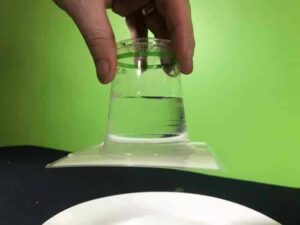
When the cup is upside down, let go of the card.
Can you explain why the water doesn’t come out?
-
School science visits since 2004!
– Curriculum-linked & award-winning incursions.
– Over 40 primary & high school programs to choose from.
– Designed by experienced educators.
– Over 2 million students reached.
– Face to face incursions & online programs available.
– Early learning centre visits too!
-

-
Get the Unit of Work on Pressure here!
Want to dive into air pressure?
Get the 60-minute video + PDFs + curriculum links for your class here!

The science behind it
Why Does This Happen?
The Science of the Upside Down Water Cup
Air molecules are constantly pushing into everything, in every direction imaginable. This is known as atmospheric pressure. To give you an idea of its strength, if you look at your thumbnail, you have the equivalent of around 1 kg of weight pushing down on that body part alone!
When you flip the cup, there is very little air inside (if any), meaning the downward force inside the cup is coming only from the weight of the water. Depending on the size of your cup, the water might weigh around 250g. However, the air below the card is pushing upwards with the full force of the atmosphere. Because the upward air pressure is significantly greater than the downward pressure of the water, the card is held firmly against the rim, keeping the water inside the cup.
Applications
Understanding how pressure works allows engineers to design incredible structures. Airlocks, for example, allow deep-sea divers to leave and enter submersible vehicles while completely underwater. By compressing the air inside the airlock to equalise with the water pressure outside, engineers can stop the ocean from rushing in. NASA even uses these principles during underwater training to simulate the vacuum of space!
Variables to test
Find out more on variables here.
-
Volume and Mass
Try progressively larger cups. How much water can the air pressure support? Try a bucket (with a very sturdy piece of card!). -
Liquid Density
Does it matter which type of liquid is used? Try liquids of different densities, like oil or salty water. Does a heavier liquid make the card fall sooner? -
Seal Integrity
What happens if you use a mesh screen instead of a solid card? (Hint: Look up “Surface Tension Water Cup” to see how water can stay in even without a card!)

Teacher's note
Curriculums change, and so does the way you implement them in your classroom. Please use your own experience and knowledge of your students to use these resources to best effect for student learning.
Still want the curriculum links?
Here are the suggested links:
Australian Curriculum (ACARA) Science:
NSW Science syllabuses:
Victorian Curriculum Science:
Want this experiment — and many more — running in your classroom?
Have us visit your school — every student gets three hands-on experiments in 60–90 minutes with a qualified presenter.








