
Make a secchi disc
Make a secchi disc to test water turbidity in your local water way. Part of over 150 free science experiments on the Fizzics Education website!
Adult supervision for setup
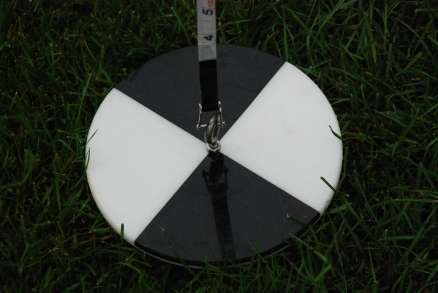
You will need
- A printer or a drawing of the secchi disk image
- A local creek, river or bay i.e. still water
- Cardboard, hole punch, metal washer and string
- A laminator would be great to preserve the disk
- Tape measure and clothes peg
- Someone with you who can swim in case of emergency.
Method
-
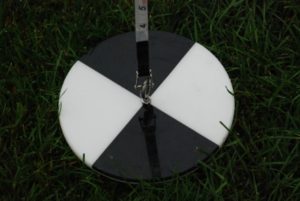
“Secchi disc”
Print or draw the secchi disk image

-
Preferably make the disk 20cm in diameter for readings to be comparable to other surveys. Laminate the disk if possible.

-
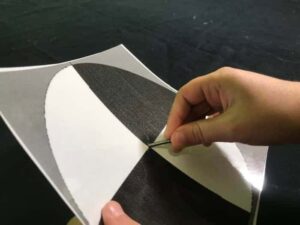
Punch a hole in the middle of the disk.
-
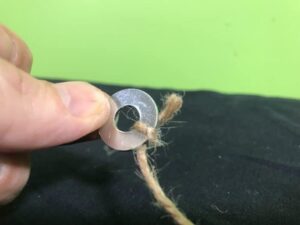
Tie the metal washer to the end of the string.
-
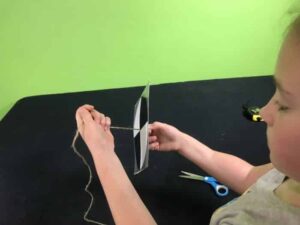
Thread the string through the disk, so that the black & white portions face up from the washer.
-
Choose a time of day that you will take readings from to make your sampling quantitative.

-
Avoid sampling during rain and up to 3 days after storms to avoid experimental error.

-
Lower the disk into each water sample & watch until it disappears.
-
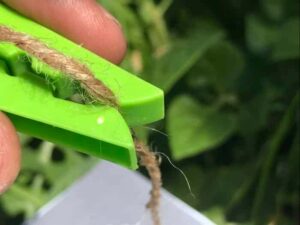
Now raise the disk until you see it again. Clip the string with the clothes peg at the surface of the water. Record how far you have to lower the disk into the water until you cant see it anymore.
This is your Secchi reading. The lower the reading, the more turbid the water; any sources of error?
-
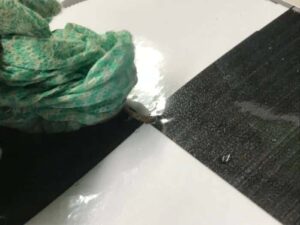
Make sure you clean the disk between each sample. Do at least 10 samples to get an average.
-
Contact your local water authority or local council environment officer to compare readings.

-
School science visits since 2004!
– Curriculum-linked & award-winning incursions.
– Over 40 primary & high school programs to choose from.
– Designed by experienced educators.
– Over 2 million students reached.
– Face to face incursions & online programs available.
– Early learning centre visits too!

-

The science behind it
More information
Turbidity is a measurement of how ‘cloudy’ the water is in a given water body. ‘Cloudiness’ in water can occur from suspended sediment, dead organic matter or algal blooms. Turbidity is measured in nephelometric turbidity units (NTU’s)which is a comparison of the amount of light scattered by the suspended particles in the water.
Aquatic and marine plants do not grow as well if light levels in water are reduced. This is a major problem, as less plants photosynthesising in water means less oxygen in the water, which in turn affects fish and other organisms needing the oxygen. Furthermore, reduced plant life in water affects the local ecosystem as animal populations that feed off the aquatic plants are reduced.
An even worse problem is that increasing turbidity can indicate high nutrient levels which are a growth factor for blue-green algae (cyanobacteria). This algae is very toxic and competitive against other microorganisms, ruining river systems such as the Murray-Darling River System.
Teacher's note
Curriculums change, and so does the way you implement them in your classroom. Please use your own experience and knowledge of your students to use these resources to best effect for student learning.
Still want the curriculum links?
Here are the suggested links:
Australian Curriculum (ACARA) Science:
NSW Science syllabuses:
Victorian Curriculum Science:
Want this experiment — and many more — running in your classroom?
Have us visit your school — every student gets three hands-on experiments in 60–90 minutes with a qualified presenter.








