
Balloon of death!
Learn about rotational forces with the coin in the balloon of death activity! A simple experiment for looking inertia and momentum
Adult supervision for setup
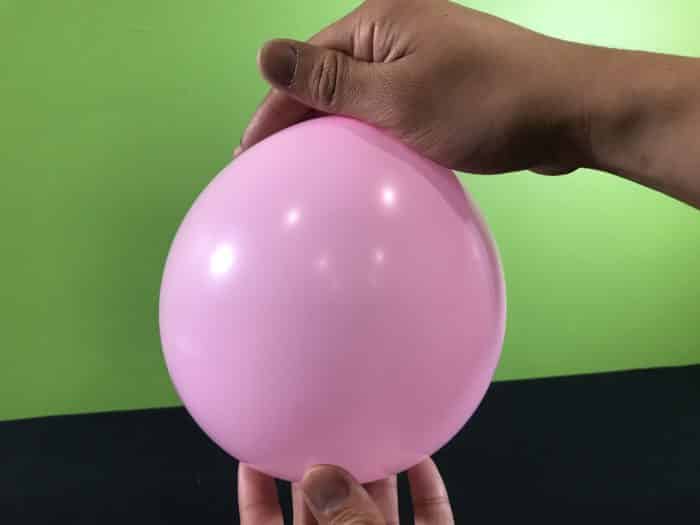
You will need
- One strong balloon
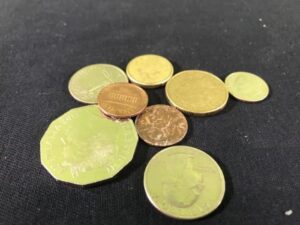
- Several round coins (try different sizes)
- A metal nut
Method
-
Squeeze a coin or nut through the opening of the balloon, make sure that the coin or nut goes all the way in.
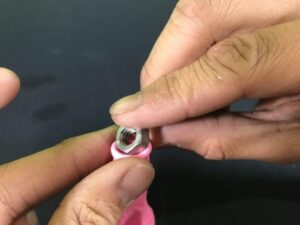
-
Blow up the balloon and tie its end.
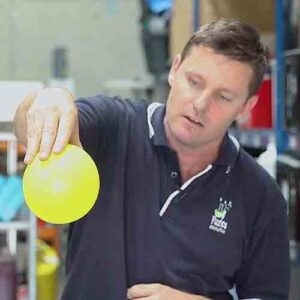
- Hold the balloon in one hand.
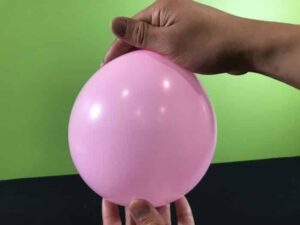
- Swirl the balloon whilst keeping it in your hand. The coin may bounce at first, but you should find that it will start to roll around inside the balloon.
- Stop swirling the balloon. You should see that the coin continues to roll, inside the balloon, for several seconds. Why?
-
Does the size of the coin matter? Repeat the experiment with different sized coins.
-
Repeat the experiment again with the metal nut. As the edges of the nut strikes the inside of the balloon the rubber will vibrate, creating a whirring sound.
Try spinning the balloon at different speeds, what happens?
-
Get the Unit of Work on Forces here!
- Push, pull
- Friction & spin!
From inertia to centripetal force, this unit covers many concepts about Newton’s Laws!
Includes cross-curricular teaching ideas, student quizzes, a sample marking rubric, scope & sequences & more
-
School science visits since 2004!
– Curriculum-linked & award-winning incursions.
– Over 40 primary & high school programs to choose from.
– Designed by experienced educators.
– Over 2 million students reached.
– Face to face incursions & online programs available.
– Early learning centre visits too!
-

The science behind it
Why Does This Happen?
The Science of the Balloon of Death
The “Balloon of Death” is a lesson in centripetal force and Newton’s First Law of Motion. This law states that an object in motion will stay in motion in a straight line unless acted upon by an external force. This property of matter is known as inertia.
Why the Coin Keeps Spinning
As you swirl the balloon, you give the coin kinetic energy. The coin wants to fly off in a straight line (tangent to the circle), but it can’t because the curved wall of the balloon is in the way.
- Centripetal Force: The balloon’s surface pushes inward on the coin, constantly changing its direction and forcing it into a circular path. This “center-seeking” force is what keeps the coin trapped against the wall.
- Friction and Gravity: Eventually, the coin slows down due to friction between the metal and the latex. As it loses speed, it lacks the necessary force to stay “pinned” against the curve, and gravity eventually pulls it to the bottom of the balloon.
This is the exact same principle used by stunt motorbikers in circular “Globes of Death” and engineers designing loops for rollercoasters! As long as the velocity is high enough, the force pushing the object against the track overcomes the pull of gravity.
Variables to test
Find out more on variables here.
-
Angular Velocity
Try different speeds of rotation. Is there a “minimum speed” required to keep the coin from falling? How does velocity affect the pitch of the sound the coin makes? -
Curvature and Radius
Does the size of the balloon matter? In a larger balloon, the curve is less sharp. Does this make it easier or harder to keep the coin spinning? -
Mass and Friction
What happens if you use different coins? A heavy coin has more inertia, but it also creates more friction. Which coin stays spinning the longest? -
Surface Texture
What if the inside of the balloon is slightly dusty or oily? How does the coefficient of friction change the energy loss of the spinning coin?
To keep your experiment valid, try to hold the balloon at the same angle for every test, as tilting it changes how gravity interacts with the coin’s path!

Teacher's note
Curriculums change, and so does the way you implement them in your classroom. Please use your own experience and knowledge of your students to use these resources to best effect for student learning.
Still want the curriculum links?
Here are the suggested links:
Australian Curriculum (ACARA) Science:
NSW Science syllabuses:
Victorian Curriculum Science:
Want this experiment — and many more — running in your classroom?
Have us visit your school — every student gets three hands-on experiments in 60–90 minutes with a qualified presenter.








