
Make a pop pop boat
Make a pop pop boat with simple materials! Part of over 150 free science experiments on the Fizzics Education website. Find out more…
Adult supervision for setup
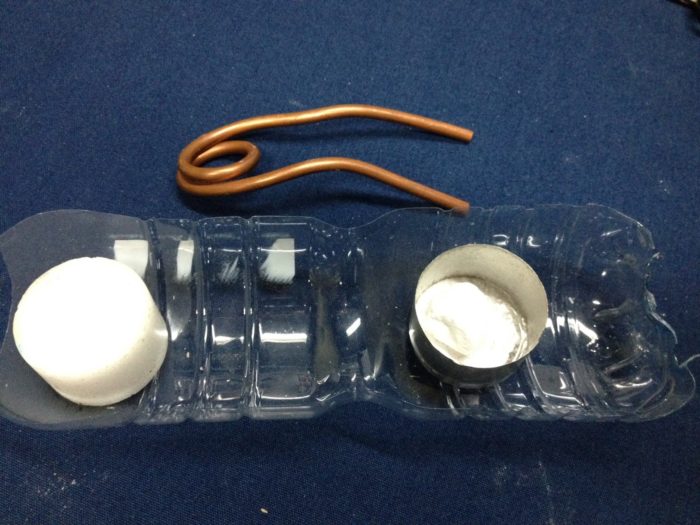
You will need
- One 600 mL plastic soft drink bottle, cut in half lengthways using scissors.
- One tea-light candle.
- Matches or cigarette lighter.
- 25 cm of 6 mm copper tubing.
- BBQ Firelighter. We've found this to be far more reliable than the candle powered versions.
- One tub of water.
- Hacksaw to cut the tubing to size
- A bench vice-to hold the tubing safely.
- A drill press with 3.5 mm drill bit-to clean out the holes.
- Two hand pliers to bend the copper tube into shape.
- Safety goggles
- Adult supervision!
Method
-
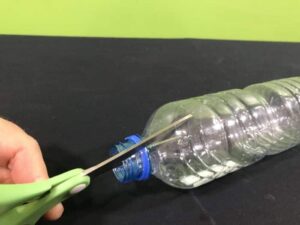
Cut your soft drink bottle in half lengthways.
-
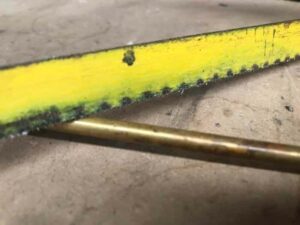
Fit your copper tube in the bench vice and use a hacksaw to cut a length of 6mm copper tubing to a 25cm length. The ends of the copper will need a small drill bit to clean out the metal burrs that can cover the opening of the tubing (we used a drill press for safety).
Use the pliers to bend the copper pipe into the shape as shown below.
-
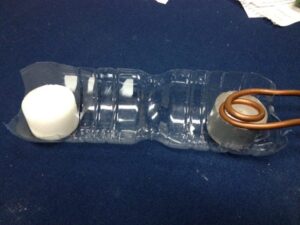
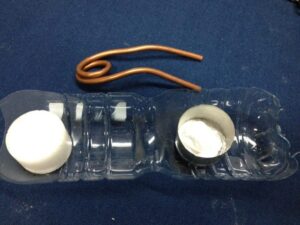
Separate the tea-light candle from its metal holder and arrange the materials in the boat as shown below. The candle acts as a counterweight for the copper tubing at the back of the boat.
-
Cut notches in the bottle so that the tubing can rest in the back of the boat.
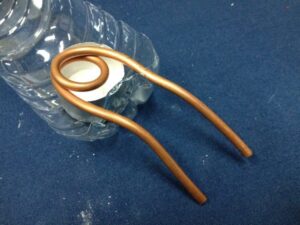
-
Add the firelighter the metal container and you’ve set the boat up!
Now put in in some water, light the firelighter and watch it go! You may need to pre-fill the tubing with water to speed the process up. Try filling the tube and then pouring most of the water out so the inside of the tube is damp.
If there are balance issues you can sort this out with additional weights (use metal nuts if needed). Make sure that the tubing is bent so that it can reach the surface of the water. You may need to make slight adjustments to this design but in essence, this is a robust science experiment that kids will love to build. Enjoy!
-
Get the Unit of Work on Heat Energy here!
- What actually is heat?
- How does heat move through different materials?
- How does heat change the properties of materials and more!
Includes cross-curricular teaching ideas, student quizzes, a sample marking rubric, scope & sequences & more
-
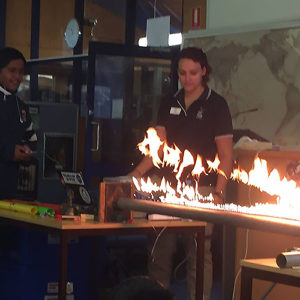
School science visits since 2004!
– Curriculum-linked & award-winning incursions.
– Over 40 primary & high school programs to choose from.
– Designed by experienced educators.
– Over 2 million students reached.
– Face to face incursions & online programs available.
– Early learning centre visits too!
-

The science behind it
Why Does This Happen?
Heat expands water. The firelighter flame heats the water inside the tubing which then pushes out of the tubes as a tiny bit of steam and heated water, producing a small amount of force to send the boat forwards. This shows the idea that objects will move in the opposite direction to a pushing force, think of Newton’s 3rd Law of Motion which states that “for every action, there is an equal and opposite reaction.”
The expelled water out of the tubing creates a temporary low-pressure area within the tubing coil. Any remaining steam inside the coiled tube condenses back into liquid water, further reducing the pressure. The water from the tub is pushed into the copper tubing by the surrounding air pressure, which is then heated and the cycle repeats!
Variables to test
- Does it matter how many coils you do for the copper tubing?
- Try different angles of the tubing into the water
- Vary the weight in the boat
- Vary the shape of the boat

Teacher's note
Curriculums change, and so does the way you implement them in your classroom. Please use your own experience and knowledge of your students to use these resources to best effect for student learning.
Still want the curriculum links?
Here are the suggested links:
Australian Curriculum (ACARA) Science:
NSW Science syllabuses:
Victorian Curriculum Science:
Want this experiment — and many more — running in your classroom?
Have us visit your school — every student gets three hands-on experiments in 60–90 minutes with a qualified presenter.








