
Benham’s Disk
Learn about Benham's Disk and how the eyes percieve colour with this fun, simple science experiment that can be done at home or in the classroom!
Adult supervision for setup
You will need
- Black pen or a printer
- Paper
- A nail
- A pencil
- Cardboard
- Some glue
Method
-
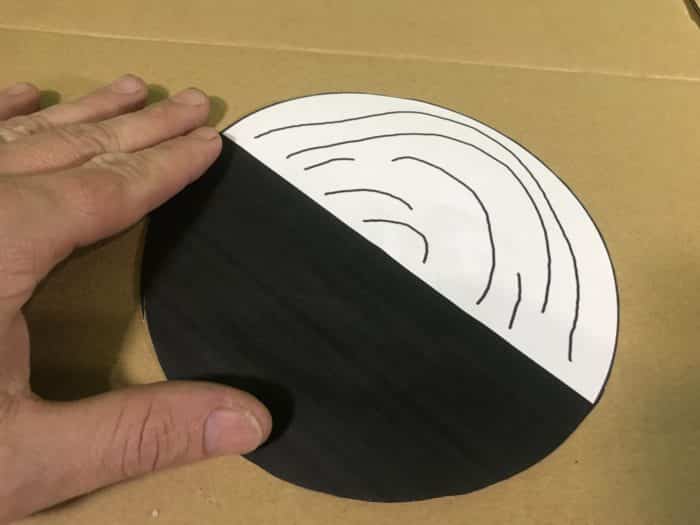
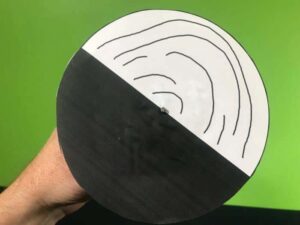
Benham’s disk example that you can make yourself.
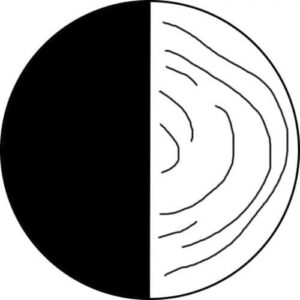
-
Glue the picture on some cardboard and allow to dry.
-
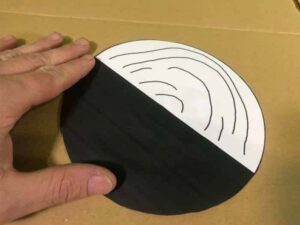
Pierce the middle of the disc with a nail.
-
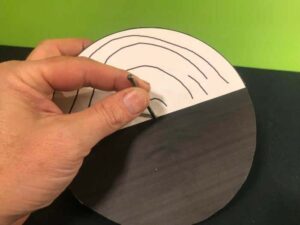
Insert the pencil through the hole and spin the disc.
-
School science visits since 2004!
– Curriculum-linked & award-winning incursions.
– Over 40 primary & high school programs to choose from.
– Designed by experienced educators.
– Over 2 million students reached.
– Face to face incursions & online programs available.
– Early learning centre visits too!
-

-
Get the Unit of Work on the human body here!
- Learn about the major body systems
- Dive into the five senses
- How does digestion, respiration, circulation and many other processes work and more!
Includes cross-curricular teaching ideas, student quizzes, a sample marking rubric, scope & sequences & more

The science behind it
Why Does This Happen?
Colour perception is achieved by three types of cells in the retina of the eye called cones.
With the three types of cones, one is more sensitive to red light, one is more sensitive to blue light and the other is more sensitive to green light. Each cone reacts at different speeds to light and keep responding for different lengths of time. You only see white when all three cones respond equally.
The alternating white and black flashes on the disk cause the cones to respond at different times and lengths, leading the brain to believe it is seeing coloured light.
Variables to test
- What is the minimum amount of black ink needed on the paper to produce the effect?
- Vary the speed of the spinning disc
- What is the minimum size of the disc needed to produce the effect?

Teacher's note
Curriculums change, and so does the way you implement them in your classroom. Please use your own experience and knowledge of your students to use these resources to best effect for student learning.
Still want the curriculum links?
Here are the suggested links:
Australian Curriculum (ACARA) Science:
NSW Science syllabuses:
Victorian Curriculum Science:
Want this experiment — and many more — running in your classroom?
Have us visit your school — every student gets three hands-on experiments in 60–90 minutes with a qualified presenter.








