
Gravitational lens demo
Learn about gravity and how it can warp spacetime with super fun, super simple experiment that can be done in the home or in the classroom!
Adult supervision for setup
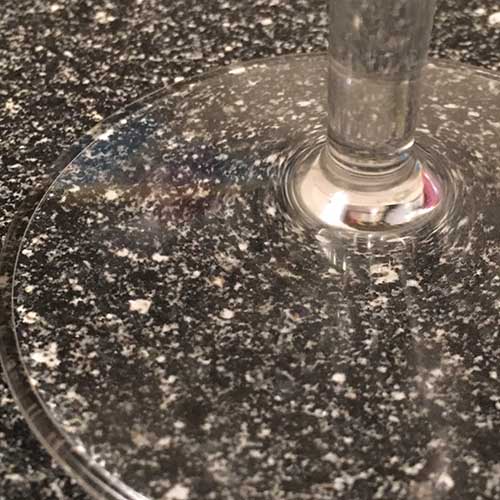
You will need
- One wine glass
- A surface with a speckled black background that simulates the night sky (we used a kitchen countertop)
Method
-
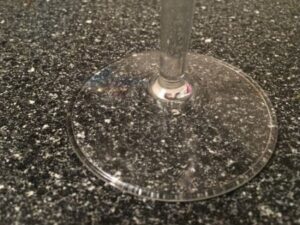
This science demonstration is so simple! Place the wine glass upright on a background that simulates the night sky. We used a kitchen countertop but you could also use a photo or poster of the night sky or even make an artwork with galaxies, nebulae and stars.
-
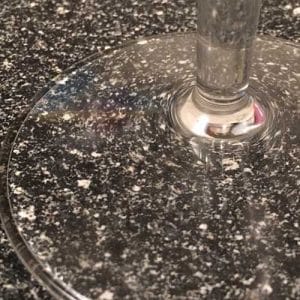
While you watch the base of the wine glass stem, slowly move the glass around on the pretend night sky backdrop. Notice how the glass distorts the images of the patterns below the glass?
This distortion is not that much different from what occurs to starlight when a very heavy celestial object passes across the front of a distant star!
-
School science visits since 2004!
– Curriculum-linked & award-winning incursions.
– Over 40 primary & high school programs to choose from.
– Designed by experienced educators.
– Over 2 million students reached.
– Face to face incursions & online programs available.
– Early learning centre visits too!
-

The science behind it
Science behind the experiment
The heavier the object, the more gravity it has. Very heavy objects such as black holes or clusters of objects such as galaxies can have a lot of gravity. When these heavy objects pass in front of a distant star, galaxy or nebulae, the light from those distant objects can be bent by the heavy object passing in front.
Why? Well, it turns out that gravity seems to be a consequence of space being warped by an object. The heavier object, the more the space surrounding the object gets warped. As light travels towards us from a distant object it can follow the bent space around the heavy object and as such the heavy object can act like a lens!
This effect means that astronomers can actually look around massive objects like galaxy clusters for the focal point of light coming from even further distant objects. Once that focal point is found you have effectively used the galaxy clusters itself as part of a giant cosmic telescope.
NB: more correctly; space & time are linked together so technically both space & time can get warped by heavy objects (called spacetime).
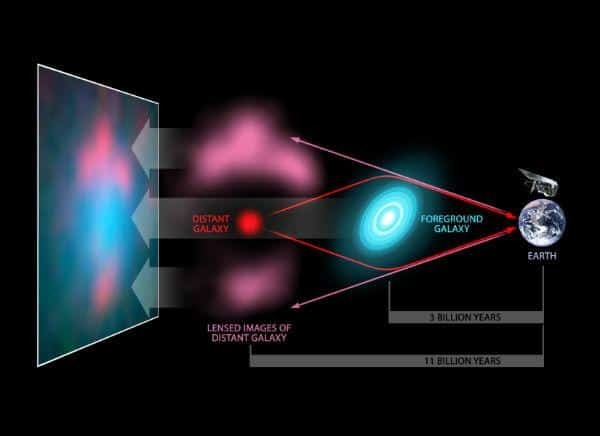
Gravitational lensing diagram by NASA. Image credit: NASA/JPL-Caltech
Teacher's note
Curriculums change, and so does the way you implement them in your classroom. Please use your own experience and knowledge of your students to use these resources to best effect for student learning.
Still want the curriculum links?
Here are the suggested links:
Australian Curriculum (ACARA) Science:
NSW Science syllabuses:
Victorian Curriculum Science:
Want this experiment — and many more — running in your classroom?
Have us visit your school — every student gets three hands-on experiments in 60–90 minutes with a qualified presenter.








