
Make a scribblebot!
Get unbalanced with a robot that draws by itself! This experiment wll teach you how to make a scribblebot that is a budnle of fun to watch and create!
Adult supervision for setup
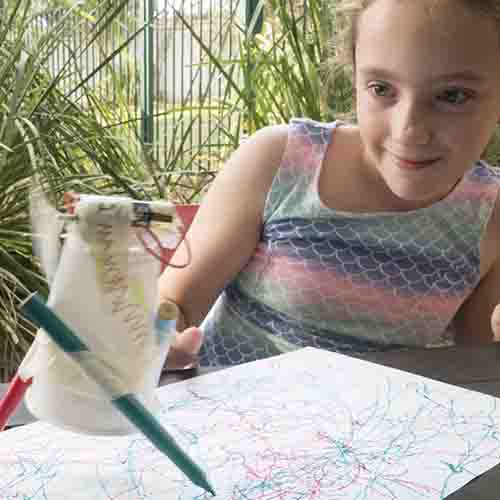
You will need
- One small DC motor that operates off 1.5 volts
- One 1.5 Volt battery.
- 10cm of insulated wire
- Three felt tip pens
- A roll of insulation tape
- Paper, scissors and cardboard
- Wire Strippers.
- Optional: battery terminal, switch, soldering iron & solder plus hot glue gun & glue stick.
- One Plastic cup
Method
-
Cut the insulated wire into two, each with a length of 3 cm. Strip off each end of the wire using wire strippers.
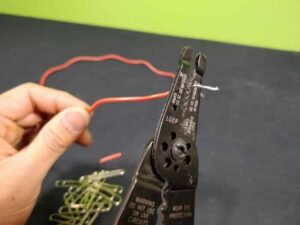
-
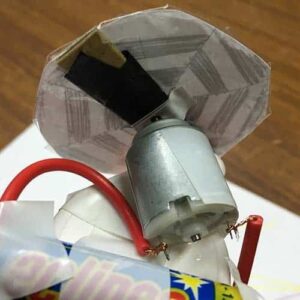
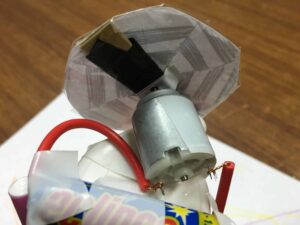
“Top of the scribble bot, showing battery connections to the motor”
Attach the wire to the motor, you can solder these connections to make them stronger.
Turn the cup upside down. Tape the battery onto the top of the cup, leaving the battery terminal ends exposed.
-
Turn the cup upside down. Tape the battery onto the top of the cup, leaving the battery terminal ends exposed.
Tape one of the insulated wires exposed ends onto a battery terminal, leaving the other wire hanging free. On the other side of the battery, add some tape that hangs loosely off the terminal so that you can tape the other insulated wire onto that wire to turn on the motor when needed. Of course, you could add a switch and a battery holder to make this easier but this design is made to minimize as much equipment as possible!
-
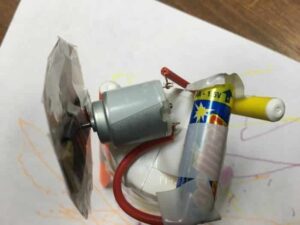
“How to attach the disc to the motor without using hot glue”
You’ll notice in the above photo that there is a disc attached to the motor shaft. You can create that by cutting out a circle of paper and attaching this to a strip of cardboard. This can now attach to the motor shaft. If you want the connection to be a bit more permanent you could use some hot glue.
-
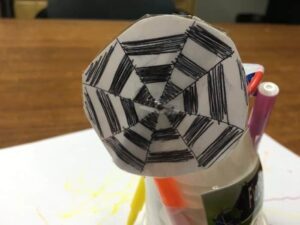
“Benham’s disc on the scribblebot”
You can draw on the front of the disc to either create a Newton colour wheel (rainbow wheel which spins to create the colour white) or perhaps a Benham’s disc (black & white wheel which seems to create colour as it spins!). In this case we put a Benham’s disc on the scribblebot.
-
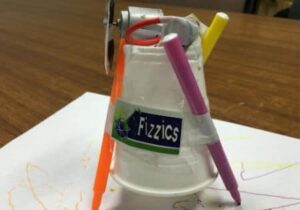
“Finished scribblebot!”
Finally, tape some felt tip pens onto the sides of the cup. You’re ready to do some scribblebot drawing!
-
Get the Unit of Work on Forces here!
- Push, pull
- Friction & spin!
From inertia to centripetal force, this unit covers many concepts about Newton’s Laws!
Includes cross-curricular teaching ideas, student quizzes, a sample marking rubric, scope & sequences & more
-
School science visits since 2004!
– Curriculum-linked & award-winning incursions.
– Over 40 primary & high school programs to choose from.
– Designed by experienced educators.
– Over 2 million students reached.
– Face to face incursions & online programs available.
– Early learning centre visits too!
-

The science behind it
Why Does This Happen
How a Scribblebot Works
This experiment takes advantage of physics by having an uneven weight spinning on a motor that is not positioned in the centre of the robot’s balance.
When the motor spins the unbalanced mass (like a piece of hot glue or a cork), it creates a rapidly shifting centrifugal force. Because the weight is lopsided, the motor vibrates intensely as it tries to pull itself in different directions. This vibration is transferred to the body of the Scribblebot. Since the motor is placed away from the robot’s metacentre, these vibrations translate into a scuttling movement, generally directed toward one side.

Application
In engineering, spinning objects that are unbalanced cause destructive vibrations. This is why when you get your car’s wheels balanced at the mechanic, small lead weights are added to the rim of the tyre so that the mass is perfectly distributed.
This balancing prevents unnecessary wear on the shock absorbers, struts, and steering assembly of the car. If the wheels weren’t balanced, the constant “Scribblebot-like” shaking would eventually shake the car apart! Proper wheel alignment and balancing make your car significantly safer and smoother to drive.
Variables to test
Find out more about variables here.
-
Motor Orientation
Try placing the motor in different positions on the Scribblebot (e.g. facing upwards vs sideways). How does the drawing pattern change? -
Mass Distribution
What happens if you add more weight to just one of the pens? Does the robot spin in circles or move in a straight line? -
Battery Placement
Does the location of the battery (the heaviest component) change how much energy is needed for the robot to start moving?

Teacher's note
Curriculums change, and so does the way you implement them in your classroom. Please use your own experience and knowledge of your students to use these resources to best effect for student learning.
Still want the curriculum links?
Here are the suggested links:
Australian Curriculum (ACARA) Science:
NSW Science syllabuses:
Victorian Curriculum Science:
Want this experiment — and many more — running in your classroom?
Have us visit your school — every student gets three hands-on experiments in 60–90 minutes with a qualified presenter.








