
Model meteorite strikes
Learn about how meteors create craters on the moon with this fun, simple experiment that can be done in the home or the classroom!
Adult supervision for setup

You will need
- One baking tray filled with plain flour
- Some instant coffee (International Roast works well due to the fine powder)
- Some rocks of different sizes
Method
-
Lightly sprinkle the instant coffee powder all over the plain flour in the tray.
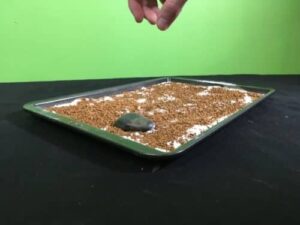
Drop the rocks of different sizes into the flour and coffee tray from different heights.
-
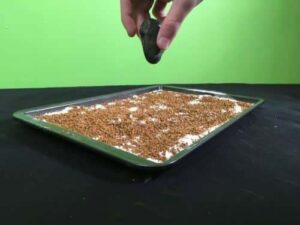
Try gently tossing the rocks from different angles, does this produce different shaped craters?
-
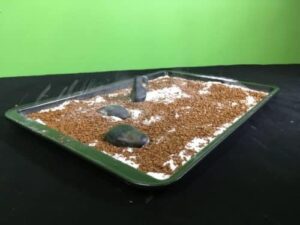
Compare the meteorite strikes you’ve made with photos of the Moon.
-
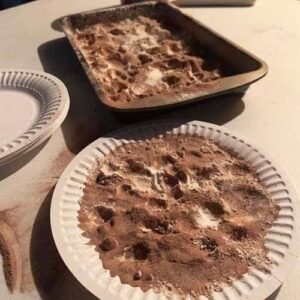
You can try finer coffee grains, cocoa powder or even brown dust too!
-
School science visits since 2004!
– Curriculum-linked & award-winning incursions.
– Over 40 primary & high school programs to choose from.
– Designed by experienced educators.
– Over 2 million students reached.
– Face to face incursions & online programs available.
– Early learning centre visits too!

-

The science behind it
Science behind the experiment
Your simple model of meteorites striking the Moon’s surface using flour, coffee and rocks really was quite close to what occurs. Why? The surface of the moon is covered in a very fine powder of rock dust which has a similar consistency to flour. This surface dust is incredibly dry, and has formed over time due to both relentless solar radiation and dramatic changes of surface temperature as the Moon spins. Dropping the rocks into the plain flour produced similar strike patterns that can be seen on the Moon, with the depressions made analogous to the craters you see as well.
The Moon has many more visible craters than the Earth purely due to the number of meteorite strikes it has sustained over time compared to Earth. As the Moon is only 1.23% the mass of Earth, it has much less gravity and is unable to hold much of an atmosphere at all (yes, whilst incredibly thin the Moon does have a tenuous atmosphere – check NASA for more details). This lack of gases in the Moon’s atmosphere means that any impacting meteor will not warm up that much compared to Earth and so largely they hit the Moon intact. We also have meteors coming into the atmosphere but less reach the ground as the smaller ones heat up quickly and explode.
Why do meteors heat up as they enter an atmosphere? It’s got to do with the compression of the gases underneath the meteor as it speeds through the atmosphere. Due to the speed of the meteor, the gases underneath cannot escape easily and so get squashed under all that kinetic energy. When you press on a gas, some of that kinetic energy from pressing the gas converts to heat energy … plus the gas molecules themselves are able to collide together more in a smaller space which also converts kinetic energy into heat. It’s that heat from gas compression under the meteor that heats meteors up as they passes through an atmosphere rather than the effects of friction from the atmosphere itself (the trapped compressed gases underneath the meteor effectively protects the meteor) .
Below is the recorded footage of the 20 meter wide meteorite that exploded over Chelyabinsk, Russia on February 15, 2013.
On Earth, we have a variety of well-known impact crater sites. From the Chicxulub crater in Mexico (prime candidate for the dinosaur extinction event 66 million years ago) through to 90km wide Acraman crater in Australia, our Earth is pockmarked with impact sites. National Geographic lists some of the major hits the Earth has sustained (at least the ones we’re aware of anyway!).
Teacher's note
Curriculums change, and so does the way you implement them in your classroom. Please use your own experience and knowledge of your students to use these resources to best effect for student learning.
Still want the curriculum links?
Here are the suggested links:
Australian Curriculum (ACARA) Science:
NSW Science syllabuses:
Victorian Curriculum Science:
Want this experiment — and many more — running in your classroom?
Have us visit your school — every student gets three hands-on experiments in 60–90 minutes with a qualified presenter.








