
Constellations in a Canister
Can the kids work out which constellation is which? This science activity helps students visualize the night sky even whilst they're in the classroom.
Adult supervision for setup

You will need
- Six small black film canister, you can often pick these up for free!
- One Nail or a wooden Skewer
- Bicarbonate Soda
- Paper
- Stick tape or glue
Method
-
Print the pictures shown or make your own on paper.
Click on the image above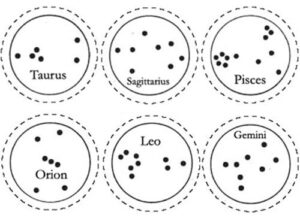
-
Cut each picture out and stick it onto the bottom of the film canister.
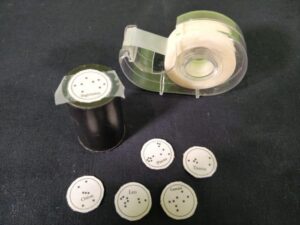
-
Pierce the middle each dot with the skewer/nail.
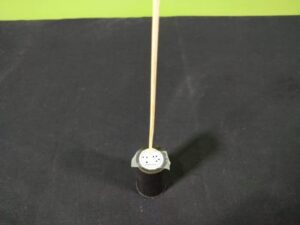
-
Look through the film canister without the lid to see the stars!
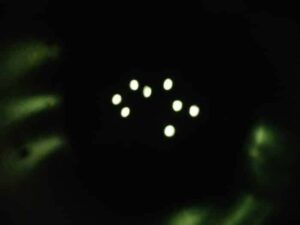
-
School science visits since 2004!
– Curriculum-linked & award-winning incursions.
– Over 40 primary & high school programs to choose from.
– Designed by experienced educators.
– Over 2 million students reached.
– Face to face incursions & online programs available.
– Early learning centre visits too!
-

The science behind it
Why Does This Happen?
Constellations are a group of stars and/or galaxies that astronomers use to map the sky. The International Astronomical Union (IAU) currently lists 88 constellations in the night, breaking up the sky into specific areas.
People are generally most familiar with the Zodiac, being those 13 constellations that lie on the ecliptic (the path that sun appears to travel through the sky). Yes, there is an extra constellation in the Zodiac on top of the well-known astrology constellations known as Ophiuchus.
Different cultures have depicted the constellations in different ways.
The IAU bases most of the constellations on the ancient Greek symbols. However, there are different stories and legends from many cultures including the Aztecs, Aborigines and American Indians; just to name just a few.
How can you find south using a constellation in the Southern Hemisphere?
Three steps…
- Have a look up tonight and find Crux, also known as ‘The Southern Cross.’ Draw an imaginary line from the top of the cross, through the bottom of the cross and keep going downwards towards the horizon.
- Look to the west and you will see two bright stars called the Pointers. Draw an imaginary line between these two stars. Find the mid-point between the Pointers on this line and then draw a perpendicular line towards the horizon.
- Where the line from Crux meets the line from the Pointers draw an imaginary line straight down to the horizon. You’ve found the direction for the South Celestial Pole.
Templates to print

Teacher's note
Curriculums change, and so does the way you implement them in your classroom. Please use your own experience and knowledge of your students to use these resources to best effect for student learning.
Still want the curriculum links?
Here are the suggested links:
Australian Curriculum (ACARA) Science:
NSW Science syllabuses:
Victorian Curriculum Science:
Want this experiment — and many more — running in your classroom?
Have us visit your school — every student gets three hands-on experiments in 60–90 minutes with a qualified presenter.








