
Create a water filter
Learn about natural and man-made water filtration systems and how they work with this fun and simple science experiment for home and the classroom!
Adult supervision for setup

You will need
- Three plastic cups
- Two water bottles (to run two different versions)
- Scissors
- A rubber band
- Old stocking material (or kitchen cleaning wipe)
- Sand and gravel with materials of different sizes
- Water and dirt
- Optional cardboard cutter (adult use only)
Method
-
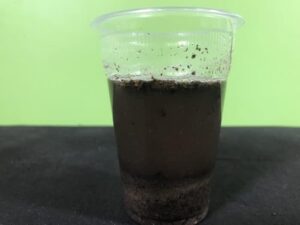
Make a cup of dirty water and set it to one side.
-
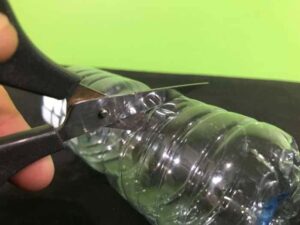
Cut each water bottle in half. You can either use the cardboard cutter to make a small cut or alternatively pinch the plastic bottle and then use the scissors to cut the bottle.
-
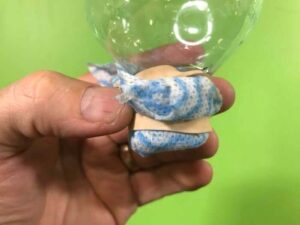
Using the rubber band, tie a piece of cut stocking or kitchen wipe onto the opening of the water bottles. Make this fairly strong as it will need to hold the weight of the sand and gravel.
-
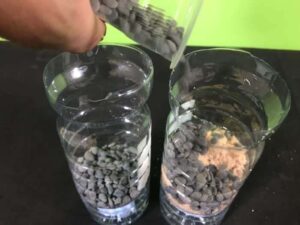
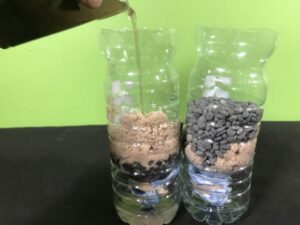
In one water bottle add sand first and then gravel, in the other bottle put the gravel in first and then the sand. The idea is to see if the order of filtering materials makes a difference to how well the water is filtered… all about variable testing!
-
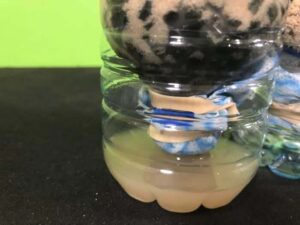
Balance each of the two bottles upside-down in the remaining cups. Pour the dirty water into each water bottle and see how well the dirty water gets filtered!
-
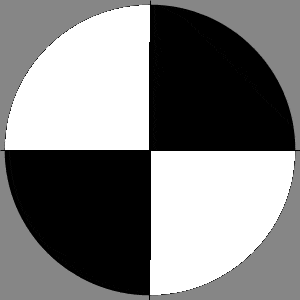
You could test how well you’ve filtered water using a secchi disc
-
Also, try measuring the pH before and after the water filter experiment… did it make any difference?
-
School science visits since 2004!
– Curriculum-linked & award-winning incursions.
– Over 40 primary & high school programs to choose from.
– Designed by experienced educators.
– Over 2 million students reached.
– Face to face incursions & online programs available.
– Early learning centre visits too!
-
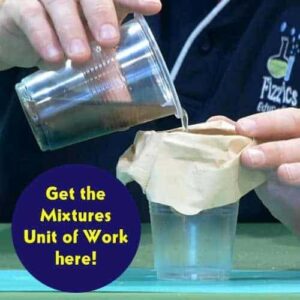
Get the Unit of Work on Mixtures here!
- How can we separate mixtures?
- What are the different techniques?
- From chromatography to magnetism, join us to explore the variety of ways we can separate mixtures!
Includes cross-curricular teaching ideas, student quizzes, a sample marking rubric, scope & sequences & more
-

The science behind it
Why Does This Happen?
How a Simple Water Filter Works
You have created a simple water filter! The sand and gravel particles act as a multi-layered sieve, trapping larger material and debris from travelling down with the water as it moves through the bottle.
Filtering like this occurs in the natural environment every day. As rainwater soaks into the ground, it passes through different layers of soil and rock. This process relies on porosity (the tiny spaces between the grains) and permeability (how easily water can flow through those spaces). While the sand traps solid particles, the chemical properties of some soils can even help neutralise certain impurities.
There are many communities that rely on underground aquifers which have accumulated over millions of years as water has filtered through the soil to the bedrock. A classic example is Australia’s Great Artesian Basin, which covers much of Queensland and South Australia, with extensions into the Northern Territory and NSW. It is one of the largest and deepest artesian basins in the world!
You can create a simple model of soil horizons that produce these natural water filters by alternating different types of sand and gravel in a clear container to see how the “clarity” of the water improves as it passes through each layer.
Variables to test
Find out more on variables here.
-
Mesh Density
Try different size sieve meshes by changing the dishcloth type at the bottom of the filter. Does a tighter weave result in clearer water? -
Particle Size
What happens if you change the size of the sand and gravel grains? Does using very fine sand slow down the filtration process too much, or does it make the water cleaner? -
Layer Order
Does it matter if the gravel is on top of the sand or vice versa? Consider which arrangement would trap the largest “bits” first to prevent the filter from clogging.

Teacher's note
Curriculums change, and so does the way you implement them in your classroom. Please use your own experience and knowledge of your students to use these resources to best effect for student learning.
Still want the curriculum links?
Here are the suggested links:
Australian Curriculum (ACARA) Science:
NSW Science syllabuses:
Victorian Curriculum Science:
Want this experiment — and many more — running in your classroom?
Have us visit your school — every student gets three hands-on experiments in 60–90 minutes with a qualified presenter.








