
Film canister rockets
Launch a film cannister rocket using vinegar & bicarb soda! It goes so high and is very effective for learning about variables. Time for blast off!
Adult supervision for setup
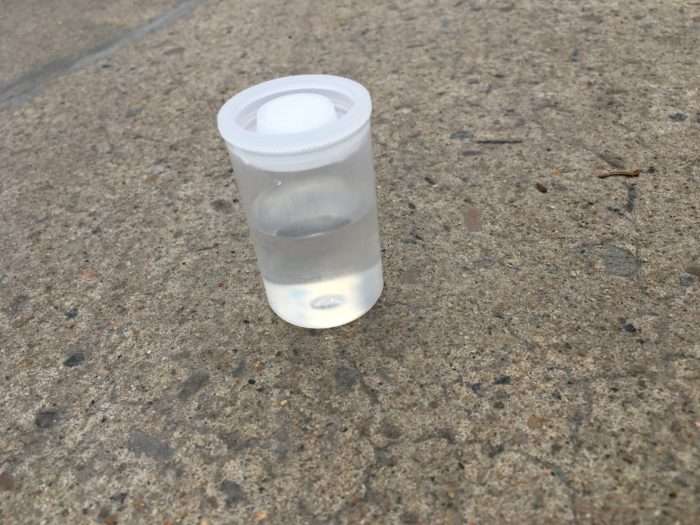
You will need
- A small film canister (Available on Amazon/eBay or from photography stores)
- Note: Clear canisters often work better as they have a well for the bicarbonate paste and a tighter lid. Alternatively, a mini M&Ms canister with the lid strap removed will work.
- Vinegar
- Bicarbonate Soda
- Small mixing bowl and spoon
- Water
- Safety goggles
Method
-
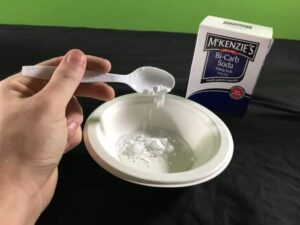
Take one teaspoon of bicarbonate soda and place it into the dish. Add 5 drops of water and mix into a thick paste.
The paste should stick to the bottom of your finger without falling off.
-
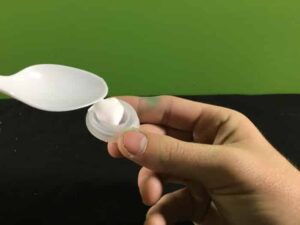
Use the spoon to pack the bicarbonate soda paste onto the underside of the film canister lid.
-
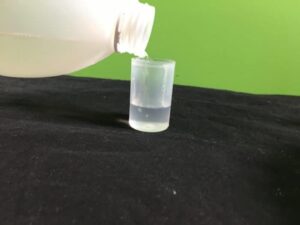
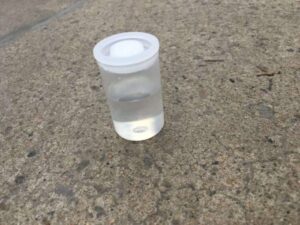
Fill your film canister halfway with vinegar. You’re ready for launch!
-
Gently clip the lid onto the canister, making sure that the whole lid is secure.
Double-check that the children are at least 5 meters back and that you are away from anything that can break above your head.
Making sure your safety goggles are over your eyes, turn the entire film canister upside down onto its lid on a flat surface outside. Stand back and watch it fly!
-
Get the Unit of Work on Forces here!
- Push, pull
- Friction & spin!
From inertia to centripetal force, this unit covers many concepts about Newton’s Laws!
Includes cross-curricular teaching ideas, student quizzes, a sample marking rubric, scope & sequences & more
-
School science visits since 2004!
– Curriculum-linked & award-winning incursions.
– Over 40 primary & high school programs to choose from.
– Designed by experienced educators.
– Over 2 million students reached.
– Face to face incursions & online programs available.
– Early learning centre visits too!

-
Want to dive into air pressure?
Get the 60-minute video + PDFs + curriculum links for your class here!

The science behind it
Why Does This Happen?
The Science of Film Canister Rockets
The film canister rocket is a classic demonstration of chemical kinetics and Newton’s Third Law of Motion. It transforms a simple acid-base reaction into a high-pressure propulsion system.
The Chemical Reaction
When you mix vinegar (acetic acid) and bicarbonate soda (sodium bicarbonate), a two-step chemical reaction occurs:
Vinegar + Bicarbonate Soda → Carbonic Acid + Sodium Acetate
The carbonic acid produced is very unstable. It immediately breaks down into liquid water (H2O) and carbon dioxide (CO2) gas. In the confined space of a film canister, these gas molecules quickly run out of room.
Newton’s Third Law: Action and Reaction
As the CO2 gas builds up, the internal pressure increases until it overcomes the friction holding the lid on. When the lid “pops,” the gas and liquid are forced downward. This provides the action.
“For every action, there is an equal and opposite reaction.”
According to Newton’s 3rd Law, the downward force of the escaping gas and the lid pushing against the ground creates an equal opposite reaction—an upward force (thrust) that sends the canister screaming into the air!
Canister rockets are always fun, but it’s the fair test you can create where the learning happens #BEEINS19 #BeInspirational @FizzicsEd pic.twitter.com/7fsKGJr1tl
— Ash (@ashsix4) March 30, 2019
Variables to test
Find out more on variables here.
-
Fuel Ratios
Change the amounts of vinegar or bicarbonate soda. Is there an optimal ratio where all the ingredients react perfectly, or does adding more “fuel” just make the rocket too heavy to lift? -
Thermal Energy
Does temperature make a difference? Use warm vinegar versus cold vinegar. Molecules move faster when they are warm—does this reaction rate increase lead to a faster launch? -
Container Volume
What happens if you use a larger container with the same amount of ingredients? Does the increased volume mean it takes longer for the pressure to reach the “popping” point? -
Aerodynamics
Add paper fins or a nose cone to your canister. How does air resistance affect the height and stability of the flight?
To ensure a fair test, try to use the same brand of canister for every launch, as the “grip” of different lids can change how much pressure is needed to pop them off!

Teacher's note
Curriculums change, and so does the way you implement them in your classroom. Please use your own experience and knowledge of your students to use these resources to best effect for student learning.
Still want the curriculum links?
Here are the suggested links:
Australian Curriculum (ACARA) Science:
NSW Science syllabuses:
Victorian Curriculum Science:
Want this experiment — and many more — running in your classroom?
Have us visit your school — every student gets three hands-on experiments in 60–90 minutes with a qualified presenter.








