
Create fog rings
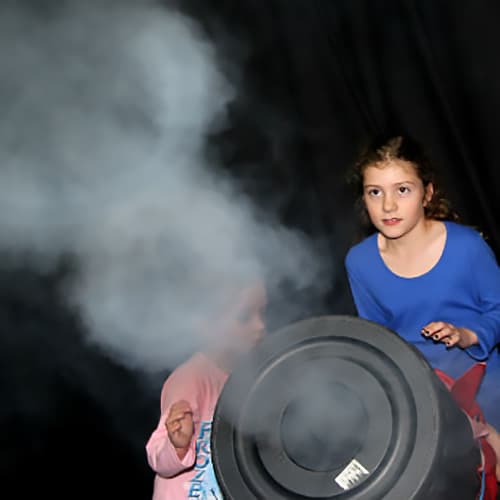
Create fog rings that wow everyone! This step by step procedure shows you how to make an awesome demonstration for kids of all ages.
Adult supervision for setup
You will need
- Adult supervision
- A bin, or bucket.
- A piece of vinyl plastic, or table cloth larger than the bin.
- A ratchet strap, gaffer tape or similar.
- A knife (adult use only)
- A fog machine and fog liquid.
Method
-
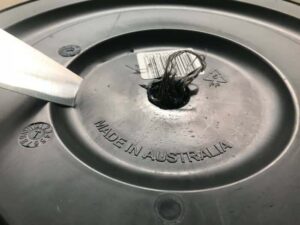
Use the knife to cut a hole out of the base of your bin, no larger than half the diameter of the bin bottom.
-
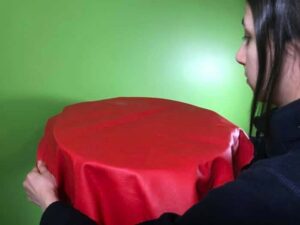
Stretch the table cloth or similar material across the larger opening of the bin. If you can get your hands on some vinyl this is the best material to use.
-
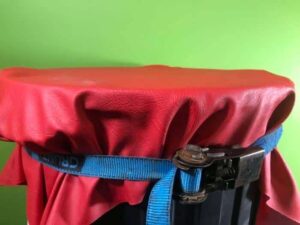
Secure the vinyl with a strap, or strong tape, to make the bin into a drum.
-
Fill the bin opening with stage fog.
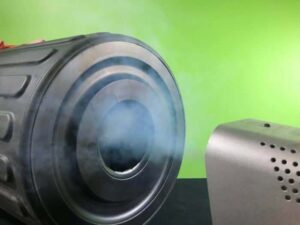
-
Hit the drum and watch the fog rings fly!
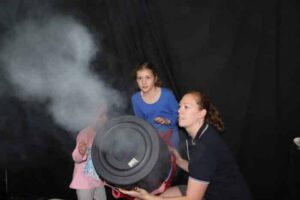
-
School science visits since 2004!
– Curriculum-linked & award-winning incursions.
– Over 40 primary & high school programs to choose from.
– Designed by experienced educators.
– Over 2 million students reached.
– Face to face incursions & online programs available.
– Early learning centre visits too!
-

-
Get the Unit of Work on Pressure here!
- Want to dive into air pressure?
- It’s all about air pressure in many ways!
From how storms form to how planes fly, this unit covers many concepts about air pressure.
Includes cross-curricular teaching ideas, student quizzes, a sample marking rubric, scope & sequences & more
The science behind it
Why Does This Happen?
Creating Giant Vortex Smoke Rings
In this experiment, a fog machine fills a drum made from a rubbish bin. Hitting the back of the drum forces a concentrated burst of air out of the hole. As this air exits, a toroidal vortex is formed due to the friction between the air and the edges of the opening.
The air hitting the sides of the hole slows down due to friction, while the air in the centre continues to move at high speed. This difference in velocity causes the air to curl back on itself, creating a rolling “donut” shape. Because the ring is spinning, it creates a stable structure that can travel across a room without dissipating.
The mathematician Daniel Bernoulli discovered that moving air has less pressure than still air. This helps maintain the fog rings; the slower, high-pressure air on the edge of the hole rushes toward the faster, low-pressure air in the centre. This pressure differential “locks” the ring together as it moves.
Essentially, low air pressure occurs when air is sped up because the energy of the molecules is being used primarily for forward motion rather than bouncing off one another. With fewer collisions, the internal pressure drops, and the surrounding, slower-moving air molecules have enough energy to “push” into that space, containing the fog into that iconic ring shape.
Want to make smaller rings?

Variables to test
Find out more on variables here.
-
Aperture Geometry
What happens if you change the shape of the hole in the bin? Does a square hole create a square ring, or does physics force it back into a circle? -
Impact Force
Does hitting the drum harder make the rings travel faster, or does too much force cause the vortex to become turbulent and break apart? -
Drum Volume
If the bin was half the size, would the rings be just as stable? Consider how much air needs to be “pushed” to create a successful vortex.

Teacher's note
Curriculums change, and so does the way you implement them in your classroom. Please use your own experience and knowledge of your students to use these resources to best effect for student learning.
Still want the curriculum links?
Here are the suggested links:
Australian Curriculum (ACARA) Science:
NSW Science syllabuses:
Victorian Curriculum Science:
Want this experiment — and many more — running in your classroom?
Have us visit your school — every student gets three hands-on experiments in 60–90 minutes with a qualified presenter.








