
How do nail chairs work?
Ever wondered how a chair of nails works? Find out! Part of over 150 free science experiments on the Fizzics Education website.
Adult supervision for setup
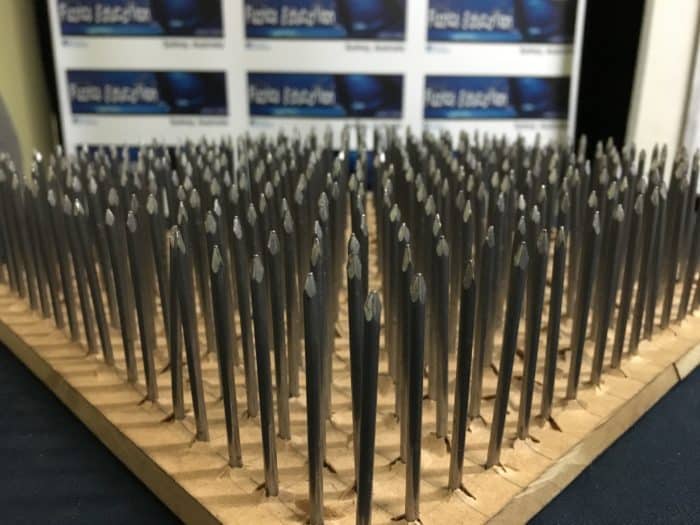
Method
-
Read below learn how the chair of nails works. DO NOT TRY THIS AT HOME.
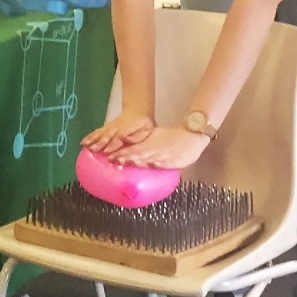
-
Get the Unit of Work on Forces here!
- Push, pull
- Friction & spin!
From inertia to centripetal force, this unit covers many concepts about Newton’s Laws!
Includes cross-curricular teaching ideas, student quizzes, a sample marking rubric, scope & sequences & more
-
School science visits since 2004!
– Curriculum-linked & award-winning incursions.
– Over 40 primary & high school programs to choose from.
– Designed by experienced educators.
– Over 2 million students reached.
– Face to face incursions & online programs available.
– Early learning centre visits too!
-

The science behind it
Why Does This Happen
The Science of the Bed of Nails
Safety Note: Do not try to replicate this. While it is based on physics, incorrect setup or movement can cause serious injury. This is a demonstration for trained professionals only.
The “Bed of Nails” is a classic physics demonstration that often looks like a magic trick or a feat of superhuman endurance. In reality, it is a perfect example of how pressure is related to force and surface area.
Pressure vs. Force
To understand why the nails don’t pierce the skin, we have to look at the formula for pressure:
P = F / A
- P = Pressure
- F = Force (the weight of the person)
- A = Total Surface Area (the tips of the nails)
When you sit or lie down on a bed of hundreds of nails, your body weight (the force) is distributed across all of those tiny points. Because the total surface area (A) is relatively large when you add up all those nail tips, the pressure (P) on any single point of your skin remains low—low enough that it doesn’t break the skin.
The Danger of “Just One”
If you were to step or sit on just one nail, your entire body weight would be concentrated on a single, tiny point. The surface area would be incredibly small, causing the pressure to skyrocket. This high pressure easily overcomes the strength of your skin, causing the nail to pierce through.
The “trick” only works because the nails are spaced closely together, ensuring that as much of your body as possible is supported by as many nails as possible.
Variables to Consider
- Nail Density: The more nails there are in the bed, the lower the pressure on each individual nail. If you were to remove half the nails, the pressure on the remaining ones would double.
- Body Position: Lying down is safer than sitting, and sitting is safer than standing. Why? Because lying down spreads your weight over the largest possible surface area.
- The “Entry” and “Exit”: The most dangerous part of the demonstration is getting on and off the bed. If you shift your weight poorly, you might momentarily put too much force on a small group of nails.

Teacher's note
Curriculums change, and so does the way you implement them in your classroom. Please use your own experience and knowledge of your students to use these resources to best effect for student learning.
Still want the curriculum links?
Here are the suggested links:
Australian Curriculum (ACARA) Science:
NSW Science syllabuses:
Victorian Curriculum Science:
Want this experiment — and many more — running in your classroom?
Have us visit your school — every student gets three hands-on experiments in 60–90 minutes with a qualified presenter.








