
Ping pong activity!
Learn about a cool theory by a guy named Bernoulli. This ping pong science experiment is simple and all you need is a ping pong ball string and water!
Adult supervision for setup
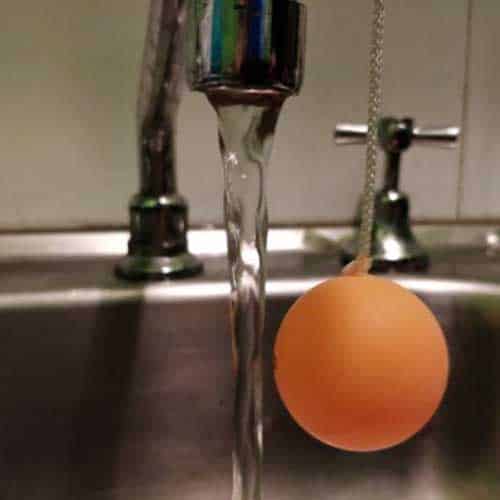
You will need
- A Ping Pong Ball
- String
- Tape
- Running water
Method
-
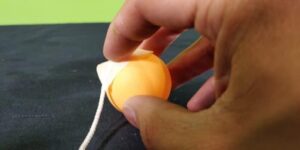
Tape the string onto the ball.
-
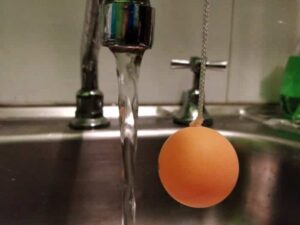
Turn on the water tap.
-
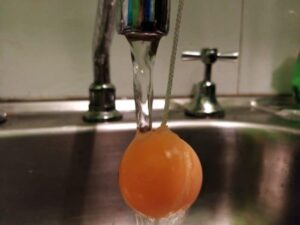
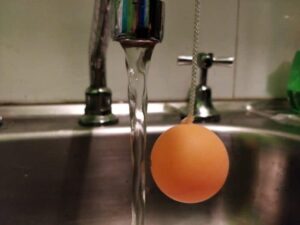
Hold the string and dangle the ping pong ball in the running water.
-
Which way does the ping pong ball move; towards or away from the water stream?
-
School science visits since 2004!
– Curriculum-linked & award-winning incursions.
– Over 40 primary & high school programs to choose from.
– Designed by experienced educators.
– Over 2 million students reached.
– Face to face incursions & online programs available.
– Early learning centre visits too!
-

-
Want to dive into air pressure?
Get the 60-minute video + PDFs + curriculum links for your class here!
The science behind it
Why Does This Happen
The Science of the Ping Pong Bernoulli Effect
This experiment is a hands-on demonstration of Bernoulli’s Principle. Daniel Bernoulli, an 18th-century mathematician, discovered a fundamental rule of fluid dynamics: as the speed of a moving fluid (like air or water) increases, the pressure within that fluid decreases.
The “Coanda Effect” and Pressure
When the water stream touches the curved surface of the ping pong ball, it doesn’t just bounce off; it “hugs” the curve. This is known as the Coanda Effect. Because the water is moving quickly over that curved surface, it creates a pocket of low pressure on that side of the ball.
- High Pressure vs. Low Pressure: The air on the “dry” side of the ball is still, meaning it is at normal atmospheric pressure.
- The Push: Nature hates a vacuum (or a pressure imbalance!). The higher-pressure air on the dry side pushes against the ball, forcing it into the low-pressure stream of water.
This same principle is what allows massive airplanes to fly! Air moves faster over the curved top of a wing than underneath it, creating low pressure on top and “lifting” the plane into the sky.
Variables to test
Find out more on variables here.
-
Fluid Medium
Try the same experiment using a hair dryer or a fan instead of water. Does the lower density of air compared to water change how strongly the ball is “pulled” into the stream? -
Flow Velocity
Vary the speed of the water stream. According to Bernoulli, the faster the fluid, the lower the pressure. Does a faster stream make the ball snap toward the water more aggressively? -
Mass and Inertia
Set up the experiment with larger, heavier balls (like a tennis ball). Is the pressure differential created by the water stream strong enough to overcome the increased weight of the ball? -
Aerodynamics and Shape
What happens if you suspend a cube-shaped block instead? Without the curved surface to trigger the Coanda Effect, does the fluid still create a low-pressure pocket, or does it just push the block away?
To keep your experiment valid, try to keep the length of the string the same for each object you test. This ensures that the only thing changing is the variable you’ve chosen!

Teacher's note
Curriculums change, and so does the way you implement them in your classroom. Please use your own experience and knowledge of your students to use these resources to best effect for student learning.
Still want the curriculum links?
Here are the suggested links:
Australian Curriculum (ACARA) Science:
NSW Science syllabuses:
Victorian Curriculum Science:
Want this experiment — and many more — running in your classroom?
Have us visit your school — every student gets three hands-on experiments in 60–90 minutes with a qualified presenter.








