
Create a rubber band racer
Ever wondered how storing and releasing energy worked? This crazy and super fun experiment teaches you how to make a rubber band racer!
Adult supervision for setup
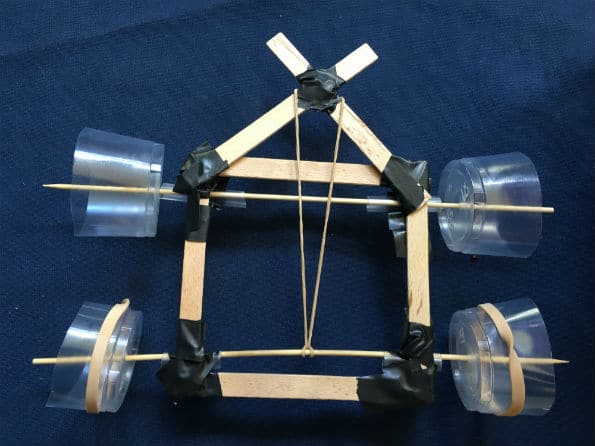
You will need
- Six ice-cream sticks (paddle pop sticks)
- Three thin rubber bands
- Two wooden kebab sticks
- Two plastic drinking straws
- Four plastic cups
- Sticky tape (we used black insulation tape so you can see the joins more clearly)
- Scissors
- A sharp knife or metal screw (adult use only)
Method
-
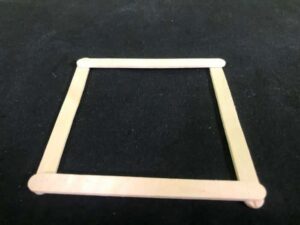
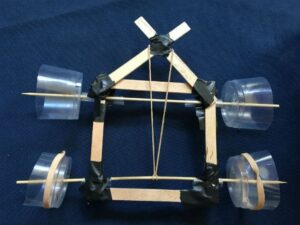
Create a simple square using your wooden ice-cream sticks, making sure that you overlap the corners for strength. Secure strongly with sticky tape.
-
“Attached straw near the corner of the wooden stick square.”
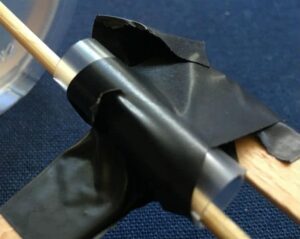
On each corner, use the tape to place a small piece of straw. The kebab stick should be able to pass through the star without being caught by the sticky tape.
-
“Wooden square with straws and kebab sticks in place… see how the rubber band is able to attach easily?”
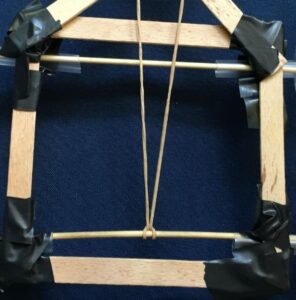
Using scissors, cut your straw into four small pieces and secure these near the corners of the square you created. Make sure that there is at least 20 mm of distance from the end of the square edges so that your axle can have its rubber band fitted more easily. Thread the two kebab sticks through the straws as shown below.
-
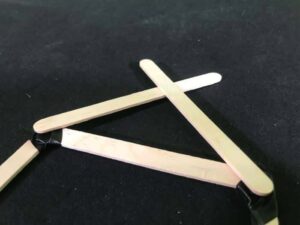
Use the remaining two wooden sticks and one side of the ice-cream stick square, to create a triangular shaped front end for your rubber band racer. Make sure that the two wooden sticks form that a small ‘cross’ at the front of your racer. Make sure that you can hook your rubber band over the front easily. As before, you should overlap the wooden sticks and secure strongly with sticky tape.
-
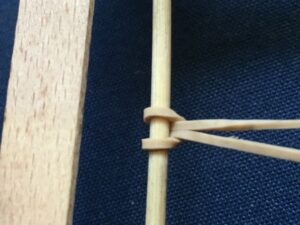
“Rubber band attachment to the rear kebab stick axle.”
Attach your rubber band to the back axle by wrapping the rubber band over the kebab stick. Now feed the rubber band through the loop created. Avoid using large rubber bands – they bend the kebab stick axle and do not grip the axle very well.
-
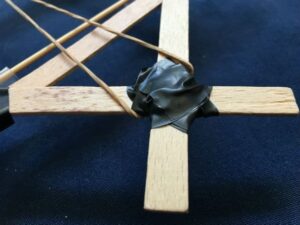
“Rubber band attachment on the front of rubber band racer.”
Gently pull the rubber band forwards and over the cross, you created on the front of your rubber band racer.
-
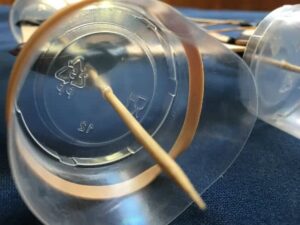
“A Kebab stick through the base of a plastic cup on the rear axle.”
Get an adult to create a small hole in the centre of each of the four plastic cups so that the kebab stick can only just pass through the base of each cup, make the hole fit tightly around the kebab sticks. Use the scissors to cut down each cup so that they look like four small wheels. Attach the cup bases as shown below and add rubber bands around the outside to give the rear wheels some extra grip.
-
“Completed rubber band racer, ready for action!”
You’re done! You should be able to carefully pull back the rubber band racer and then let it go. And watch it move forwards!
-
Get the Unit of Work on Forces here!
- Push, pull
- Friction & spin!
From inertia to centripetal force, this unit covers many concepts about Newton’s Laws!
Includes cross-curricular teaching ideas, student quizzes, a sample marking rubric, scope & sequences & more
-
School science visits since 2004!
– Curriculum-linked & award-winning incursions.
– Over 40 primary & high school programs to choose from.
– Designed by experienced educators.
– Over 2 million students reached.
– Face to face incursions & online programs available.
– Early learning centre visits too!

-

The science behind it
Why Does This Happen
The Physics of the Rubber Band Racer
This science experiment applies multiple ideas in classical physics, all in one fun little STEM challenge!
Firstly, by pulling back the rubber band racer you stretch the rubber band, thereby storing energy. This is specifically known as elastic potential energy. The further you stretch the band, the more energy is stored within the material’s tension.
When you let the rubber band racer go, the stored potential energy is released and converted into kinetic energy (the energy of motion). This energy is transferred to the rear axle, which is a perfect application of the first law of thermodynamics—also known as the Law of Conservation of Energy. This law states that energy cannot be created or destroyed in an isolated system; it can only be transformed from one form to another.
As the rear axle spins, the rear wheels grip the floor and push backwards, which then sends the rubber band racer forwards! This is a classic way of demonstrating Newton’s 3rd Law of Motion, which states that for every action there is an equal and opposite reaction. The wheels push the floor back, and the floor pushes the car forward!
Road safety application
You need friction to move forwards just as much as you need friction to stop. Tyres provide the essential grip on the ground that you need to control your vehicle and make it stop in time, just as much as they transfer force backwards to send your vehicle forwards.
Regularly check your tyre treads to ensure there is enough depth to disperse water. This allows your tyres to maintain direct contact and friction with the road in wet conditions, preventing the vehicle from sliding or losing control.
Variables to try
-
Surface Friction
Try different floor surfaces. Is carpet better than tiles, or does the extra friction of the carpet slow the car down too much? -
Potential Energy
How far will the car travel if you pull it backwards set distances? Measure the results to see if the relationship between pull-distance and travel-distance is linear. -
Elasticity
Does a different size or thickness of rubber band make the racer go further or faster? -
Mechanical Design
Can you create a different wooden stick arrangement to add a second rubber band to the racer? Does this double the power, and how does that affect the final distance achieved?

Teacher's note
Curriculums change, and so does the way you implement them in your classroom. Please use your own experience and knowledge of your students to use these resources to best effect for student learning.
Still want the curriculum links?
Here are the suggested links:
Australian Curriculum (ACARA) Science:
NSW Science syllabuses:
Victorian Curriculum Science:
Want this experiment — and many more — running in your classroom?
Have us visit your school — every student gets three hands-on experiments in 60–90 minutes with a qualified presenter.








