
Make Ice Stalagmites
Create supercooled water that makes instant ice stalagmites! Easy to create and amazing to see. Part of >150 free science experiments. Find out more…
Adult supervision for setup
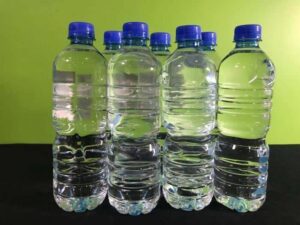
You will need
- Four bottles of very pure water, distilled water is best
- One bowl
- A freezer
- Lots of patience – this can be a difficult experiment to reproduce!
Method
-
Take the labels off the bottles of water.
Place the bottles in a freezer and leave undisturbed for at least 30 minutes. Check on the bottles regularly!
As soon as it looks like a bottle is forming ice crystals, gently remove them from the freezer
-
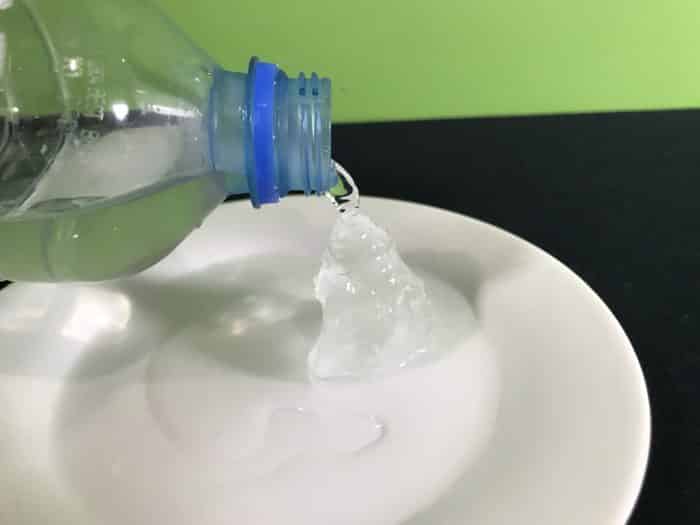
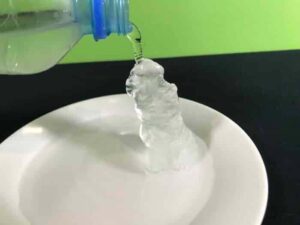
Try carefully pouring the supercooled water into the bowl over an ice cube… you’ll form an ice stalagmite!
Other things to try
- Shake one of the bottles and watch the ice crystals form instantly!
- Try stirring one of the bottles with a straw, or perhaps adding a piece of ice or dirt to the solution.
-
School science visits since 2004!
– Curriculum-linked & award-winning incursions.
– Over 40 primary & high school programs to choose from.
– Designed by experienced educators.
– Over 2 million students reached.
– Face to face incursions & online programs available.
– Early learning centre visits too!
-
Get the Unit of Work on States of Matter here!
- What are the different states of matter?
- How does heat affect the size of materials?
- How does liquid nitrogen affect materials and much more!
Includes cross-curricular teaching ideas, student quizzes, a sample marking rubric, scope & sequences & more
-

The science behind it
Why Does This Happen
The Science of Ice Stalagmites & Supercooling
Normally, pure water freezes at 0°C. However, for ice crystals to actually start growing, they need a “starting point” known as a nucleation site. These sites are usually microscopic scratches on a container, tiny specks of dust, or even dissolved minerals like calcium. Without these “bumps” to latch onto, water molecules can’t easily organise themselves into a solid lattice.
If you use very pure water in a smooth, clean container and cool it down slowly and undisturbed, you can achieve a state called supercooling. This is where the water remains a liquid even though its temperature is well below zero! Supercooled water is incredibly unstable; the moment you introduce a “seed crystal” or even a tiny air bubble, the molecules find the structure they need and the water freezes almost instantly.
It is important to note that supercooling is different from freezing point depression. Freezing point depression happens when you dissolve a substance like salt in water, which physically lowers the temperature at which freezing is possible. In supercooling, the water wants to freeze at 0°C, it just doesn’t have the right “platform” to begin the process.
Variables to test
Find out more on variables here.
-
Solute Interference
Try salty versus freshwater. Does the salt make it harder to achieve supercooling, or does it just lower the overall freezing point so much that your freezer can’t reach it? -
Thermal Shock
What happens if you rapidly heat up the supercooled water in the bottle? Does the sudden change in kinetic energy trigger a phase change, or does it simply move the water further away from its freezing point? -
Agitation & Vibration
Does flicking the bottle or tapping it on the table provide enough mechanical energy to act as a nucleation trigger? -
Container Texture
Compare a brand-new, smooth plastic bottle to a scratched or recycled one. Do the physical imperfections on the surface of the plastic prevent the water from supercooling?
When you pour your supercooled water onto ice to make stalagmites, you are watching latent heat of fusion in action as the water releases energy to become a solid. Keep your movements gentle to ensure the water doesn’t freeze inside the bottle first!

Teacher's note
Curriculums change, and so does the way you implement them in your classroom. Please use your own experience and knowledge of your students to use these resources to best effect for student learning.
Still want the curriculum links?
Here are the suggested links:
Australian Curriculum (ACARA) Science:
NSW Science syllabuses:
Victorian Curriculum Science:
Want this experiment — and many more — running in your classroom?
Have us visit your school — every student gets three hands-on experiments in 60–90 minutes with a qualified presenter.








