
Piaget’s pendulum
Do you know what a piaget's pendulum is? With simple materials you will be able to create this experiment and know what and how it works.
Adult supervision for setup

You will need
- 50cm of string
- Something to act as a mass (e.g., metal nuts, dough, or mass carriers)
- A stick to wind the string around (a retort stand or any steady rod)
- A ruler
- A stopwatch
- A stack of books (to act as a consistent measure of height)
- Optional: A sensitive scale for measuring mass
Method
-
Weight the metal nuts or whatever you’re using for mass in your experiment. If you can’t measure the weight of these at least make sure that you can show a significant difference in the amount of material you use for each time you repeat the experiment.
Make sure that the stick is secured to a fixed point and that you have another person ready with the stop watch.

-
Tie the string to the stick so that it can swing freely below the stick. Tie the metal nuts or whatever you’re using for a mass to the end of the string. Stack some books next to your pendulum – these will act as a constant measurement of height that you will use to release the pendulum from.

-
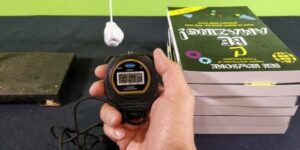
Pull back the mass in the same fashion that you’d pull back a chair swing to the height of the stacked books. Release the mass and record how long it takes for the pendulum to swing 5 times (also known as the period).
-
Repeat the experiment three times so that you can get results for the following combinations:
– short string/light mass
– short string/heavy mass
– long string/light mass
– long string/heavy massIdeally you should repeat each combination several times and calculate an average time of swing for each combination.
Is there a difference between the four combinations above? Which variable affects the period of a pendulum?

-
Get the Unit of Work on Forces here!
- Push, pull
- Friction & spin!
From inertia to centripetal force, this unit covers many concepts about Newton’s Laws!
Includes cross-curricular teaching ideas, student quizzes, a sample marking rubric, scope & sequences & more

-
School science visits since 2004!
– Curriculum-linked & award-winning incursions.
– Over 40 primary & high school programs to choose from.
– Designed by experienced educators.
– Over 2 million students reached.
– Face to face incursions & online programs available.
– Early learning centre visits too!

-

The science behind it
Why does this work?
The Science of Piaget’s Pendulum
You have just repeated a classic experiment first discussed by Galileo Galilei in the late 16th century! Legend has it that while watching a bronze chandelier swing in a cathedral, Galileo used his own pulse to time the oscillations. He discovered that the time it takes for one full swing—the period—remains constant regardless of the width of the arc.
The Physics of the Swing
In a simple pendulum, the only variable that significantly changes the period is the length of the string. A longer string creates a longer period. Surprisingly, the mass at the end (the bob) has no effect. This is because all objects accelerate toward Earth at the same rate due to gravity, regardless of their weight!
For those who want to calculate the exact motion, the formula is:
T = 2π × √(l / g)
- T = time period for one oscillation (s)
- l = length of pendulum (m)
- g = acceleration due to gravity (9.8 m/s²)
Psychology and Variable Testing
In 1958, the psychologist Jean Piaget used this experiment to study how children think. He found that younger children often struggle to isolate variables, changing both the weight and the string length at the same time.
This led them to the incorrect conclusion that mass matters. Developing the ability to change only one variable at a time while keeping others constant is a hallmark of “formal operational thinking”—the foundation of the scientific method.
Real-World Applications
- Foucault’s Pendulum: A massive pendulum used to prove that the Earth is rotating.
- Grandfather Clocks: Using the constant period of a pendulum to keep accurate time.
- Tuned Mass Dampers: Huge pendulums inside skyscrapers that swing to counteract the swaying caused by earthquakes or high winds.
- Metronomes: Helping musicians keep a steady beat.
Sources of Error
Ensure your experiment is valid by checking for these:
- Release Method: Was the bob dropped cleanly, or was it accidentally “pushed,” adding extra energy?
- Starting Height: Was the drop angle identical for every test?
- Measurement Timing: Did you start and stop the stopwatch at the exact same point in the arc?

Teacher's note
Curriculums change, and so does the way you implement them in your classroom. Please use your own experience and knowledge of your students to use these resources to best effect for student learning.
Still want the curriculum links?
Here are the suggested links:
Australian Curriculum (ACARA) Science:
NSW Science syllabuses:
Victorian Curriculum Science:
Want this experiment — and many more — running in your classroom?
Have us visit your school — every student gets three hands-on experiments in 60–90 minutes with a qualified presenter.








