
Lovely light beam experiment
Ever heard of a lovely light beam? Well that's exactly what this experiment is! Pour light out of a bottle and learn how optic fibre works in a fun time!
Adult supervision for setup
You will need
- A clear plastic bottle
- Water
- A flashlight (a laser works better, but be careful of specular reflections!)
- Aluminium foil
- A dark room
Method
-
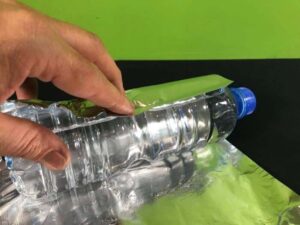
Wrap the sides of the bottle in aluminium foil.
-
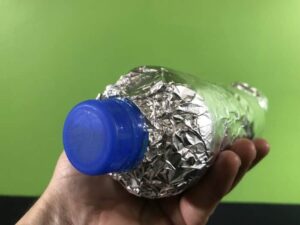
Fill the bottle with water and turn off the lights.
-
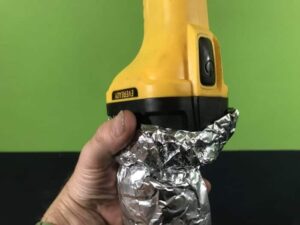
As you turn the bottle upside down, to pour the water out, shine the torch through the base of the bottle.
In this image we’ce used a torch but a laser works much better (be careful of specular reflections)
-
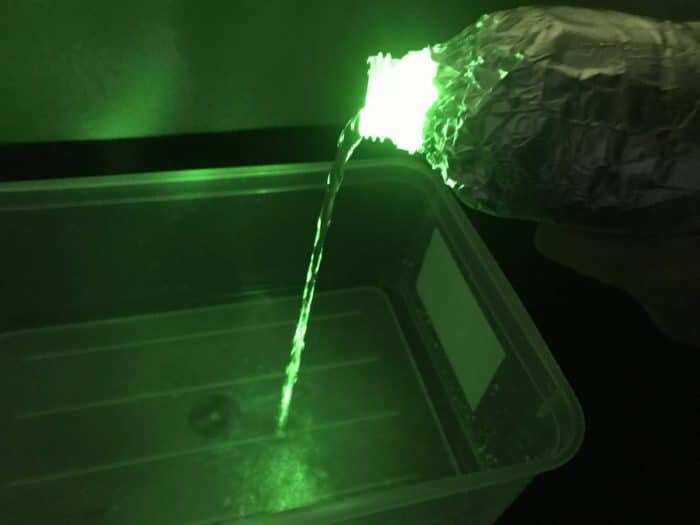
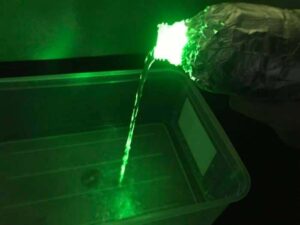
The lights shines through the water and creates a beam of light that pours from the mouth of the bottle. A stream.
This image shows a green laser being used (its shows up better in the photo and in real life too!).
-
School science visits since 2004!
– Curriculum-linked & award-winning incursions.
– Over 40 primary & high school programs to choose from.
– Designed by experienced educators.
– Over 2 million students reached.
– Face to face incursions & online programs available.
– Early learning centre visits too!
-

-
Get the Unit of Work on Light & Colour here!
- What is colour addition vs subtraction?
- What is opacity, translucence & transparency?
- What is the difference between refraction & reflection?
- Explore UV light, lenses, thermochromism and more!
Includes cross-curricular teaching ideas, student quizzes, a sample marking rubric, scope & sequences & more
The science behind it
Why Does This Happen?
The Science of the Lovely Light Beam
This experiment demonstrates a spectacular optical phenomenon where light appears to “pour” out of a bottle along with a stream of water. Instead of travelling in a straight line, the light follows the curve of the water. This is the foundation of modern high-speed communication!
Total Internal Reflection (TIR)
Usually, when light hits a boundary between water and air, it refracts (bends) and exits into the air. However, if the light hits that boundary at a steep enough angle—called the critical angle—it cannot escape.
- The “Mirror” Effect: At this critical angle, the surface of the water acts like a perfect mirror, reflecting the light back inside the stream. This process is called Total Internal Reflection.
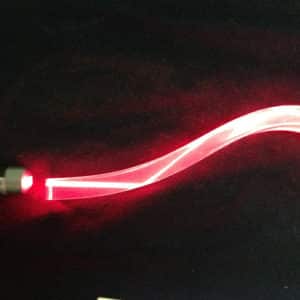
- Fibre Optics: This is exactly how fibre optic cables work! Light pulses (carrying internet data or phone calls) bounce off the inside walls of thin glass or plastic cables, travelling thousands of kilometres with very little loss of signal.
Safety Note: If you choose to use a laser instead of a torch, never look directly into the beam. Be careful of specular reflections—shiny surfaces like the glass bottle or a watch face can reflect the laser into your eyes. Adult supervision is required.
Variables to test
Find out more on variables here.
-
Light Containment
What happens when you remove the aluminium foil from the bottle? Does the ambient light make the “trapped” beam harder to see, or does the foil help focus the light into the hole? -
Source Intensity and Cohesion
Try using a laser pointer versus a torch. Why does the laser work so much better? (Hint: Lasers are collimated, meaning the rays are perfectly parallel, making it easier for all the light to hit the water at the correct angle.) -
Laminar vs. Turbulent Flow
How far can the water fall and still show the effect? As the water stream breaks up into droplets, the smooth “mirrored” surface disappears—does the light scatter when the stream becomes turbulent? -
Wavelength
Try different laser colours (red vs. green). Does the colour of the light change how brightly the stream glows?

Teacher's note
Curriculums change, and so does the way you implement them in your classroom. Please use your own experience and knowledge of your students to use these resources to best effect for student learning.
Still want the curriculum links?
Here are the suggested links:
Australian Curriculum (ACARA) Science:
NSW Science syllabuses:
Victorian Curriculum Science:
Want this experiment — and many more — running in your classroom?
Have us visit your school — every student gets three hands-on experiments in 60–90 minutes with a qualified presenter.








