
Make honeycomb
Learn about chemical reactions in a fun, safe and delicious way when you make honeycomb with resources that can be bought from any supermarket.
Adult supervision for setup
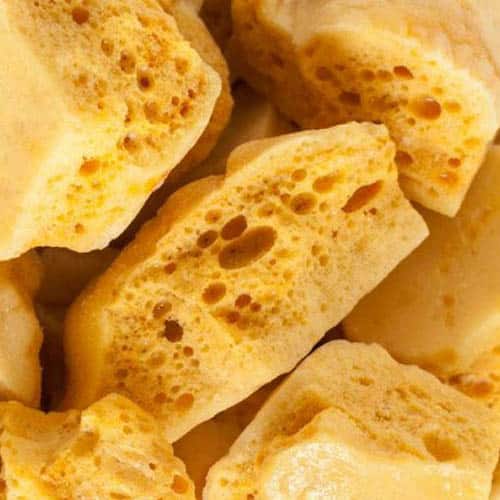
You will need
- Honey
- Water
- Sugar
- Baking soda
- Butter or oil
- Baking tray
- Saucepan
- Whisk
- Spoons
- Cup
- Stove and oven
- Adult help
Method
-
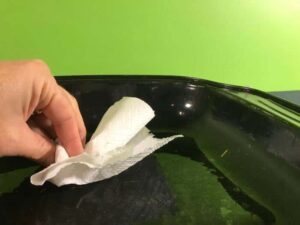
Grease a baking tray with the butter or oil.
-
“Bubbling sugar syrup”
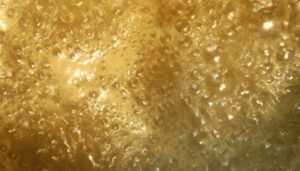
Add 2 tablespoons of honey, 2 tablespoons of water and 3/4 cup of sugar to a saucepan. Cook the ingredients over a high heat without stirring to about 150°C. The sugar should melt, bubbles should form and the sugar should caramelize into a light brown or amber colour.
-
Remove the pan from heat and whisk 1.5 teaspoons of baking soda into the hot syrup. This will cause the mixture to foam up.
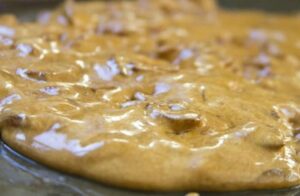
Stir just enough to mix the ingredients and then pour the mixture into the baking tray. Don’t spread the mixture as it will pop the formed bubbles.
-
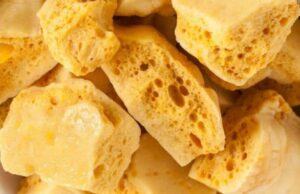
“Honeycomb ready to eat!”
Allow the mixture to cool. Break the honeycomb up and eat or store!
-
School science visits since 2004!
– Curriculum-linked & award-winning incursions.
– Over 40 primary & high school programs to choose from.
– Designed by experienced educators.
– Over 2 million students reached.
– Face to face incursions & online programs available.
– Early learning centre visits too!

-

-
Get the Unit of Work on Heat Energy here!
- What actually is heat?
- How does heat move through different materials?
- How does heat change the properties of materials and more!
Includes cross-curricular teaching ideas, student quizzes, a sample marking rubric, scope & sequences & more

The science behind it
Why Does This Happen?
The Science of Making Honeycomb
Making honeycomb is a delicious way to observe a thermal decomposition reaction. When you add sodium bicarbonate (bicarbonate soda) to the hot sugar syrup, the high temperature of the liquid provides enough thermal energy to break the chemical bonds within the bicarbonate molecules.
As the powder breaks down, it transforms into sodium carbonate, water vapour, and carbon dioxide gas (CO2). The chemical equation for this reaction is:
2NaHCO3 → Na2CO3 + CO2 + H2O
Because the sugar syrup is very thick and viscous, it traps the CO2 gas as it is released. This causes the mixture to expand and rise rapidly, creating thousands of tiny bubbles. Once the syrup cools and hardens, those bubbles remain trapped as empty pockets, giving the honeycomb its signature light, crunchy, and “holy” texture!
Variables to test
Find out more on variables here.
-
Reactant Concentration
Change the amount of sodium bicarbonate. Does adding more powder create a larger volume of carbon dioxide, or does it make the honeycomb taste bitter due to excess sodium carbonate? -
Thermal Energy Levels
Change the temperature of the sugar syrup before adding the bicarb. Does a higher temperature make the reaction happen faster, and does that affect the size of the bubbles? -
Agitation Rate
Does stirring the mixture quickly versus slowly change the gas distribution? Does fast stirring pop the bubbles before they can set? -
Syrup Viscosity
Try changing the ratio of sugar to water or golden syrup. How does the thickness of the liquid affect its ability to trap the gas?
Be very careful when handling the hot syrup, as it can cause serious burns. Always have an adult help you with the stove! To keep your experiment valid, try to change only one of these variables at a time.

Teacher's note
Curriculums change, and so does the way you implement them in your classroom. Please use your own experience and knowledge of your students to use these resources to best effect for student learning.
Still want the curriculum links?
Here are the suggested links:
Australian Curriculum (ACARA) Science:
NSW Science syllabuses:
Victorian Curriculum Science:
Want this experiment — and many more — running in your classroom?
Have us visit your school — every student gets three hands-on experiments in 60–90 minutes with a qualified presenter.








