
Endothermic reaction
An easy science experiment to do to demonstrate endothermic reaction or change in enthalpy by using vinegar, bicarbonate soda, and a thermometer
Adult supervision for setup
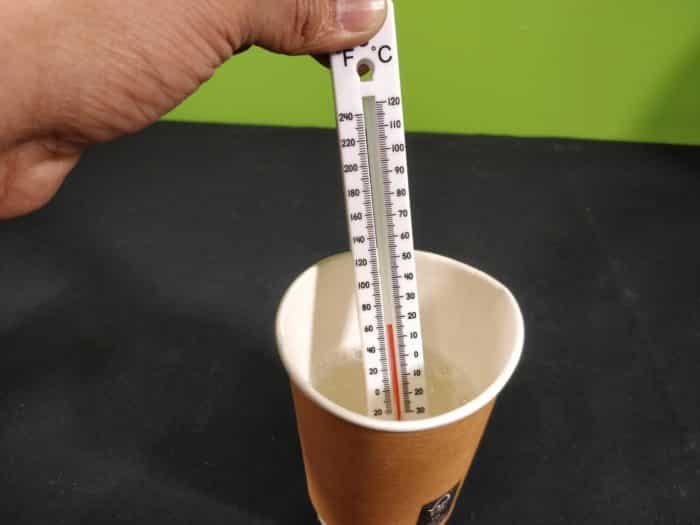
You will need
- Foam cup
- Thermometer
- A quarter cup of vinegar
- 1 tablespoon of bicarbonate soda
Method
-
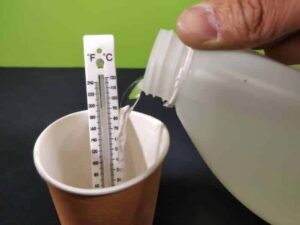
Pour vinegar into the foam cup and measure its temperature with the thermometer and record this.
-
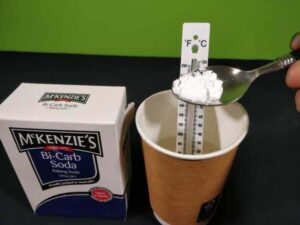
Add the bicarbonate soda gradually to avoid overflowing foam and stirring with the thermometer.
-
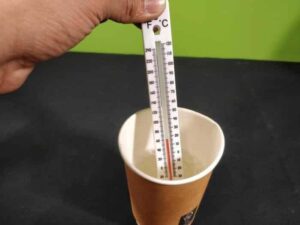
Record your observations of the temperature changes over time. Does the liquid get hotter or colder?
-
Get the Unit of Work on Heat Energy here!
- What actually is heat?
- How does heat move through different materials?
- How does heat change the properties of materials and more!
Includes cross-curricular teaching ideas, student quizzes, a sample marking rubric, scope & sequences & more

-
School science visits since 2004!
– Curriculum-linked & award-winning incursions.
– Over 40 primary & high school programs to choose from.
– Designed by experienced educators.
– Over 2 million students reached.
– Face to face incursions & online programs available.
– Early learning centre visits too!

-

The science behind it
Why Does This Happen:
The Science of Endothermic Reactions
When you mix bicarbonate soda and vinegar, you aren’t just making bubbles—you’re manipulating energy! You should have noticed a decrease in temperature during the reaction. This is because the process is endothermic.
In an endothermic reaction, the chemical bonds in the products (Carbon Dioxide, Water, and Sodium Acetate) have more stored energy than the bonds in the original reactants. To bridge that gap, the reaction must “steal” thermal energy from the surrounding environment. This is why the cup feels cold to the touch!
Vinegar + Bicarbonate Soda → Carbon Dioxide + Water + Sodium Acetate
Looking for more ways to use this reaction? Check out this list of vinegar and bicarb experiments in our blog!
High School Extension: Calculating Enthalpy
In senior chemistry, we can measure exactly how much energy was absorbed by calculating the change in enthalpy (ΔH). By measuring the mass of your solution and the temperature drop, you can use the specific heat capacity formula:
ΔH = m × c × ΔT
- ΔH = change in enthalpy (kJ)
- m = mass of solution (kg)
- c = specific heat capacity of water (4.18 kJ kg-1 °C-1)
- ΔT = change in temperature of the solution (°C)
Variables to test
Find out more on variables here.
-
Reactant Ratios
Does it matter how much vinegar or bicarbonate you add? Is there a limiting reagent where adding more of one ingredient no longer causes the temperature to drop further? -
Initial Thermal Energy
If you change the starting temperature of the vinegar, does this affect the total change in temperature (ΔT)? Does the reaction happen faster in warm vinegar? -
Insulation
If you perform the experiment in a polystyrene foam cup versus a glass beaker, does the rate of heat transfer from the room change your results?
Remember, for a “fair test,” ensure you only change one variable at a time while keeping the others identical. This is how you ensure your experiment is valid!

Teacher's note
Curriculums change, and so does the way you implement them in your classroom. Please use your own experience and knowledge of your students to use these resources to best effect for student learning.
Still want the curriculum links?
Here are the suggested links:
Australian Curriculum (ACARA) Science:
NSW Science syllabuses:
Victorian Curriculum Science:
Want this experiment — and many more — running in your classroom?
Have us visit your school — every student gets three hands-on experiments in 60–90 minutes with a qualified presenter.








