
Celery transpiration
Celery transpiration is a really cool and interesting experiment that show how plants transport water using their leaves and vascular bundles.
Adult supervision for setup
You will need
- One bunch of Celery
- One cup of Water (roughly 400mL)
- Food Colouring
- One sharp Knife and chopping board (adult help please!)
- Somewhere to leave the experiment undisturbed
Method
-
Use adult help when cutting the celery
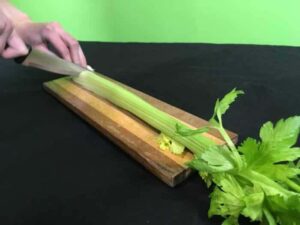
Take one stick of celery off the bunch and cut the bottom 2 cm off of the stick. Careful; choose a length of celery that won’t tip over your cup of water when it’s placed in the cup.
-
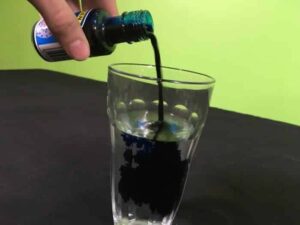
Add some food colouring to the cup of water (make the colour quite dark).
-
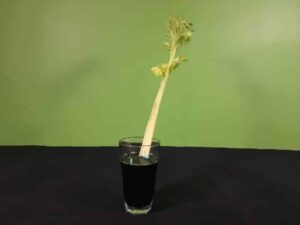
The celery should be able to lean against the cup without tipping it over.
Put the cut end of the stick of celery into the cup of darkly coloured water.
-
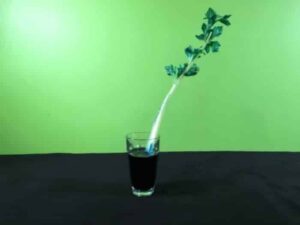
Leave the cup and celery for at least half an hour. Check on the leaves regularly to see if there is any discolouration at the ends of the leaves.
-
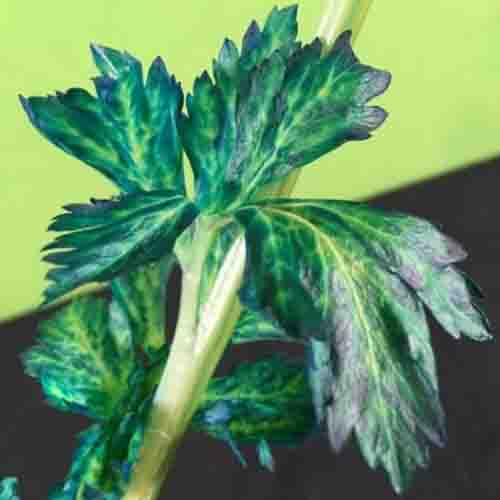
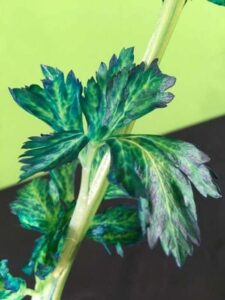
The celery changes to a shade of blue…
Observe the differences in the celery.
How did this happen? Did the food colouring cause this?
-
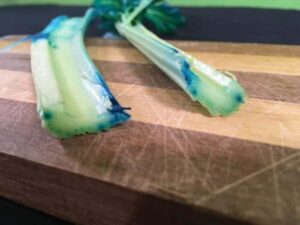
Look near the outside of the cut celery stem…
Cut the celery stick around halfway up, and have a look at the inside of the stem.
Can you see where the food colouring went?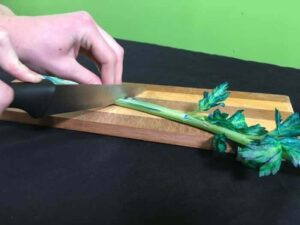
-
Try testing different variables (different colours, different plant types, sugar or salt in the water etc).
-
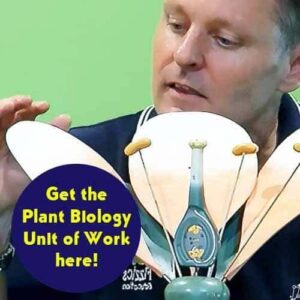
Get the Unit of Work on Plant Biology here!
- Learn about the parts of a flower
- Discover how vascular tissue transports water & sugars around the plant
- Learn about plant pigments and adaptations to the environment
- From photosynthesis to transpiration & more, there’s a heap covered!
Includes cross-curricular teaching ideas, student quizzes, a sample marking rubric, scope & sequences & more
-
School science visits since 2004!
– Curriculum-linked & award-winning incursions.
– Over 40 primary & high school programs to choose from.
– Designed by experienced educators.
– Over 2 million students reached.
– Face to face incursions & online programs available.
– Early learning centre visits too!

-

The science behind it
Why Does This Happen?
You should have seen that the food coloured water travelled up the stem of the celery and into the leaves.
How does food colour get up there? Gravity should be holding the water down, right?
Water is found all the way through the celery: in the stems, the leaves and the roots. The water in the leaves of the celery evaporates through the surface of the leaves, and this leaves space inside the leaves where the water was. This process is called transpiration. That new empty space inside the leaves creates a low pressure, and like a drinking straw, this low pressure allows water below the leaf to travel up the stem. You’ll see the little tubes the water travels up when you cut the celery stem, and you can see the colour up in the leaves. These tubes are called Xylem and are part of the plant’s vascular system. This how plants transport the water and nutrients from the soil up to the very highest leaves. By the way, the tubes that transport sugars from the leaves downwards are called phloem).
Variables to test
- Does warm vs cold food colouring influence the speed of the experiment?
- Try flowers in food colouring
- Run this experiment on a hot vs a cold day
- Does cutting off the leaves at the top of the celery make a difference?

Teacher's note
Curriculums change, and so does the way you implement them in your classroom. Please use your own experience and knowledge of your students to use these resources to best effect for student learning.
Still want the curriculum links?
Here are the suggested links:
Australian Curriculum (ACARA) Science:
NSW Science syllabuses:
Victorian Curriculum Science:
Want this experiment — and many more — running in your classroom?
Have us visit your school — every student gets three hands-on experiments in 60–90 minutes with a qualified presenter.








