
Making Layered Liquids
A layered liquids sciece activity you can do at home! Create a colourful creation using household materials of different densities. Kids love this one 🙂
Adult supervision for setup
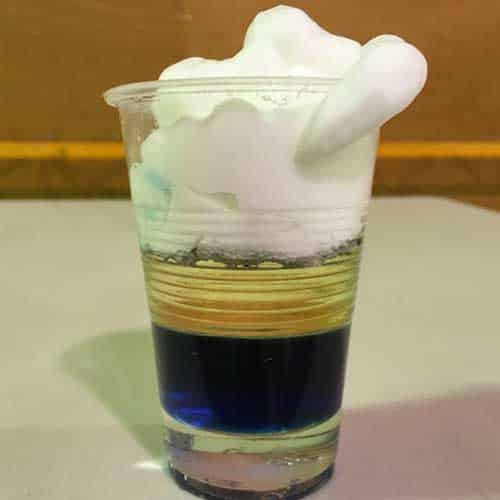
You will need
- 50mL Vegetable oil
- 50mL Glycerol or Glucose syrup
- 50mL Water, coloured with food colouring
- Shaving cream
- Clear Plastic container
- Beads, marbles and foam
Method
-
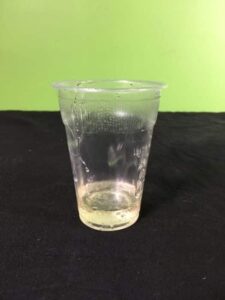
Pour the glycerol (or corn syrup) into the bottom of the plastic container. Try not to touch the sides.
-
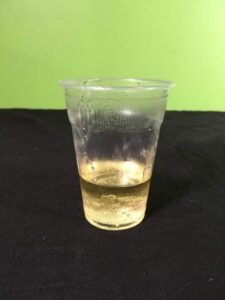
Carefully pour the oil down the side of the container. There should be two distinct layers.
-
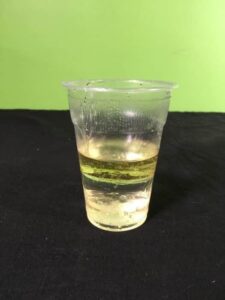
Now carefully pour the water down the side of the container. Where did this layer end up floating?
-
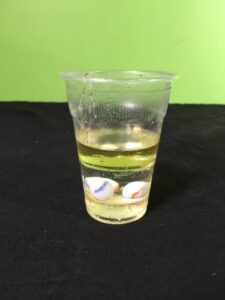
Carefully place the beads (etc.) onto the surface of your layered liquid. Where do they float? Why?
-
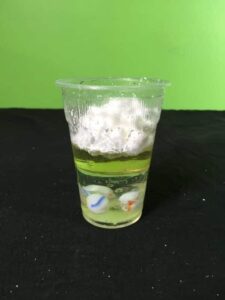
Add some shaving cream on the top!
-
Get the Unit of Work on Mixtures here!
- How can we separate mixtures?
- What are the different techniques?
- From chromatography to magnetism, join us to explore the variety of ways we can separate mixtures!
Includes cross-curricular teaching ideas, student quizzes, a sample marking rubric, scope & sequences & more
-
School science visits since 2004!
– Curriculum-linked & award-winning incursions.
– Over 40 primary & high school programs to choose from.
– Designed by experienced educators.
– Over 2 million students reached.
– Face to face incursions & online programs available.
– Early learning centre visits too!
-

The science behind it
Why Does This Happen:
The Science of Making Layered Liquids
This experiment is a brilliant visual demonstration of density. Even though you might pour the same volume (amount) of each liquid into your container, they don’t have the same mass. Density is a measure of how much “stuff” or mass is packed into a specific space.
Density = Mass ÷ Volume
The rule of thumb for density columns is simple: the most dense materials sink to the bottom, while the least dense materials float to the top.
- Corn Syrup (1.37g/ml): This is the densest liquid in our list. Its molecules are packed very tightly together, so it sits firmly at the bottom.
- Water (1.00g/ml): Water is less dense than the syrup but denser than the oil, so it floats right in the middle.
- Vegetable Oil (0.91g/ml): Oil is hydrophobic and less dense than water, allowing it to sit on top of the water layer.
- Shaving Cream (~0.80g/ml): Because shaving cream is a foam (mostly air trapped in soap), it has a very low density and sits at the very top of the stack.
Fascinating Density Facts
- Floating Planets: The planet Saturn is actually less dense than water. If you could find an ocean big enough to hold it, Saturn would float!
- The Ice Anomaly: Most substances become denser when they turn from a liquid to a solid. Water is a rare exception! When water freezes, its molecules form a lattice that actually takes up more space, making ice less dense than liquid water. This is why icebergs and ice cubes float.
Variables to test
Find out more on variables here.
-
Solute Addition
What happens if you dissolve sugar or salt into the water layer? Adding a solute increases the mass of the liquid without changing the volume much—how does this affect its position in the column? -
Thermal Expansion
Try using hot liquids versus cold liquids. Heat increases the kinetic energy of molecules, causing them to spread out. Does warm water float on top of room-temperature water? -
New Materials
Try adding honey, milk, or dish soap. Based on how they layer, can you estimate their approximate density compared to water? -
Optical Properties
Shine a spotlight through the side of your density column. Different liquids have different refractive indices, meaning they bend light at different angles!
To keep your experiment valid, try to pour each layer slowly over the back of a spoon to prevent the liquids from mixing too much as you build your tower.

Teacher's note
Curriculums change, and so does the way you implement them in your classroom. Please use your own experience and knowledge of your students to use these resources to best effect for student learning.
Still want the curriculum links?
Here are the suggested links:
Australian Curriculum (ACARA) Science:
NSW Science syllabuses:
Victorian Curriculum Science:
Want this experiment — and many more — running in your classroom?
Have us visit your school — every student gets three hands-on experiments in 60–90 minutes with a qualified presenter.








