
How to Make Sherbet
Find out how to make Sherbet with easy to find materials. Part of > 150 free science experiments. Easy to do and cheap to make.
Adult supervision for setup

You will need
- Icing Sugar
- Citric acid (found in the 'herbs and spices' aisle)
- Bicarbonate Soda (baking soda)
- A cup per person
- A spoon per person
Method
-
Add twenty parts icing sugar to one part citric acid and one part bicarbonate soda.
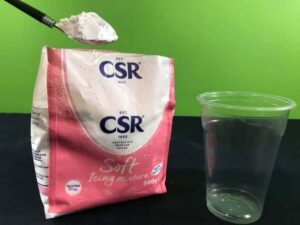
-
Mix it together.
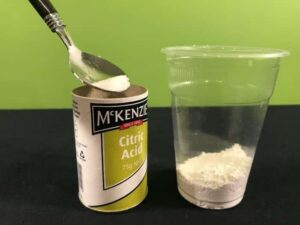
-
And eat… it is that simple!

-
Get the Unit of Work on Mixtures here!
- How can we separate mixtures?
- What are the different techniques?
- From chromatography to magnetism, join us to explore the variety of ways we can separate mixtures!
Includes cross-curricular teaching ideas, student quizzes, a sample marking rubric, scope & sequences & more
-
School science visits since 2004!
– Curriculum-linked & award-winning incursions.
– Over 40 primary & high school programs to choose from.
– Designed by experienced educators.
– Over 2 million students reached.
– Face to face incursions & online programs available.
– Early learning centre visits too!

-

-
Want to dive into acid-base chemistry?
Get the 30-minute video + PDF + curriculum links for your class here!
The science behind it
Why Does This Happen:
The Science of How to Make Sherbet
The tingling, fizzing sensation you feel when you eat sherbet is actually a chemical reaction happening right on your tongue! Sherbet is primarily made of two key reactive ingredients: citric acid and bicarbonate soda (a base).
When these ingredients are dry in the bowl, they cannot react because their molecules are locked in solid form and can’t move to meet each other. However, once they touch your tongue, the water in your saliva acts as a solvent. This allows the citric acid and bicarbonate soda to go “into solution.” Now that the molecules can swim around and collide, the reaction takes place instantly.
Citric Acid + Bicarbonate Soda → Sodium Citrate + Water + Carbon Dioxide
The “fizz” is caused by the rapid release of carbon dioxide gas (CO2). As these tiny bubbles of gas escape the liquid on your tongue, they create that famous popping sensation. Because this reaction also absorbs a small amount of heat from your mouth, it can actually make your tongue feel slightly cooler!
Variables to test
Find out more on variables here.
-
Acid Concentration
Change the amount of citric acid. Does adding more acid make the sherbet taste more sour, or does it also increase the intensity of the fizz? -
Base Ratio
Change the amount of bicarbonate soda. Is there a “perfect balance” where the acid and base neutralise each other completely, or does too much bicarb leave a soapy aftertaste? -
Solubility and Texture
Change the amount of icing mixture. The sugar doesn’t participate in the fizzing reaction, but it affects the viscosity of the solution on your tongue. How does this change the mouthfeel? -
Flavor Additives
Try adding crushed jelly crystals! Jelly crystals contain gelatin and extra sugar; how do these polymers affect the way the bubbles form and last?
For a truly scientific sherbet, try to measure your ingredients carefully and change only one variable at a time. This ensures your taste-test results are valid!

Teacher's note
Curriculums change, and so does the way you implement them in your classroom. Please use your own experience and knowledge of your students to use these resources to best effect for student learning.
Still want the curriculum links?
Here are the suggested links:
Australian Curriculum (ACARA) Science:
NSW Science syllabuses:
Victorian Curriculum Science:
Want this experiment — and many more — running in your classroom?
Have us visit your school — every student gets three hands-on experiments in 60–90 minutes with a qualified presenter.








