
Mentos & coke experiment
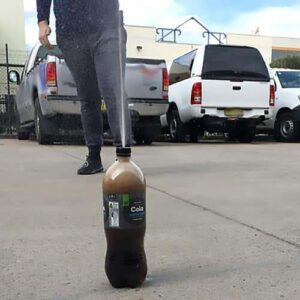
Turn a Mentos and a bottle of Coke into a geyser! Learn the science behind this classic do-at-home experiment and learn how to do it yourself.
Adult supervision for setup
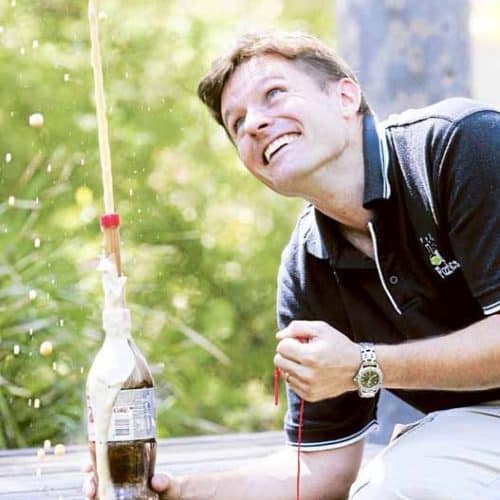
You will need
- A parent’s help
- 1 Bottle of diet coke
- 1 Nail or small hand drill
- String
- Scissors
- Outside space
- Needle
Method
-
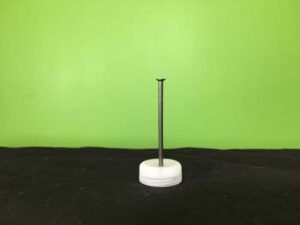
Drill a small hole through the lid of the bottle using a hand drill or a nail. Pour out the first 5cm of Diet Coke for extra working room.
-
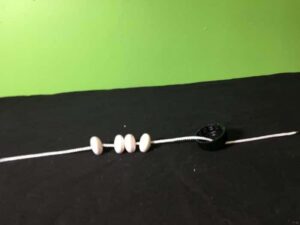
Use the needle to thread the string through four Mentos, leaving a 10cm length of sting trailing off the Mentos Bundle.
Thread the trailing string length through the bottle cap. Tie a knot on the end of the string behind the mentos so they can’t fall of the string.
Pull the string tight, so that the Mentos bundle is up against the lid. Don’t let go of this string yet!
-
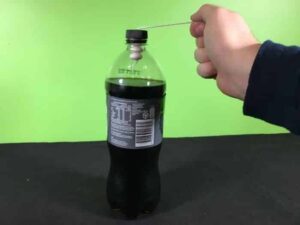
Carefully screw the lid onto the bottle, making sure that the Mentos do not touch the Diet Coke.
-
Find an area that can get wet. When you’re ready, release the string!
-
School science visits since 2004!
– Curriculum-linked & award-winning incursions.
– Over 40 primary & high school programs to choose from.
– Designed by experienced educators.
– Over 2 million students reached.
– Face to face incursions & online programs available.
– Early learning centre visits too!
-

The science behind it
Why Does This Happen:
The Science of the Mentos & Coke Experiment
We are often asked how this experiment works when we visit schools! The famous Mentos and Diet Coke fountain is one of the most exciting displays of rapid gas release in science. While many people assume it is a chemical reaction between acids and bases, research shows that the process is actually a physical reaction called nucleation.
Diet Coke is super-saturated with dissolved carbon dioxide gas (CO2). Inside an unopened bottle, high pressure keeps the gas squeezed into the liquid. When you open the cap, the pressure drops, and the gas begins to escape—but it needs a “starting point” to form a bubble. These starting points are called nucleation sites.
If you look at a Mentos candy under a microscope, you won’t see a smooth surface. Instead, it is covered in thousands of tiny pits and craters. Each one of these microscopic nooks acts as a nucleation site. When the Mentos hits the liquid, thousands of CO2 bubbles form instantly on the surface of the candy. Because the Mentos is heavy and sinks quickly, it triggers bubble formation all the way to the bottom of the bottle.
The result is a massive, sudden increase in volume as the gas expands, forcing the liquid out of the narrow neck of the bottle in a spectacular eruption!
Why Diet Coke?
While any carbonated drink will work, Diet Coke is the favourite for scientists because it contains aspartame and potassium benzoate. these ingredients lower the surface tension of the liquid, making it even easier for bubbles to form rapidly. Plus, it isn’t sticky like regular sugar-filled soda!
Variables to test
Find out more on variables here.
-
Nucleation Site Density
Try different numbers of Mentos. Does doubling the amount of candy double the height of the fountain, or is there a point of diminishing returns? -
Liquid Composition
Try different soda drinks. Which carbonated drink makes the eruption go higher? This tests how different surfactants and sugar levels affect bubble formation. -
Thermal Energy
What happens if you use cold versus room temperature soda? Gases are generally less soluble in warm liquids—does this mean a warm bottle will erupt more violently? -
Surface Texture
Does using different flavours of Mentos (like Fruit vs. Mint) produce a difference? Mint Mentos often have more pits than the smooth glaze on fruit versions, affecting the number of available nucleation points.
To ensure your experiment is a fair test, remember to keep your “launch” method the same every time and only change one variable at a time!

Teacher's note
Curriculums change, and so does the way you implement them in your classroom. Please use your own experience and knowledge of your students to use these resources to best effect for student learning.
Still want the curriculum links?
Here are the suggested links:
Australian Curriculum (ACARA) Science:
NSW Science syllabuses:
Victorian Curriculum Science:
Want this experiment — and many more — running in your classroom?
Have us visit your school — every student gets three hands-on experiments in 60–90 minutes with a qualified presenter.








