
Make food colours swirl
Turn food colouring into swirling, spiralling rainbows! Learn about surface tension through invesitgation. Part of > 150 free science experiments.
Adult supervision for setup
You will need
- One white plate
- One eyedropper, pipette or straw
- Water
- Food colouring
- Rubbing alcohol / Methylated Spirits
- Adult Help
- A well-ventilated room (or run it outside)
Method
-
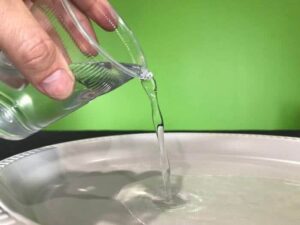
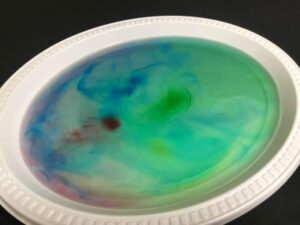
Fill the plate with water.
-
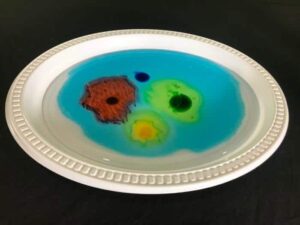
Add several drops of food colouring, evenly spaced near the centre of the plate.
-
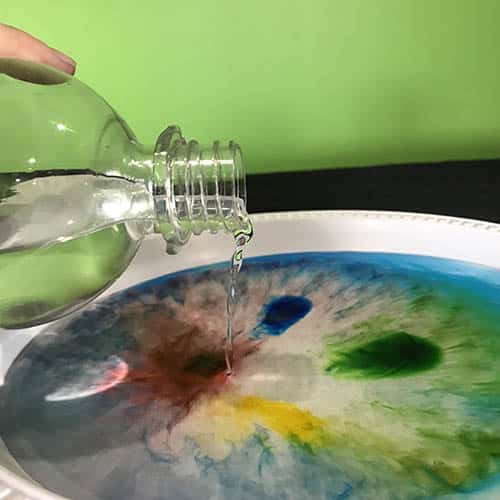
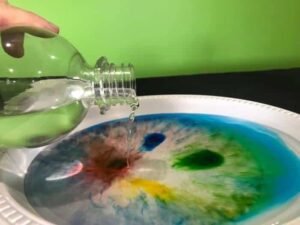
In the middle of your square of colours, pour some of the the methylated spirits, or rubbing alcohol (in a well ventilated space)
-
Watch what happens!
-
Get the Unit of Work on Mixtures here!
- How can we separate mixtures?
- What are the different techniques?
- From chromatography to magnetism, join us to explore the variety of ways we can separate mixtures!
Includes cross-curricular teaching ideas, student quizzes, a sample marking rubric, scope & sequences & more
-
School science visits since 2004!
– Curriculum-linked & award-winning incursions.
– Over 40 primary & high school programs to choose from.
– Designed by experienced educators.
– Over 2 million students reached.
– Face to face incursions & online programs available.
– Early learning centre visits too!

-

The science behind it
Why Does This Happen?
The Science of Swirling Food Colours
This mesmerising experiment is all about a property called surface tension. Surface tension acts like an invisible, elastic “skin” that holds the surface of a liquid together. It is caused by cohesion—the attractive forces between the molecules of the liquid.
Molecules in the middle of a cup of water are pulled in every direction by their neighbours. However, the molecules right at the surface have no water molecules above them, so they are pulled more strongly sideways and downwards into the liquid. This creates a tension that makes the liquid try to occupy the smallest surface area possible, which is why water “beads” into droplets on a smooth surface.
In this experiment, you are seeing a “tug-of-war” between two different liquids. Water has a much higher surface tension than alcohol (methylated spirits). When the alcohol touches the water, it breaks the surface tension in that spot. The stronger surface tension of the surrounding water pulls away from the weaker alcohol, dragging the food colouring along with it and creating the beautiful swirling patterns you see!
Variables to test
Find out more on variables here.
-
Solvent Reversal
What happens if you fill the plate with methylated spirits first and then add the food colours? Does the lack of a strong surface tension gradient stop the swirling effect? -
Surfactant Interference
Try adding a drop of detergent to the water instead of alcohol. Detergent is a surfactant designed to break surface tension. Does it produce a more powerful “explosion” of colour? -
Thermal Energy
Chill the methylated spirits in the freezer first. Does lowering the internal energy of the alcohol molecules change how quickly they spread through the water? -
Liquid Density
Try using milk instead of water. Milk contains fats and proteins that change the viscosity and surface tension of the liquid. Does the colour swirl differently?
Remember, for a “fair test,” ensure you only change one factor at a time. This allows you to be certain that your results are valid and scientifically accurate!

Teacher's note
Curriculums change, and so does the way you implement them in your classroom. Please use your own experience and knowledge of your students to use these resources to best effect for student learning.
Still want the curriculum links?
Here are the suggested links:
Australian Curriculum (ACARA) Science:
NSW Science syllabuses:
Victorian Curriculum Science:
Want this experiment — and many more — running in your classroom?
Have us visit your school — every student gets three hands-on experiments in 60–90 minutes with a qualified presenter.








